Anemone Meaning: What Does “Anemone” Mean?
Quick Answer
Anemone (from Greek anemos, “wind”) means “windflower” — a flower symbolizing love, fragility, and anticipation, born from the myth of Adonis and Aphrodite. Sea anemones (the ocean animals) were named after the flower.
- Literal meaning: “Windflower” (Greek)
- Core symbolism: Love, fragility, anticipation
- Victorian meaning: Forsaken love, expectation
- Myth: Sprang from Adonis’s blood
What Does “Anemone” Mean?
The name comes from Greek anemos (ἄνεμος) — “wind.” The anemone is the “windflower”: legend says the wind blows the blossoms open — and soon blows the petals away. The flower’s brevity is built into its name.
Botanically, Anemone is a genus of flowering plants in the buttercup family (Ranunculaceae) — over 120 species, from the wood anemones of spring forests to the Japanese anemones of autumn gardens. But the meaning of “anemone” lives in myth and symbolism, not taxonomy.
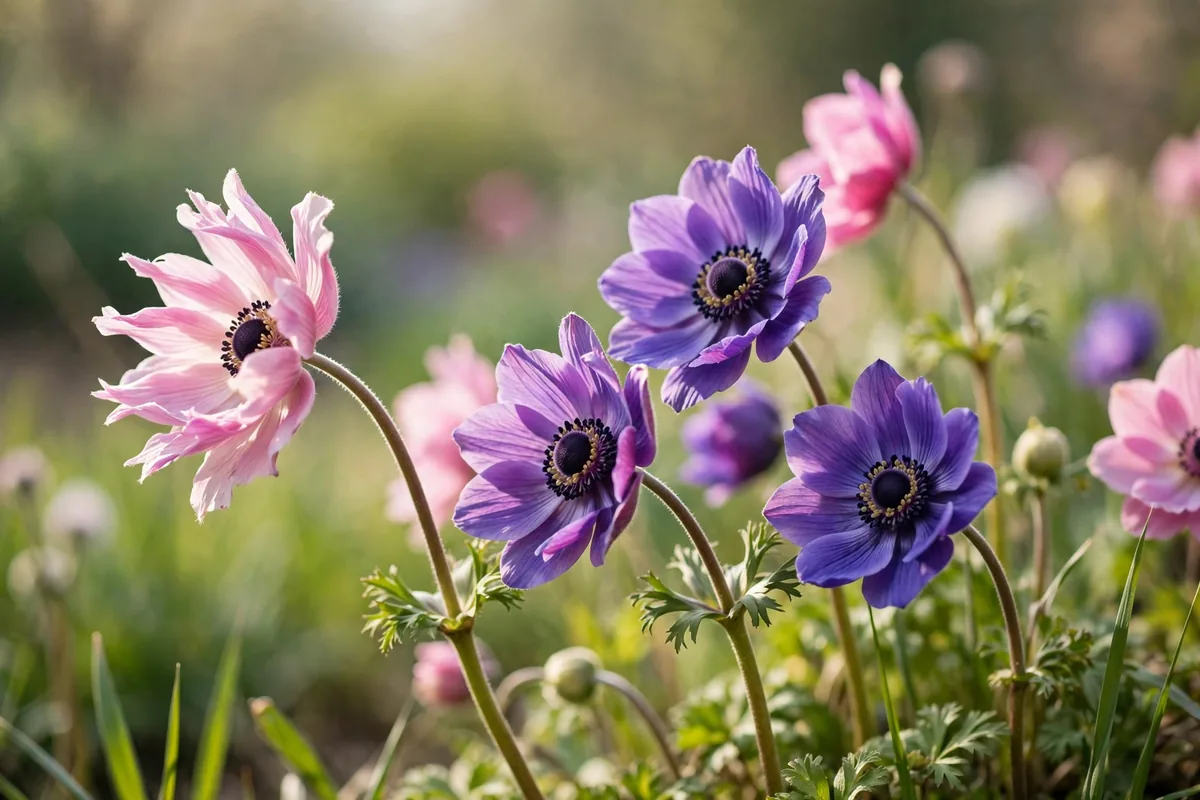
The Greek Myth: Adonis & Aphrodite
The anemone’s origin story is one of mythology’s great tragedies:
- The lovers: Aphrodite (goddess of love) and Adonis (a mortal of extraordinary beauty) — a doomed romance from the start.
- The death: Adonis was gored by a wild boar while hunting — some versions say the boar was Ares (god of war, Aphrodite’s jealous lover) in disguise.
- The flowers: where Adonis’s blood fell, red anemones sprang from the earth — mingled with Aphrodite’s tears. The flower is literally born of love and loss.
- The dual meaning: the anemone thus symbolizes both the arrival of spring (Adonis’s annual return from the underworld) and the death of the beloved — joy and grief in one bloom.
- Ovid’s version: in the Metamorphoses, Ovid describes Venus transforming Adonis’s blood into the anemone — a flower “short-lived” like the youth himself: “brief is the life of the flower.”
This myth is why the anemone’s symbolism is permanently double — love and loss, anticipation and forsaking, held in tension.
Symbolism by Culture & Color
| Culture | Meaning | Context |
|---|---|---|
| Victorian England | Forsaken love, brevity, expectation | Floriography — a farewell flower |
| Ancient Greece | Love and loss (Adonis myth) | Sacred to Aphrodite |
| China | Illness, bad luck | Avoid as gifts |
| Japan | Ill tidings | Funerary associations |
| Egypt | Illness, frailty | Medicinal (and cautionary) |
| European folklore | Protection from evil | Peasants carried them as charms |
By color:
- Red: death, forsaken love — the Adonis blood connection. The most mythologically loaded color.
- White: sincerity, expectation — used in wedding bouquets (hope for the future).
- Purple: protection from evil — the folkloric color.
- Pink: forgotten love — gentler than red’s forsaken love.
- Blue: anticipation, perseverance — rarer, more hopeful.

Anemones in Art & Literature
- Van Gogh: painted anemones in his Paris period — the vivid blooms suited his color experiments.
- Matisse: the Fauvist loved anemones — bold, flat color masses that matched his style.
- Shakespeare: references the Adonis myth in Venus and Adonis — the poem that fixed the flower’s tragic associations in English literature.
- Modern poetry: anemones appear as fragility symbols — the flower that blooms beautifully and briefly.
- Birth flower: the anemone is associated with April (spring’s fragility) — and specifically April 2nd in some traditions.
Sea Anemones: The Animals
Sea anemones — the ocean animals — were named after the flower:
- The resemblance: their tentacle crowns look like flower petals — early naturalists saw the visual echo and named accordingly.
- What they are: predatory marine invertebrates (order Actiniaria) — not plants. They sting prey with nematocysts.
- The irony: the flower symbolizes fragility; the animal is a voracious predator. Same name, opposite natures.
- Symbiosis: clownfish live among sea anemone tentacles, immune to the sting — the Finding Nemo relationship.
- The naming chain: flower → sea animal. When someone says “anemone” without context, clarify — you might be discussing mythology or marine biology.

Growing Anemones
- Types: wood anemones (A. nemorosa — spring woodland), Japanese anemones (A. hupehensis — autumn), poppy anemones (A. coronaria — the florist’s anemone).
- Planting: corms/tubers planted in autumn (for spring bloom) or spring (for autumn bloom).
- Conditions: partial shade, well-drained soil rich in organic matter.
- The wind connection: plant where breezes move them — the dance is part of the beauty (and the name).
- Symbolic planting: white anemones for weddings (sincerity); red for memorial gardens (love and loss).
Anemone Varieties: A Field Guide
| Variety | Blooms | Known For |
|---|---|---|
| Wood anemone (A. nemorosa) | Spring | Wildflower carpets in European woods |
| Poppy anemone (A. coronaria) | Spring | The florist’s anemone — vivid, showy |
| Japanese anemone (A. hupehensis) | Autumn | Tall, elegant, late-season |
| Pasque flower (A. pulsatilla) | Spring | Silky buds, Easter timing |
| Windflower (A. blanda) | Spring | Daisy-like, blue/white/pink |
The florist’s favorite: A. coronaria (poppy anemone) — the bold red/white/blue blooms with dark centers you see in bouquets. The “Meron” and “Meron Blue” cultivars dominate the cut-flower trade.
The Language of Flowers: Anemone
In Victorian floriography (the “language of flowers”), the anemone carried specific messages:
- Forsaken love: the primary meaning — giving anemones said “I feel abandoned“ or “you’ve forsaken me.” A reproach in petals.
- Expectation: the secondary meaning — “I await you” or “I have expectations.” Given to a lover who was late — in every sense.
- Brevity: the flower’s short bloom symbolized fleeting things — youth, beauty, opportunity. “This won’t last.”
- The combination: an anemone bouquet could mean “our love was brief, and now I feel forsaken“ — the breakup flower of the Victorian era.
- Modern revival: contemporary florists often ignore the Victorian meanings — selling anemones for their beauty alone. But knowing the history adds depth to the gift.
Anemone Myths Beyond Greece
- Roman: the Romans adopted the Adonis myth — Venus (their Aphrodite) and the anemone. Roman gardens featured anemones as love symbols.
- Christian: in medieval art, the red anemone sometimes symbolized the blood of Christ — the Adonis myth repurposed.
- Persian: the anemone appears in Persian poetry as a symbol of ephemeral beauty — the beloved’s fleeting glance.
- The universal thread: across cultures, the anemone means beauty that doesn’t last — the one constant in its varied symbolism.
The Bottom Line
The anemone is a flower of beautiful contradictions:
- Name: “windflower” — Greek anemos
- Myth: born from Adonis’s blood and Aphrodite’s tears
- Meaning: love and loss, anticipation and forsaking
- Victorian: the breakup flower — “you’ve forsaken me”
- Modern: wedding bouquets (white) and memorial gardens (red)
- Sea namesake: the ocean predator named for the delicate flower
Give anemones when the feeling is complex — love with fragility, hope with uncertainty. The anemone doesn’t do simple.
Anemone Quick Facts
| Fact | Detail |
|---|---|
| Scientific name | Anemone (genus, 120+ species) |
| Family | Ranunculaceae (buttercup) |
| Name origin | Greek anemos — “wind” |
| Common name | Windflower |
| Myth | Born from Adonis’s blood |
| Victorian meaning | Forsaken love |
| Sea namesake | Sea anemones (animals) |
| Toxicity | Mildly poisonous (protoanemonin) |
Anemone vs Similar Flowers
- Anemone vs poppy: poppy anemones (A. coronaria) look like poppies — but they’re unrelated (poppy = Papaveraceae). The name describes the appearance, not the family.
- Anemone vs ranunculus: close cousins (same family) — ranunculus has layered, rose-like petals; anemones have simpler, daisy-like blooms with dark centers.
- Anemone vs windflower: same plant — “windflower” is just the English translation of the Greek.
Frequently Asked Questions
What does “anemone” mean?
From Greek anemos — “wind.” The “windflower.”
What is the anemone flower’s symbolism?
Love, fragility, and anticipation — or forsaken love (Victorian). Born from the Adonis myth.
Why are sea anemones called anemones?
Named after the flower — their tentacles resemble petals.
What does a red anemone mean?
Death or forsaken love — from Adonis’s blood in Greek myth.
What does a white anemone mean?
Sincerity and expectation — used in wedding bouquets.
Are anemones good luck?
It depends on culture. European folklore: protection from evil. Chinese/Japanese: ill tidings. Know your audience.
How do you pronounce “anemone”?
“ah-NEM-oh-nee” — four syllables, stress on the second.
How do you use “anemone” in a sentence?
“She planted white anemones — sincerity and hope for the future.”
Are anemones poisonous?
Yes — mildly. All parts contain protoanemonin, which can cause skin irritation and is toxic if ingested. Handle with care; keep away from pets and children.
What is the difference between anemone and windflower?
None — “windflower” is the common name for anemones, from the Greek anemos (wind). They’re the same plant.
Do anemones come back every year?
Yes — most are perennials. Japanese anemones are especially long-lived; poppy anemones are often grown as annuals in cold climates.
Related flower meanings on SpellProf: phlox meaning, butterfly tattoo meaning.
Source: For the myth and cultural meanings, see Wikipedia’s article on anemone.