CFM Meaning: What Does CFM Mean?
Quick answer: CFM stands for Cubic Feet per Minute — the volume of air moved through a space or system every minute. It’s the standard unit for airflow in HVAC systems, fans, air compressors, and ventilation equipment. Higher CFM means more air moved; the right CFM for a space depends on its volume and how many air changes per hour (ACH) it needs. The basic formula: CFM = (Room Volume in cubic feet × ACH) ÷ 60.
In this article
What Does CFM Mean?
CFM (pronounced “see-eff-em”) stands for Cubic Feet per Minute. Break it apart and it’s beautifully simple: “cubic feet” is a volume of air (imagine a box 1 foot on each side), and “per minute” is the rate that volume moves. So 500 CFM means 500 of those boxes of air flow past every single minute.
It’s a volumetric flow rate — it measures how much air, not how hard it pushes. That’s an important distinction: air pressure (measured in PSI, pounds per square inch) is the force of air, while CFM is the quantity flowing. A tiny nozzle can have high pressure but low CFM; a big slow ceiling fan has low pressure but high CFM.
CFM is the standard airflow unit in the United States. Metric countries use litres per second (L/s) or cubic metres per hour (m³/h): 1 CFM ≈ 0.47 L/s ≈ 1.70 m³/h.
Why CFM Matters
Every ventilation decision comes back to CFM. Get it wrong in either direction and problems follow:
Too little CFM: weak airflow, hot and cold spots, rooms that never quite reach temperature, frozen evaporator coils, overheating equipment, stale air, and moisture buildup.
Too much CFM: wasted energy, noisy drafts, poor humidity control (air moves too fast for the coil to dehumidify), and “short cycling” — equipment turning on and off too frequently, wearing itself out.
The goal is never “maximum airflow” — it’s matched airflow: the right CFM for the space, the system, and the climate. An HVAC professional sizes equipment to deliver roughly 400 CFM per ton of cooling capacity (a “ton” being 12,000 BTU/hr) — so a 3-ton system moves about 1,200 CFM.
The comfort connection: humans don’t feel temperature alone — we feel temperature + humidity + air movement together. A room at 78°F with good airflow can feel more comfortable than a stuffy room at 74°F. That’s why CFM is a comfort metric, not just an engineering one: moving air evaporates moisture from skin, breaks up stagnant pockets, and distributes conditioned air evenly. Ceiling fans don’t lower a room’s temperature a single degree — they just move air — yet they make 80°F feel like 76°F. That’s CFM doing its invisible work.
How to Calculate CFM
Method 1 — From room volume and air changes (most common):
CFM = (Length × Width × Height × ACH) ÷ 60
ACH (Air Changes per Hour) is how many times the room’s full air volume should be replaced each hour. Typical values: bedrooms/living rooms 5–6, offices 4–6, classrooms 4–6, kitchens 7–8, bathrooms 8, workshops/garages higher.
Worked example: a 12 × 15 ft bedroom with 8 ft ceilings = 1,440 cubic feet. At 6 ACH: (1,440 × 6) ÷ 60 = 144 CFM.
Method 2 — From cooling capacity: CFM ≈ Tonnage × 400. A 2.5-ton AC ≈ 1,000 CFM. (Range: 350–450 per ton depending on climate and humidity needs.)
Method 3 — From duct velocity: CFM = Velocity (feet per minute) × Duct area (square feet). Air moving at 500 fpm through a 2 sq ft duct = 1,000 CFM.
Method 4 — From heat load: CFM = Sensible BTU/hr ÷ (1.08 × ΔT in °F) — the engineer’s precision method for commercial design.
Choosing the right method: homeowners sizing a bathroom fan use Method 1; HVAC contractors rough-sizing a system use Method 2; commissioning technicians verifying an installation use Method 3; and design engineers use Method 4. They should all converge — if Method 1 says 144 CFM and Method 2 says 400 CFM for the same bedroom, something’s off (usually the ACH assumption or the tonnage rule being misapplied to a single room).
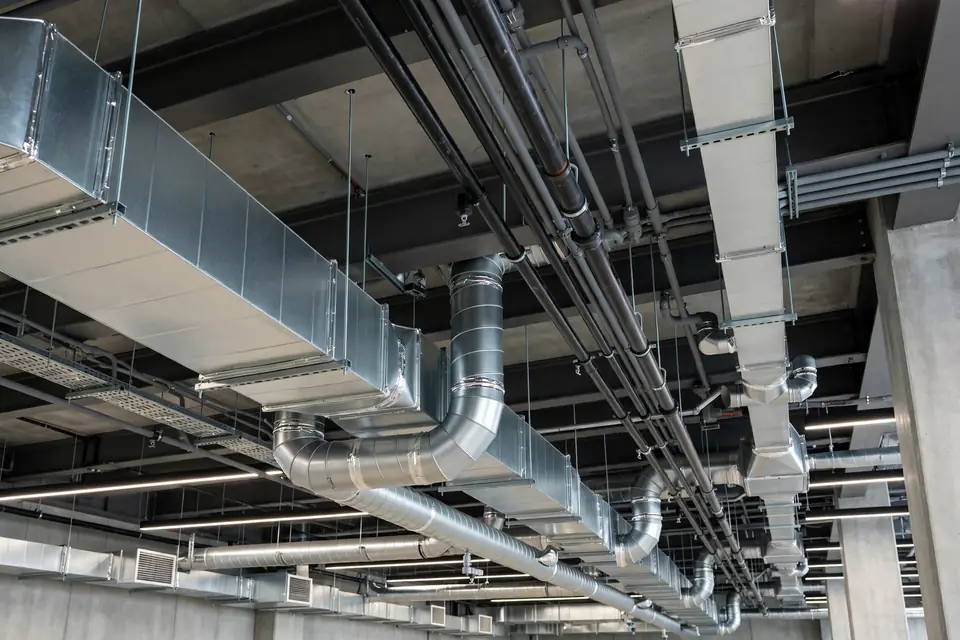
Duct sizing follows CFM: ducts must be large enough to carry the required airflow without excessive noise or pressure drop. As a rough guide, a 6-inch round duct handles ~100 CFM, 8-inch ~200 CFM, 10-inch ~300 CFM, 12-inch ~500 CFM. Undersized ducts are the number-one cause of delivered CFM falling short of designed CFM — the fan can only push so hard against resistance.

How Is CFM Measured?
For existing systems, technicians don’t calculate — they measure:
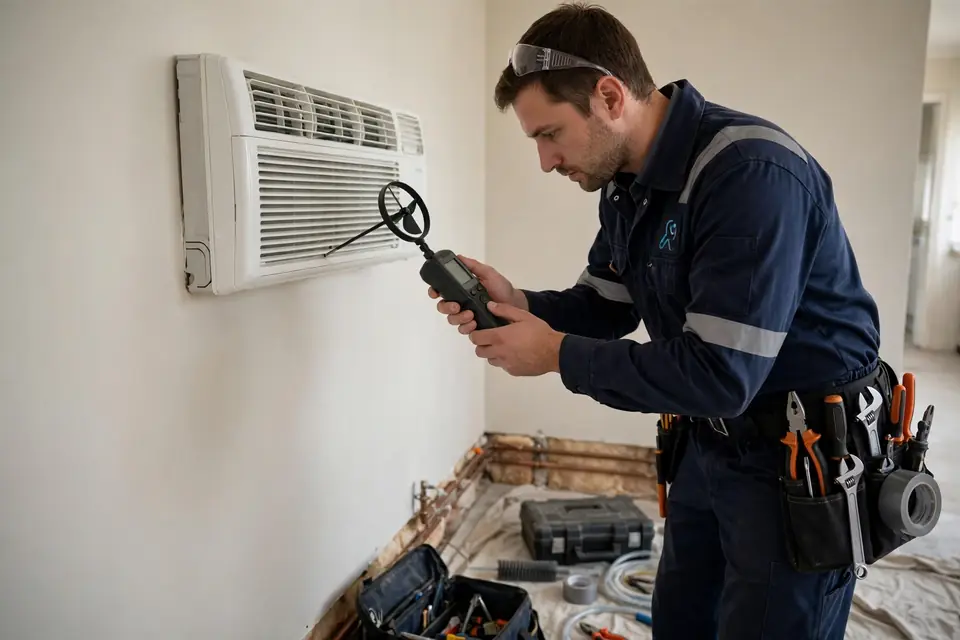
- Anemometer: a handheld device (vane or hot-wire type) that reads air velocity in feet per minute at a vent or duct. Multiply by the duct’s cross-sectional area → CFM.
- Flow hood / capture hood: placed over a diffuser or grille, it captures all the air and reads CFM directly — the most accurate field method.
- Manometer + pitot tube: measures pressure differential across a point; velocity = 4005 × √(ΔP), then × area = CFM. The classic commissioning method.
This verification step matters: designed CFM and delivered CFM are often different — leaky ducts, dirty filters, and poor installation can steal 20–30% of airflow. Measuring confirms the system actually performs.
CFM in Different Applications
- HVAC systems: the core use — sizing furnaces, ACs, and heat pumps to rooms and buildings.
- Bathroom/kitchen exhaust fans: rated in CFM; a bathroom needs roughly 1 CFM per square foot (a 50 sq ft bath → 50 CFM fan).
- Range hoods: 100 CFM per linear foot of cooktop is the rule of thumb; pro-style ranges need 600+.
- Air compressors: CFM ratings tell you which tools a compressor can run — a nail gun sips air, a sandblaster gulps it.
- PC cooling: case fans and CPU coolers are rated in CFM — higher CFM (at acceptable noise) means better cooling.
- Garage/shop fans: a 2-car garage typically wants 3,000+ CFM for real comfort.
- Leaf blowers: marketed in CFM (volume) and MPH (speed) — CFM moves the pile, MPH scatters it.
CFM and Indoor Air Quality
CFM isn’t just about temperature — it’s the primary lever for indoor air quality. Every hour, a building’s air accumulates CO₂ from occupants, volatile organic compounds from furniture and cleaners, cooking particles, and excess moisture. Ventilation — measured in CFM — is how that cocktail gets diluted and removed.
ASHRAE Standard 62.1 (the ventilation bible for commercial buildings) prescribes minimum CFM per person plus CFM per square foot, varying by space type: offices need about 15–20 CFM per person, classrooms 15, healthcare spaces 25–30. Modern airtight homes often can’t hit these numbers passively, which is why mechanical ventilation — exhaust fans, energy recovery ventilators (ERVs), whole-house systems — has become essential rather than optional.
The pandemic sharpened this further: higher ACH (and thus higher CFM) dilutes airborne pathogens faster. A classroom at 2 ACH replaces its air every 30 minutes; at 6 ACH, every 10 minutes. CFM went from an obscure engineering spec to a public-health number — and it’s never going back.
CFM vs SCFM
| CFM | SCFM |
|---|---|
| Cubic Feet per Minute | Standard Cubic Feet per Minute |
| Volume at actual operating conditions | Volume normalized to standard conditions (set temperature, pressure, humidity) |
| Used for HVAC, fans, ventilation | Used for air compressors, industrial equipment |
| Simple, practical | Comparable across altitudes and climates |
Why the distinction? Air expands and contracts with temperature and pressure — a cubic foot of hot thin mountain air contains less actual air than a cubic foot of cold sea-level air. SCFM corrects for this so equipment ratings stay comparable everywhere. The CFM number on consumer fans and HVAC gear is the simpler, non-standardized kind.
Frequently Asked Questions
What does CFM stand for?
Cubic Feet per Minute — the volume of air moved per minute; the standard airflow measurement.
What is a good CFM for a room?
It depends on volume and use — a typical bedroom needs roughly 100–150 CFM; use CFM = (L × W × H × ACH) ÷ 60.
How many CFM per ton of AC?
About 400 CFM per ton (range 350–450) — a 3-ton system moves ~1,200 CFM.
Is higher CFM always better?
No — oversized airflow wastes energy, creates noise and drafts, and hurts humidity control. Match CFM to the space.
How is CFM measured?
With an anemometer (velocity × duct area), a flow hood (direct reading), or a manometer (pressure differential).
What is the difference between CFM and SCFM?
CFM is airflow at actual conditions; SCFM normalizes to standard conditions for fair comparison across climates and altitudes.
What CFM do I need for a bathroom fan?
Roughly 1 CFM per square foot — a 60 sq ft bathroom wants a 60 CFM fan (minimum 50).
What CFM is a good leaf blower?
Handhelds: 400–600 CFM; backpacks: 600–900+ CFM. Remember CFM moves the pile, MPH (speed) scatters it.
How many CFM for a 2-car garage?
Around 3,000 CFM or more for genuine comfort; hotter or dustier shops want more.
What does CFM mean on a fan?
How much air the fan moves per minute — the higher the CFM, the more air (compare at similar noise levels).
Can low CFM damage my AC?
Yes — restricted airflow can freeze evaporator coils, overheat components, and spike energy bills.
How do I convert CFM to metric?
1 CFM ≈ 0.472 L/s ≈ 1.70 m³/h.
What is ACH?
Air Changes per Hour — how many times a room’s full air volume is replaced in one hour; the key input for CFM calculations.
Does a ceiling fan have a CFM rating?
Yes — typically 3,000–6,000+ CFM on high; ENERGY STAR models list CFM per watt (efficiency).
Source: For CFM fundamentals in HVAC systems, see Cielo’s HVAC glossary entry on CFM.