
Deluge Meaning: What Does Deluge Mean?
Quick answer: Deluge (pronounced DEL-yooj, /ˈdɛljuːdʒ/) means a great flood — either literally (a deluge of rain) or figuratively (an overwhelming rush of anything: a deluge of emails, complaints, applause). As a verb, to deluge = to flood or overwhelm. From Latin dīluvium (“a washing away”), it entered English in the 14th century — and capitalized, “the Deluge” is the biblical Flood of Noah.
In this article
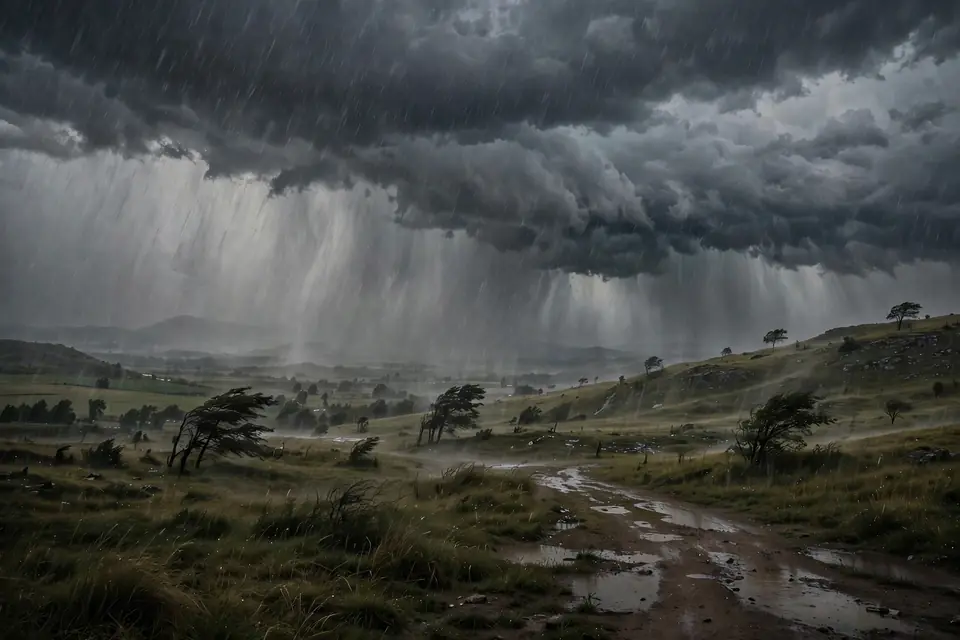
What Does Deluge Mean?
Deluge works as both noun and verb, with literal and figurative lives:
As a noun:
- A great flood of water — “the deluge destroyed the village.”
- A heavy downpour — “we waited out the deluge under the awning.”
- An overwhelming amount of anything — “a deluge of fan mail,” “a deluge of complaints.”
As a verb (deluged, deluging):
- To flood with water — “the river deluged the fields.”
- To overwhelm — “she was deluged with congratulatory letters.”
Pronunciation: DEL-yooj (/ˈdɛljuːdʒ/) — stress on the first syllable; the “g” is soft, like in “huge.” (Not “de-LOOJ” — the stress never moves to the second syllable.)
The key nuance: deluge implies suddenness and excess. A flood can be gradual; a deluge arrives all at once and more than you can handle. That’s why the figurative use dominates modern English — we live in an age of deluges: of information, of notifications, of content.
Deluge as emotional metaphor: beyond inboxes, we speak of “a deluge of grief,” “deluged by memories,” “a deluge of relief.” The word handles feelings as naturally as water — because emotions, like floods, arrive suddenly and overwhelm the banks we’ve built. Therapists and poets both reach for it: the hydrology of the heart.
The Etymology: A Washing Away
Latin dīluvium: “a washing away, flood” — from dīluere (“to wash away, drench”), built from dis- (“apart, away”) + luere (from lavere, “to wash” — the root of “lave” and “lavatory”).
14th century: entered Middle English via Old French — first meaning “flood,” then specifically Noah’s Flood, then the general “overwhelming rush.”
The dilute connection: dilute shares the root — to dilute is to “wash away” concentration. A deluge dilutes everything it touches: attention, meaning, dry land.
“The Deluge” capitalized: in biblical and literary contexts, the Deluge = the Great Flood of Noah’s time (Genesis 6–9). Capitalization marks it as the archetype — the flood against which all floods are measured.
The washing family: lavere (“to wash”) is prolific — it gives us lavatory (a place for washing), lotion, launder, and dilute. Deluge is the family’s dramatic member — where the others describe cleaning, deluge describes overwhelming. Same root, opposite energies: washing can purify or drown, and language kept both.

Deluge in Sentences
Literal (water):
- “After the deluge, the streets were full of water.”
- “The storm deluged the region for three days straight.”
- “Hurricane Helene deluged western North Carolina in 2024.”
Figurative (overwhelm):
- “She received a deluge of emails after the announcement.”
- “The company faced a deluge of complaints after the recall.”
- “He was deluged with requests for interviews.”
- “A deluge of applause filled the theater.”
The pattern: figurative deluges take “of” + plural noun — of mail, of calls, of orders, of criticism. The construction is so productive it’s nearly a template: “a deluge of ___.”
Verb forms: deluged (past) — “we were deluged”; deluging (present participle) — “the deluging rain.” The verb is transitive — something deluges something else.
Deluge in Science and Weather
Meteorology: a deluge is not a technical term — forecasters say “heavy rainfall,” “flash flooding,” “extreme precipitation.” But journalists reach for deluge when the rain is newsworthy: “the deluge that submerged the subway.” The word marks the moment weather becomes story.
Climate change: warming air holds more moisture — about 7% more per degree Celsius — making deluge-class downpours more frequent. What was once “biblical” is becoming seasonal. The word’s ancient drama now describes modern statistics: the 1-in-100-year flood arriving every decade.
Geology’s megafloods: the Missoula Floods (15,000 years ago) — glacial dam bursts that deluged the Pacific Northwest with more water than all Earth’s rivers combined. The Black Sea deluge hypothesis suggests a catastrophic flood may underlie Noah’s story itself. Science keeps finding real deluges beneath the myths.
The Noah’s Ark debate: geologists find no evidence for a global flood — but abundant evidence for massive regional ones. The deluge stories may be memory, not myth: ancient peoples witnessing sea-level rises and glacial floods, encoding catastrophe in narrative built to survive.
Deluge vs. drought — the twin fears: human civilization has always lived between too much water and too little. We pray for rain in drought and curse it in flood. Deluge is the word for when the blessing becomes the curse — the moment abundance turns violent. Every farmer knows both prayers; every city planner fears both failures.
Deluge vs Flood vs Inundation
| Word | Core sense | Register | Example |
|---|---|---|---|
| Deluge | Sudden overwhelming flood | Literary, dramatic | Deluge of mail |
| Flood | Overflow of water | Neutral, common | Flood warning |
| Inundation | Being covered (by water) | Formal, technical | Coastal inundation |
| Downpour | Heavy rain | Everyday | Sudden downpour |
| Torrent | Violent rushing stream | Vivid | Torrent of abuse |
| Barrage | Sustained attack/volume | Military metaphor | Barrage of questions |
Choosing well: use deluge when you want biblical scale and drama — it carries 700 years of flood-memory. Use flood for news, inundation for reports, downpour for weather chat.
The writer’s scale: think of water words as a volume knob. Drizzle → rain → shower → downpour → deluge → cataclysm. Each step up adds force and consequence. Deluge sits near the top — below only apocalypse-grade terms. Turning the knob to “deluge” tells readers: this is not weather; this is event.

The Deluge in Culture
Noah’s Flood: the archetypal deluge — forty days and forty nights, the ark, the dove, the rainbow covenant. It established the template: divine judgment through water, destruction and renewal in one story. Nearly every culture has a flood myth — Gilgamesh, Deucalion, Manu — suggesting the deluge is humanity’s shared nightmare.
Literature: from Ovid’s Metamorphoses to modern climate fiction, the deluge is apocalypse’s favorite instrument — water as both destroyer and cleanser. The metaphor survives because it feels true: too much of anything drowns us.
The information deluge: our era’s signature use — the daily overwhelming of emails, news, notifications, content. We coined “information overload” because “deluge” felt too biblical for the inbox — but the older word is more honest. We are, quite literally, drowning in data.
Why it endures: every generation finds new things to be deluged by. The word is future-proof — as long as excess exists, deluge will describe it.
Deluge in headlines: scan any news archive and the word recurs like rainfall: “deluge of refugees,” “deluge of misinformation,” “deluge of resignations.” Editors love it because it converts quantity into emergency — a hundred complaints is news; a “deluge” of complaints is a crisis. The word is journalism’s floodlight: it doesn’t just report the water, it makes you feel wet.
Deluge in music and art: composers have long scored the flood — from Handel’s “Israel in Egypt” to modern film soundtracks where rising strings signal the waters coming. Painters from Poussin to Turner rendered deluges as sublime terror: nature’s power made visible. The word belongs to art’s vocabulary of overwhelm — the moment beauty and destruction become indistinguishable.
Frequently Asked Questions
What does deluge mean?
A great flood — literally of water, or figuratively an overwhelming amount of anything.
How do you pronounce deluge?
DEL-yooj (/ˈdɛljuːdʒ/) — stress on the first syllable, soft “g” like “huge.”
What is the origin of deluge?
Latin dīluvium (“a washing away”), via Old French — 14th century.
Is deluge a noun or verb?
Both — noun: “a deluge of mail”; verb: “deluged with requests.”
What does “the Deluge” mean in the Bible?
The Great Flood of Noah’s time (Genesis 6–9) — capitalized as the archetypal flood.
What’s the difference between deluge and flood?
Deluge implies suddenness, excess, and drama; flood is the neutral term.
What does “deluged with emails” mean?
Overwhelmed by far too many emails — the figurative use.
What are synonyms for deluge?
Flood, downpour, torrent, inundation, barrage, floodtide.
What is the verb form of deluge?
To deluge — deluged, deluging: “the river deluged the fields.”
Is deluge related to dilute?
Yes — both from dīluere (“to wash away”); a deluge dilutes everything.
Can deluge be positive?
Rarely — “a deluge of applause” or “of donations” works, but the word leans overwhelming.
What does “after the deluge” mean?
After the overwhelming event — picking up pieces once the flood (literal or figurative) passes.
Is deluge formal?
Literary-formal — stronger than “flood”; choose it for drama and scale.
What cultures have flood myths?
Nearly all — Noah (Bible), Gilgamesh (Mesopotamia), Deucalion (Greece), Manu (India).
What is a “deluge of information”?
Information overload — far more data than anyone can process; the modern figurative use.
Can deluge be a verb?
Yes — “to deluge”: deluged, deluging. “The inbox was deluged overnight.”
Is “deluge” too dramatic for everyday use?
For rain, maybe — “downpour” is calmer; save deluge for true excess.
What does “après moi, le déluge” mean?
French for “after me, the flood” — attributed to Louis XV: chaos after I’m gone.
What’s the opposite of a deluge?
A drought — too little instead of too much; or a trickle for the figurative sense.
Is “deluge” used in weather forecasts?
Rarely — forecasters prefer “heavy rainfall”; journalists use deluge for drama.
Source: For the full dictionary entry and word history, see Merriam-Webster’s definition of deluge.