Discrepancy Meaning: What Does Discrepancy Mean?
Quick answer: A discrepancy (noun, pronounced /dɪˈskrɛpənsi/) is a difference or inconsistency between two or more things that should be the same — facts, figures, statements, or expectations. Example: “The audit found a discrepancy between the reported revenue and the actual bank deposits.” It comes from Latin discrepantia (“discord, disagreement”). Plural: discrepancies.
In this article

What Does Discrepancy Mean?
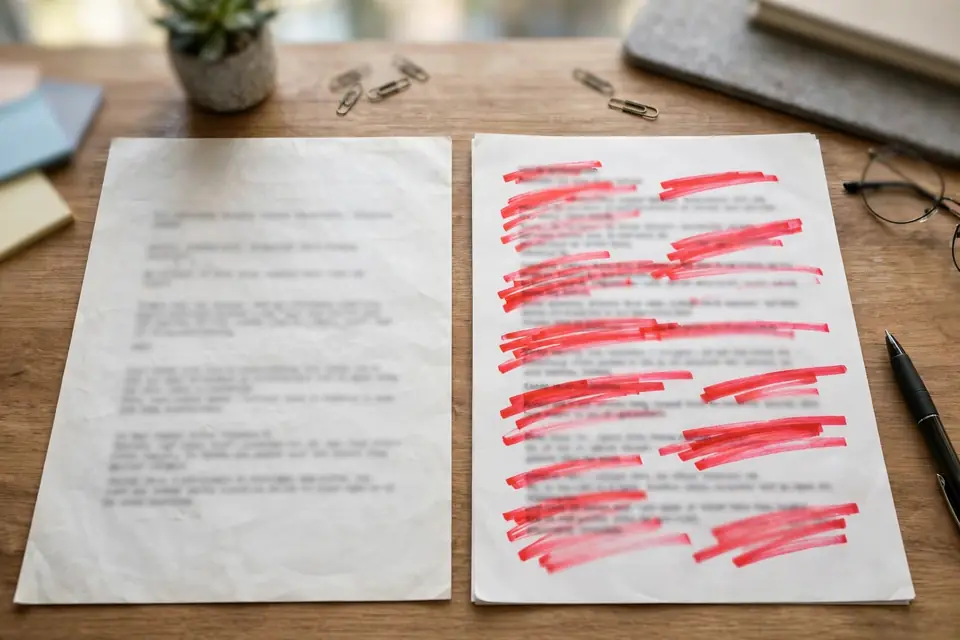
A discrepancy is an inconsistency or disagreement between things that ought to match. The key word is ought: a discrepancy isn’t just any difference — it’s a difference where agreement was expected. Two people’s heights differ; that’s not a discrepancy. Two copies of the same bank statement showing different balances — that’s a discrepancy.
Part of speech: noun (countable). Plural: discrepancies. Pronunciation: /dɪˈskrɛpənsi/ — dis-KREP-un-see, stress on the second syllable.
The word carries a built-in signal of wrongness: where there’s a discrepancy, something needs investigating, explaining, or fixing. It shows up wherever accuracy matters — audits, science, journalism, contracts — because it names the exact moment when reality stops matching the record.
Degrees of discrepancy: not all mismatches are equal. A minor discrepancy (a $2 rounding difference, a one-day date slip) usually has a boring explanation — timing, rounding, a typo. A material discrepancy (missing millions, contradictory alibis) changes decisions. Professionals learn to triage: quantify first, panic later. The word itself doesn’t tell you the size — context does — which is why “minor discrepancy” and “glaring discrepancy” are both natural phrases.
Discrepancy vs simple difference: this is the distinction that trips up learners. Difference is neutral and universal — apples differ from oranges, and nobody’s alarmed. Discrepancy is difference plus expectation violated. Use it only when the two things were supposed to align: two measurements of the same object, two reports of the same event, a promise versus a delivery.
Discrepancy in a Sentence
- Finance: “The auditors flagged a discrepancy between the inventory count and the ledger.”
- Everyday: “There’s a discrepancy between the delivery date promised and the one on the receipt.”
- Science: “The discrepancy between the two instruments’ readings sent the team back to recalibrate.”
- Testimony: “The discrepancy in their accounts of the evening raised the detective’s suspicions.”
- Expectations: “The discrepancy between projected sales and actual revenue worried investors.”
- Data: “A discrepancy in the survey results suggested some respondents misunderstood the question.”
Notice the pattern: each sentence pairs two things that should agree — and they don’t. Master that pattern and you’ll use the word correctly every time.
Where Does “Discrepancy” Come From?
Latin roots: discrepantia — from dis- (“apart, asunder”) + crepare (“to rattle, crack, sound”). Literally, things that “sound apart” — like instruments out of tune with each other. A beautiful image: a discrepancy is dissonance, facts clashing instead of harmonizing.
The word entered English in the late 15th century, first in formal and legal contexts — exactly where you’d expect a word about records failing to agree. Roman record-keepers lived by this concept: a small error in the scrolls could mean disaster, and discrepantia named the danger.
Its adjective form, discrepant (“showing difference; disagreeing”), is rarer in modern use — “discrepancy” does nearly all the work today.
Discrepancy vs Disparity
The most commonly confused pair. They sound alike and both involve difference — but they describe different kinds of difference:
| Discrepancy | Disparity | |
|---|---|---|
| Core idea | Inconsistency — things that should match, don’t | Inequality — a gap in levels, amounts, or quality |
| Implies error? | Yes — something needs fixing or explaining | Not necessarily — may need systemic change |
| Typical contexts | Accounts, reports, testimony, data, records | Wealth, education, health, gender, regions |
| Example | “A discrepancy in the expense report” | “The disparity between rich and poor neighborhoods” |
Memory trick: a discrepancy is about things that don’t add up (mismatched details needing alignment); a disparity is about things that aren’t equal (a broader imbalance). You find a discrepancy in a spreadsheet; you address a disparity in society.
Discrepancy in Different Fields
Accounting & auditing: the word’s home turf. A discrepancy between physical inventory and book inventory, between budgeted and actual spend, between invoices and payments — each one triggers investigation, because in accounting, unexplained differences are never innocent until proven so.
Science & research: discrepancies between expected and observed results are how discoveries happen. A discrepancy in experimental data can mean faulty equipment — or a new phenomenon. The gap between Mercury’s predicted and observed orbit was a “discrepancy” that helped lead to general relativity.
Law & journalism: discrepancies in witness statements, timelines, or official accounts are red flags — they don’t prove lying, but they demand scrutiny. Investigative reporting often starts with one stubborn discrepancy nobody can explain away.
Project management: schedule and budget discrepancies (planned vs actual) trigger root-cause analysis — the formal process of asking why reality diverged from the plan.
Everyday life: the restaurant bill that doesn’t match what you ordered, the odometer reading that contradicts the service history, the story whose details shift on retelling — small discrepancies, same instinct: something doesn’t add up.
Technology & data: in software and data engineering, discrepancy detection is automated — reconciliation jobs compare source and target datasets nightly, flagging mismatches for review. A bank’s app showing a different balance than its website isn’t a curiosity; it’s an incident ticket. The entire discipline of data quality is, at bottom, the systematic hunting of discrepancies at scale.
For the gap between expectation and reality in storytelling, see irony meaning — irony lives in a similar space of things not matching what was promised.

How to Spot and Handle Discrepancies
Finding discrepancies is a skill — auditors, journalists, and scientists are essentially professional discrepancy-hunters. Their method works anywhere:
- Compare independent sources. One source can’t disagree with itself — discrepancies emerge when you line up two records of the same thing: the invoice vs the delivery note, the alibi vs the phone records.
- Quantify before interpreting. “Off by $2” and “off by $2 million” are different universes. Measure the gap first; theories come second.
- Check the boring explanations first. Timing differences, rounding rules, currency conversion, time zones, and plain typos explain the majority of small discrepancies. Rule these out before assuming fraud or conspiracy.
- Document the trail. Note what you compared, what differed, and by how much — a discrepancy you can’t reproduce is just a feeling.
- Escalate by materiality. A pattern of small discrepancies can matter more than one big one — repeated small gaps often signal a systematic problem (or systematic skimming).
The mindset: treat every discrepancy as a question, not an accusation. “These don’t match — why?” is productive. “Someone’s lying” is premature. The best investigators follow the gap wherever it leads, including to their own mistaken assumption.
Synonyms and Antonyms
| Synonyms (similar meaning) | Antonyms (opposite meaning) |
|---|---|
| Inconsistency — the closest synonym | Consistency |
| Disagreement — between accounts or claims | Agreement |
| Contradiction — stronger, direct opposition | Concord / harmony |
| Divergence — things drifting apart | Uniformity |
| Mismatch — informal, everyday | Correspondence |
| Variance — statistical flavor | Similarity |
Choosing between them: use discrepancy when records, figures, or statements should agree; inconsistency for behavior or logic; contradiction when two claims can’t both be true; disparity for inequality of condition. Precision here is the whole point — the words exist because the differences matter.
A note on tone: “discrepancy” is formal and neutral-professional — it belongs in reports, audits, and serious discussion. In casual speech it can sound stiff; friends notice that “the stories don’t match,” not “a discrepancy in their narratives.” Save the word for contexts where its precision earns its weight: writing, work, and anywhere the mismatch itself is the story.
Frequently Asked Questions
What does discrepancy mean?
A difference or inconsistency between things that should be the same — facts, figures, statements, or expectations.
How do you pronounce discrepancy?
/dɪˈskrɛpənsi/ — dis-KREP-un-see, with the stress on the second syllable.
What is the plural of discrepancy?
Discrepancies — “The audit uncovered multiple discrepancies.”
What is the difference between discrepancy and disparity?
Discrepancy = inconsistency needing explanation (numbers that don’t match). Disparity = inequality of levels or quality (wealth gaps).
Is discrepancy a noun or verb?
Noun. (The related adjective discrepant exists but is rarely used.)
What is an example of a discrepancy?
“There was a discrepancy between the witness’s statement and the security footage.”
What does discrepancy mean in accounting?
A mismatch between recorded figures and actual counts — e.g., ledger vs physical inventory — requiring investigation.
What is the origin of the word discrepancy?
Latin discrepantia (“discord, disagreement”), from dis- (apart) + crepare (to rattle/sound) — things that “sound apart.”
What is a synonym for discrepancy?
Inconsistency is closest; also disagreement, contradiction, divergence, mismatch.
What is the opposite of discrepancy?
Consistency — also agreement, uniformity, correspondence.
Can discrepancy be used for people?
Yes — “a discrepancy in their stories” is standard; it describes conflicting accounts, not the people themselves.
Does discrepancy always imply a mistake?
Usually — it signals something needs explaining, though the explanation is sometimes innocent (a timing difference, a rounding rule).
What is a “material discrepancy”?
A mismatch large enough to change a decision — the audit term for a discrepancy that actually matters, vs a trivial one.
Can discrepancies be positive?
The discovery can be — in science, an unexplained discrepancy often points to new knowledge. The word itself stays neutral-to-negative.
Source: For definitions and usage, see Dictionary.net’s discrepancy entry.