Mortise Meaning: What Is a Mortise?
Quick Answer
Mortise (pronounced MOR-tiss) is a hole or recess cut into wood (or other material) to receive a matching projection called a tenon — together forming the mortise-and-tenon joint, one of the strongest, oldest joints in woodworking.
- Noun: The cavity/hole itself
- Verb: To join using a mortise
- Famous pair: Mortise + tenon = classic joint
- Also: Mortise lock; ankle mortise (anatomy)
What Does “Mortise” Mean?
A mortise (/ˈmɔːrtɪs/, pronounced MOR-tiss) is a rectangular or square cavity cut into a piece of wood, stone, or other material — designed to receive a tenon, the matching projecting tongue carved on another piece. Think of it as simply as possible: the mortise is the hole, the tenon is the peg. One fits snugly into the other, and the result is a joint that can hold for centuries without a single nail or screw.
The word also works as a verb: “to mortise” means to join or fasten using this technique — as in, “He mortised the two beams together.” You will encounter it in woodworking manuals, restoration guides, and anywhere traditional joinery is discussed. And the idea travels beyond the workshop: in anatomy, the ankle mortise is the socket formed by the tibia and fibula bones that receives the talus bone of the foot — the exact same “cavity receiving a projection” concept, borrowed by medicine because the image is so precise.
So whenever you meet the word, look for the pattern: a shaped hollow made to grip something that fits inside it. That is a mortise, whether it is holding a chair leg, a door lock, or an ankle bone — one of the most enduring ideas in the history of making things.
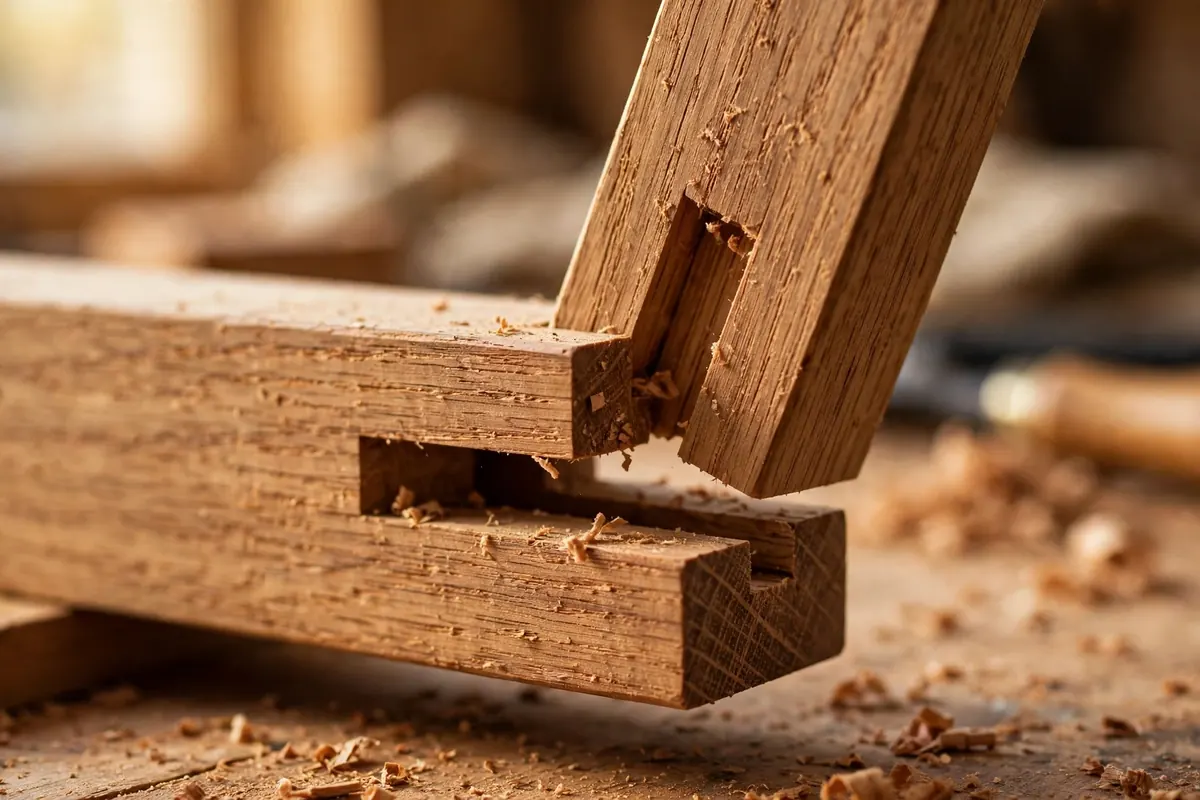
The Mortise-and-Tenon Joint
The mortise-and-tenon joint is one of the oldest known woodworking joints in human history — used for thousands of years in furniture, doors, window frames, and timber-frame buildings across Egypt, China, Rome, and medieval Europe. Many historic landmarks still standing today are held together by nothing more sophisticated than mortises and tenons.
Why has it survived so long? Strength through geometry. The tenon fits snugly into the mortise, creating a large gluing surface along the cheeks of the joint plus a mechanical interlock that resists pulling apart and twisting. A well-cut mortise-and-tenon can outlast the wood around it — which is why antique chairs and centuries-old timber barns are still sound while their nailed-together modern cousins have long since loosened.
You will find the joint wherever strength and longevity matter: chairs, tables, and cabinets; door and window frames; traditional timber-frame buildings and barns. Its signature boast — furniture built “without a single nail” — is not just romance; it is engineering. Nails rust, work loose, and split wood over time. A mortise-and-tenon, cut precisely and glued, simply holds.
Types of Mortises
Not all mortises are the same hole. Woodworkers have developed several distinct forms, each suited to different structural and aesthetic demands. Here are the main ones you will encounter.
| Type | What It Is | Used For |
|---|---|---|
| Through mortise | Passes entirely through the piece of wood; the tenon’s end is visible on the far side | Rustic or visible joinery — Arts and Crafts furniture, gates, timber framing |
| Blind (stub) mortise | Shallow; stops before breaking through the far face | Fine furniture — the joint stays hidden for a clean look |
| Open mortise | Has only three sides (essentially a bridle joint) | Frame corners and leg-to-rail joints where speed matters |
| Wedged mortise | The back of the mortise is cut wider than the opening; driving a wedge beside the tenon locks it permanently | Maximum pull-out strength — workbenches, mallets, tool handles |
| Haunched mortise | The tenon carries an extra “haunch” — a stepped shoulder that fills more of the mortise | High-stress joints, e.g., chair legs, where twisting forces are severe |
For a beginner, the practical distinction is through vs. blind: through-mortises are easier to cut and look honestly structural; blind mortises demand more precision but disappear into fine work. The wedged and haunched variants are refinements — ways of squeezing extra strength out of the same basic idea when the joint will take punishment.
Mortise Lock: The Other Meaning
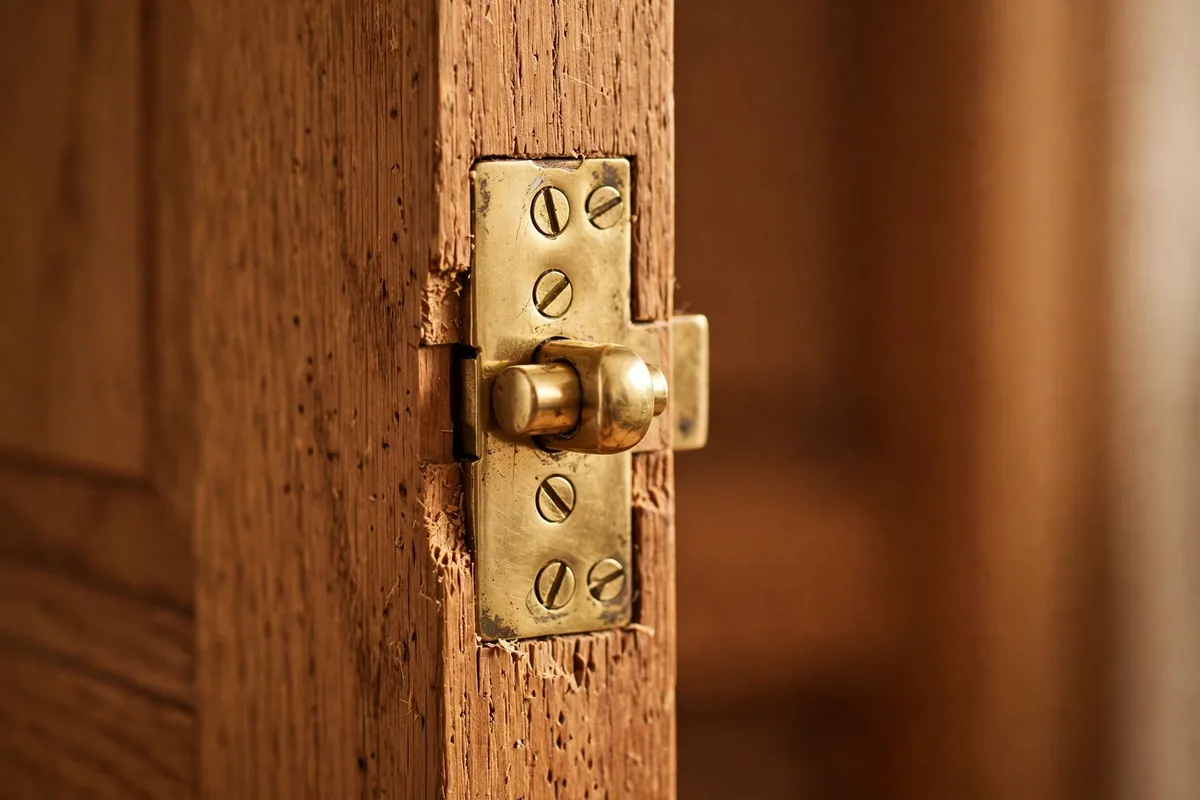
Step away from the workbench and “mortise” appears in a completely different trade: hardware. A mortise lock is a lock whose mechanism is set into a rectangular recess — a mortise — cut into the edge of the door, rather than mounted on the door’s surface. The name is literal: the lock lives inside a mortise.
Mortise locks are the standard in commercial buildings, older homes, and high-security doors. Their advantage is structural: because the mechanism sits inside the door slab rather than bolted onto it, the lock is stronger and far more tamper-resistant than a surface-mounted or basic cylindrical lock. They are bulkier to install — cutting the pocket requires real carpentry — but the security payoff is why institutions still specify them.
If you have ever struggled with an old apartment door whose lock seems buried in the wood, you have met a mortise lock. And the same “cavity receiving a projection” logic from woodworking applies in anatomy: the ankle mortise is the socket formed by the tibia and fibula that cradles the talus bone — your ankle is, structurally speaking, a living mortise-and-tenon joint.
How Mortises Are Cut
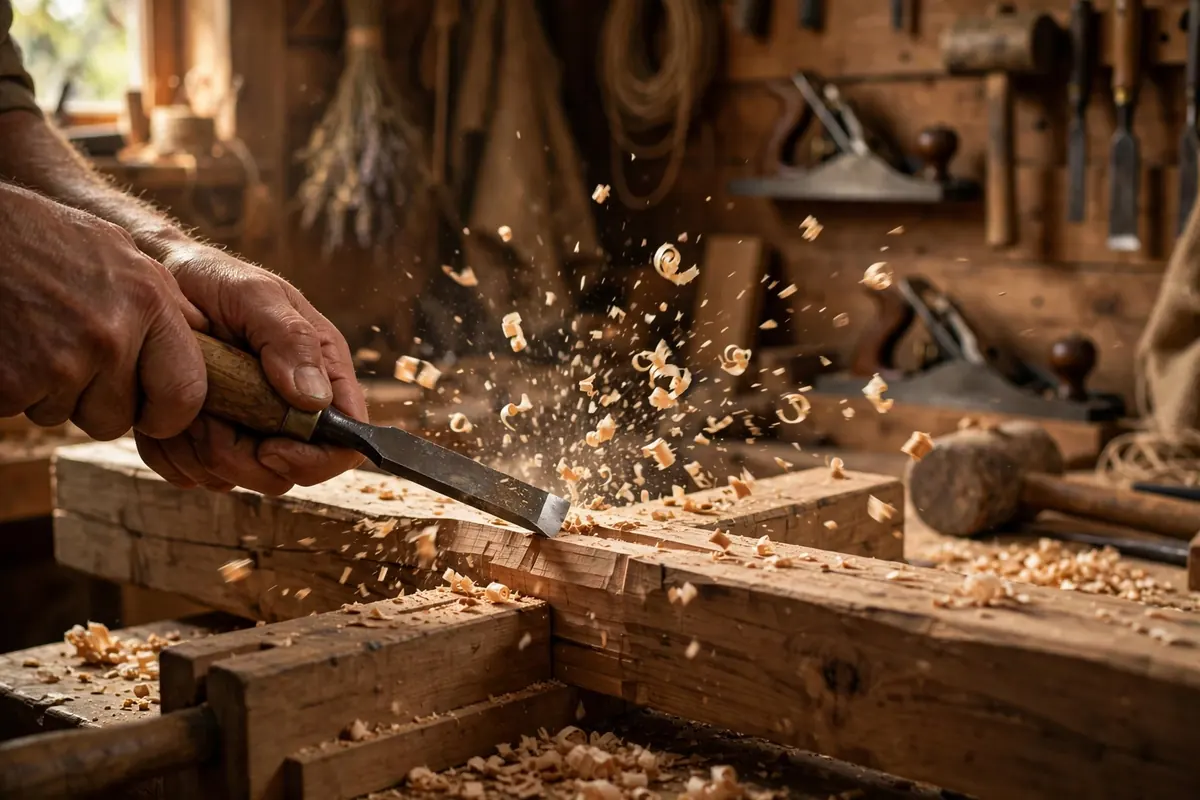
Cutting a clean mortise is one of the foundational skills of woodworking — and the tool you use depends on your era, budget, and patience. The traditional method is the mortising chisel: a thick, square-edged chisel designed to be struck with a mallet, levering out waste in crisp vertical walls. Generations of joiners learned the craft this way, and hand-cut mortises remain the mark of fine work.
The industrial age brought the mortising machine — essentially a drill press fitted with a square hollow chisel surrounding a drill bit, which bores and squares the hole in one motion. Modern small workshops often use a plunge router with jigs or templates instead, which is fast and extremely accurate. And in production settings, CNC machines cut mortises with computer-controlled precision, thousands of identical joints per run.
The simplest approach of all? A drill plus a chisel: bore out most of the waste with overlapping drill holes, then square the walls with a sharp chisel. Whatever the method, the governing skill is precision — the tenon must fit the mortise snugly: too loose and the joint is weak, too tight and you risk splitting the wood driving it home. “Snug, not forced” is the craftsman’s mantra.
Etymology
“Mortise” entered English in the 14th century from the Old French mortaise, making it a word with 600+ years of continuous workshop use. Its deeper origins are debated, and both leading theories are evocative. One traces it to the Arabic murtazz (“fixed, fastened”) — plausible given the medieval exchange of craft knowledge across the Mediterranean. The other derives it from the Latin morsus (“a bite”), for the gripping bite the mortise takes on the tenon.
Whichever root is correct, the word has barely changed shape since the Middle Ages — a testament to how stable the craft vocabulary is. Carpenters in 1400 and carpenters today mean exactly the same hole by it.
Quick Facts
| Fact | Detail |
|---|---|
| Word | Mortise — pronounced MOR-tiss |
| Noun | A cavity cut to receive a tenon |
| Verb | “To mortise” — to join using a mortise |
| Famous joint | Mortise-and-tenon — thousands of years old, no nails needed |
| Other uses | Mortise lock (hardware); ankle mortise (anatomy) |
| In English since | 14th century, from Old French mortaise |
Frequently Asked Questions
What does “mortise” mean?
A hole or recess cut into wood (or another material) to receive a tenon — the two together form the mortise-and-tenon joint.
How do you pronounce “mortise”?
MOR-tiss (/ˈmɔːrtɪs/). The final “e” is silent — it is not “mor-TEESE.”
What is the difference between a mortise and a tenon?
The mortise is the hole; the tenon is the projecting tongue that fits into it. Hole plus peg equals joint.
What is a mortise-and-tenon joint?
One of the oldest and strongest woodworking joints: a tenon fitted snugly into a mortise, usually glued. Used for thousands of years in furniture, doors, and timber framing — no nails required.
What is a mortise lock?
A lock recessed into a pocket cut in the door’s edge, rather than surface-mounted. Common in commercial buildings and older homes; stronger and more tamper-resistant than cylindrical locks.
What is a blind mortise?
A mortise that does not pass through the wood — the joint stays hidden, the standard for fine furniture.
What is a through mortise?
A mortise that passes completely through the piece, so the tenon’s end shows on the far side — used in rustic and timber-frame joinery.
What tools are used to cut a mortise?
Mortising chisels (hand), mortising machines, plunge routers with jigs, or CNC for production. The simplest method is a drill plus a chisel.
Is “mortise” also a verb?
Yes — “to mortise” means to join or fasten using a mortise: “She mortised the rails into the legs.”
What is the ankle mortise?
In anatomy, the socket formed by the tibia and fibula that receives the talus bone — the same “cavity gripping a projection” idea as the woodworking joint.
Source: For the full history and types, see Wikipedia’s article on the mortise and tenon.