Noir Meaning: What Does Noir Mean?
Quick Answer
Noir (pronounced “nwar”) is French for “black.” In English, it’s an adjective describing the film noir genre — dark, cynical crime stories with bleak settings, shadowy visuals, and morally ambiguous characters.
- Literal: French for “black”
- Film noir: “Black film” — 1940s–50s crime dramas
- Vibe: Cynical, bleak, shadowy, dangerous
- Modern form: Neo-noir
What Does “Noir” Mean?
At its simplest, noir is the French word for “black” — the masculine form (noire is the feminine, pronounced the same). Borrowed into English, it became an adjective with three related shades of meaning, all carrying the color’s associations of darkness, mystery, and danger.
First, it describes the film noir genre — the shadowy 1940s–50s Hollywood crime dramas that gave the word its English fame. Second, it describes crime literature in the same spirit — tough, cynical characters in bleak settings — from the French roman noir, literally “black novel.” Third, it works as a general adjective meaning suggestive of danger, violence, or moral darkness: a “noir atmosphere,” a “noir-ish thriller,” a city’s “noir underbelly.”
What unites all three is mood, not color. Nobody describing a film as “noir” is commenting on its palette — they are saying it feels like night: cynical, dangerous, and morally gray. One small French word, borrowed for its shadows.
Pronunciation
“Noir” is pronounced NWAR (/nwɑːr/) — one syllable, the “n” clearly sounded, rhyming roughly with “war” but with a French roundness to the vowel. Think “nwar” said quickly and smoothly. The feminine form noire is pronounced identically; French spelling distinguishes gender that the ear does not.
The classic English-speaker mistake is “noy-er” — two syllables, which is simply wrong and instantly marks the speaker. Keep it short, keep it French: one syllable, NWAR. Film critics and cinephiles are unforgiving on this one, so it is worth getting right before your next movie discussion.
Film Noir Explained
Film noir — literally “black film” or “dark film” — names a wave of Hollywood crime dramas made roughly from the early 1940s through the late 1950s, now called the “classic period.” These were not a genre in the studio-system sense — no studio had a “noir department.” They were a mood that infected crime pictures, melodramas, and thrillers across the industry.
The term itself was coined by French critic Nino Frank in 1946, writing about a batch of American films reaching postwar France that shared an unmistakably dark, pessimistic tone. The name stuck partly because of the French Série noire (1945) — a line of cheap paperbacks translating hard-boiled American crime novels by writers like Dashiell Hammett and James M. Cain. France, in other words, named America’s own darkness back to it.
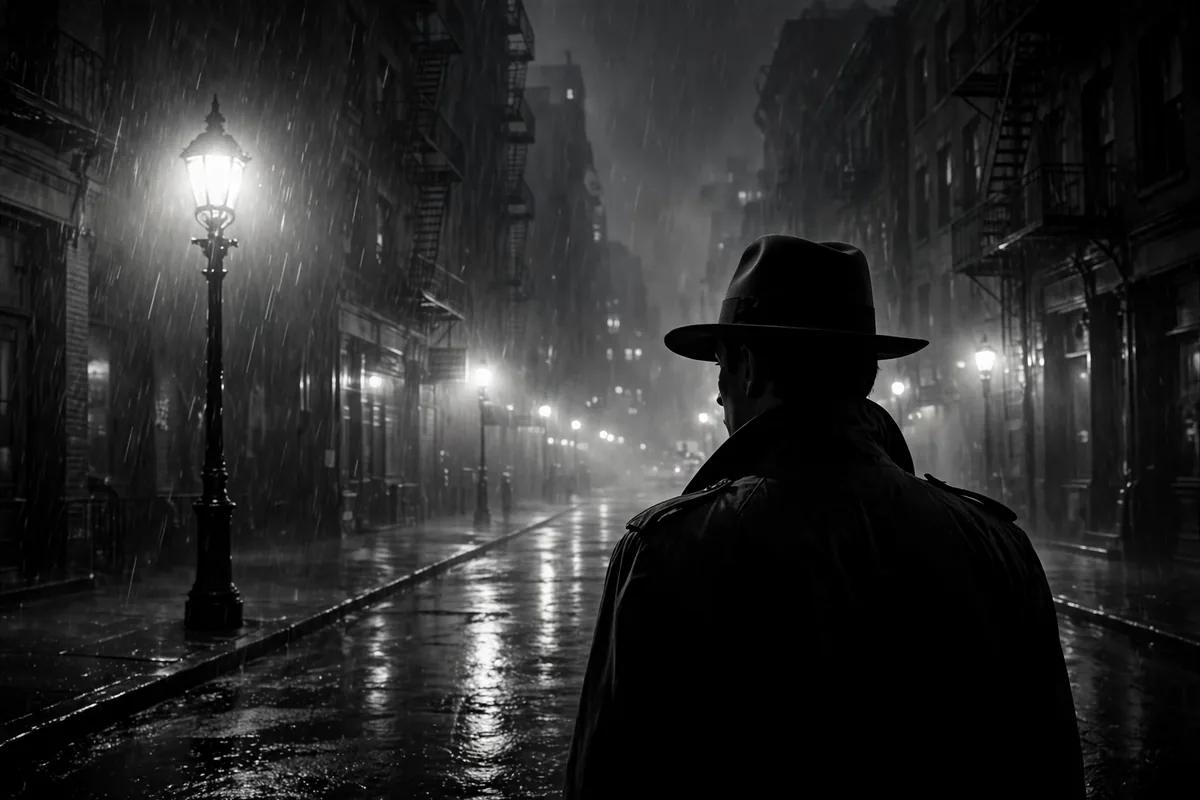
Visually, noir drank deeply from German Expressionist cinematography — many noir directors and cameramen were European émigrés fleeing the Nazis, and they brought low-key, high-contrast black-and-white lighting with them: venetian-blind shadows, rain-slicked streets, faces half-lost in darkness. Thematically, the films channeled postwar disillusionment: returning veterans, corrupt cities, moral gray zones, and the queasy sense that the night always wins. Happy endings were not guaranteed — and often, they were not even offered.
The Key Elements of Noir
Noir is instantly recognizable because its ingredients barely vary. Learn the recipe and you will spot it anywhere — in a 1944 detective picture or a 2024 prestige TV drama.
| Element | The Noir Version | Why It Matters |
|---|---|---|
| Lighting | Shadowy, high-contrast — venetian-blind stripes, rainy streets, faces half in darkness | The visuals are the moral argument: nothing is fully illuminated |
| Hero | The hard-boiled detective or anti-hero — cynical, flawed, with a personal code | He is compromised but not corrupt — the audience’s anchor in a rotten world |
| Heroine | The femme fatale — beautiful, intelligent, dangerous, possibly deadly | She weaponizes desire; trusting her is the hero’s fatal mistake |
| Setting | Bleak urban nights — alleys, bars, cheap apartments, rain | The city is a character: indifferent, corrupt, inescapable |
| Themes | Crime, betrayal, fatalism — right and wrong blur beyond recognition | Noir’s philosophy: choices matter, but the house usually wins |
| Narration | Voiceover confession — the hero tells his own downfall | Creates intimacy and doom at once: he already knows how it ends |
| Tone | Pessimistic — cynicism as a survival strategy | The famous noir shrug: everybody is guilty of something |
The through-line is moral ambiguity rendered as atmosphere. In a western, you know the good guys by their hats; in noir, the lighting itself refuses to tell you who to trust. That is why the style outlived its era — the feeling it captures, that the world is darker and more complicated than the official story admits, never goes out of date.

Classic Noir Films
If you want to understand noir, watch the canon. These are the films scholars and critics return to as the genre’s foundation — each one a masterclass in a different noir virtue.
- The Maltese Falcon (1941) — the archetype. Humphrey Bogart’s Sam Spade is the definitive hard-boiled detective: cynical, self-interested, but bound by a private code. The priceless statuette everyone chases is cinema’s most famous MacGuffin — “the stuff that dreams are made of.”
- Double Indemnity (1944) — Billy Wilder’s murder-for-insurance-money masterpiece. Told in flashback voiceover by a man already doomed, it is the perfect noir plot machine: every clever plan contains the seed of its own collapse.
- The Big Sleep (1946) — famously impenetrable plot, unforgettable mood. Legend holds that even the filmmakers could not explain one of the murders — proof that in noir, atmosphere outranks logic.
- Out of the Past (1947) — peak noir fatalism: a man tries to outrun his history and learns the past always collects. Roger Ebert admired its world-weary cool enormously.
- Sunset Boulevard (1950) — Hollywood itself goes noir. A faded silent-film star, a dead narrator, and the most chilling final close-up in cinema: “All right, Mr. DeMille, I’m ready for my close-up.”
- Touch of Evil (1958) — Orson Welles’ late classic, opening with one of the most famous long takes in film history and closing the classic period with a corrupt cop’s downfall on the US–Mexico border.
Neo-Noir: The Modern Revival
Neo-noir (“new noir”) is the term for contemporary films and shows that revive noir’s elements — the cynicism, the shadows, the compromised heroes — while speaking to modern anxieties. The classic period ended around 1960; neo-noir has been going strong ever since.
The definitive neo-noir is Chinatown (1974) — Robert Towne’s screenplay and Roman Polanski’s direction took the 1940s detective story and aimed it at something bigger: systemic corruption, the kind no lone hero can fix. Its final line — “Forget it, Jake, it’s Chinatown” — is pure noir philosophy: some rot goes too deep to cut out. Blade Runner (1982) proved noir could go science fiction, transplanting the hard-boiled detective to rain-soaked Los Angeles, 2019. Later landmarks include L.A. Confidential (corrupt 1950s cops), Se7en (noir as horror), True Detective (noir as prestige TV), and Sin City (noir distilled into graphic-novel extremes).
What neo-noir proves is that noir was never really about fedoras — it was about a way of seeing. Update the costumes and technology, and the shadows fall exactly where they always did.

Noir Beyond Film
Noir long ago escaped the movie theater. In literature, noir fiction — the hard-boiled crime novels of Raymond Chandler, Dashiell Hammett, and James M. Cain — was actually the source the films drew from, and the tradition continues in modern crime writing. In photography and visual art, the “noir aesthetic” means stark monochrome contrasts and mood over clarity: a single streetlamp in fog says more than a floodlit scene.
In everyday language, “noir” has become critical shorthand. Calling something “a noir-ish thriller” or “the city’s noir underbelly” instantly signals dark, dangerous, and morally tangled — no further explanation needed. Even music has its noir register: late-night jazz, the lonely saxophone, the soundtrack of every detective who ever nursed a whiskey at 2 a.m. The word has become an adjective for a whole emotional climate — and climates, unlike film eras, do not end.
Quick Facts
| Fact | Detail |
|---|---|
| Word | Noir — French for “black” (masculine; noire feminine) |
| Pronounced | “NWAR” — one syllable |
| Term coined | 1946, by French critic Nino Frank |
| Classic period | 1940s–1950s Hollywood crime dramas |
| Visual roots | German Expressionist cinematography |
| Modern form | Neo-noir (Chinatown, Blade Runner, True Detective) |
Frequently Asked Questions
What does “noir” mean?
French for “black.” In English it means dark, cynical crime genre or style — morally ambiguous stories in shadowy, bleak settings.
How do you pronounce “noir”?
“NWAR” — one syllable. Not “noy-er.” The feminine spelling noire sounds exactly the same.
What is film noir?
A wave of 1940s–50s Hollywood crime dramas — shadowy, cynical, and bleak, with hard-boiled detectives, femmes fatales, and morally gray worlds.
Who coined the term “film noir”?
French critic Nino Frank, in 1946, describing American crime films with a distinctively dark tone.
What is neo-noir?
Modern works reviving noir style — e.g., Chinatown (1974), Blade Runner (1982), True Detective. Same shadows, new settings.
What is a femme fatale?
The noir archetype of the dangerous woman — alluring, intelligent, and potentially deadly. Trusting her is the hero’s classic mistake.
What is the difference between “noir” and “black”?
“Black” is just the color. “Noir” carries the genre and mood — cynicism, danger, moral ambiguity. A black car is a color; a noir city is a warning.
Is noir a genre or a style?
Scholars debate it endlessly — some call it a genre, others a visual style or a mood. Either way, the atmosphere is unmistakable.
What is often cited as the first film noir?
The Maltese Falcon (1941) — though some scholars point to earlier candidates, it remains the conventional starting gun.
What does “hard-boiled” mean?
Tough, cynical, emotionally armored — the defining quality of the noir hero, borrowed from hard-boiled detective fiction.
Source: For the full genre history, see Wikipedia’s article on film noir.