Gamelan Meaning: What Is Gamelan Music? Full Guide
Quick Answer
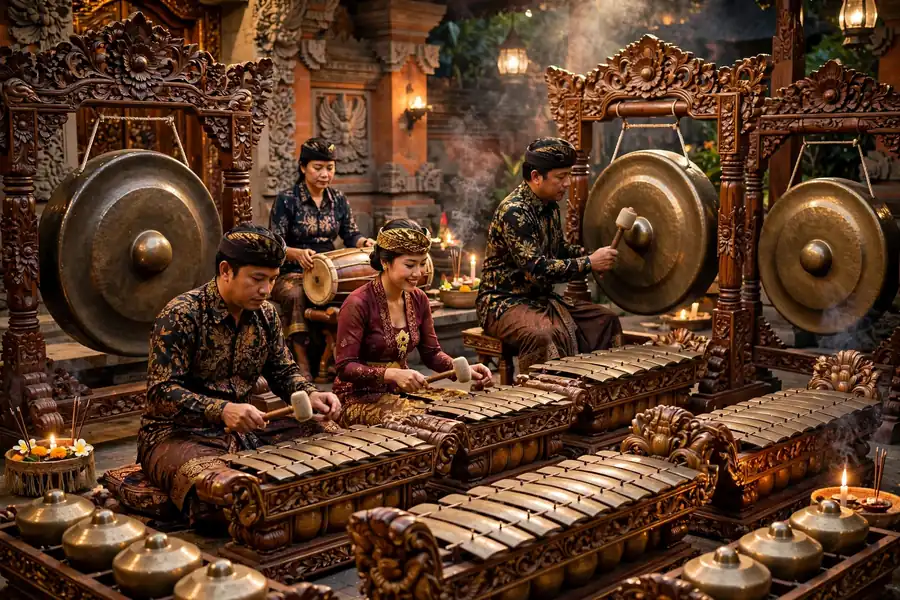
Gamelan is the traditional ensemble music of Indonesia — an orchestra made up mainly of percussion instruments like bronze gongs, metallophones (metal xylophones), and hand drums. The word refers to both the ensemble and the music it plays, central to Javanese, Sundanese, and Balinese culture.
- What it is: Indonesian percussion orchestra
- Pronunciation: GAM-uh-lan (/ˈɡæməlæn/)
- From: Java and Bali, Indonesia
- Key instruments: Gongs, metallophones, kendang drums
What Does Gamelan Mean?
Gamelan names the traditional ensemble music of the Javanese, Sundanese, and Balinese peoples of Indonesia — and, by extension, the orchestra itself and the music it performs. A gamelan is dominated by tuned percussion: bronze gongs of many sizes, metallophones struck with mallets, xylophones, and drums — sometimes joined by flutes, bowed strings, and singers.
If you’ve heard shimmering, interlocking bronze melodies in a film set in Southeast Asia, you’ve heard gamelan. Its sound is unlike anything in Western orchestral music — cyclical, hypnotic, and built on tuning systems with no exact Western equivalent.
Pronunciation
Gamelan is pronounced GAM-uh-lan (/ˈɡæməlæn/) — three syllables, stress on the first, rhyming roughly with “camel in.” Avoid “gah-meh-LAHN” — the English pronunciation keeps it simple and front-stressed.
Etymology
- Old Javanese gamĕlan — “percussion instrument; ensemble of percussion instruments”
- From gamĕl- — “playing of a percussion instrument” (related to striking/hammering) + -an, a noun-forming suffix
- → Javanese gamelan → borrowed into English, first recorded 1816
The word’s root is literally about the act of striking — fitting for music made by hitting bronze. Because it comes directly from Javanese rather than through Latin or Greek, English has no true cognates for it.
The Instruments of Gamelan
A full gamelan can include dozens of instruments, often ornately carved and painted. The main families:
- Gongs: The soul of the ensemble — from the huge gong ageng (great gong, up to a meter across) that marks the largest musical cycles, down to smaller kempul gongs subdividing the rhythm.
- Metallophones: Bronze bars struck with mallets — the saron family carries the core melody; the gender (with resonator tubes) adds shimmering elaboration.
- Gong-chimes: The bonang — rows of small tuned gongs — plays intricate interlocking patterns.
- Kendang (drums): Double-headed hand drums that lead the ensemble — the drummer controls tempo changes and cues transitions.
- Xylophones & others: Wooden gambang (xylophone), the rebab (bowed spike fiddle), suling (bamboo flute), and the zither-like siter.
- Voices: Female sindhen and male gerong singers in Javanese gamelan.
Remarkable fact: each gamelan set has a unique tuning — instruments from one ensemble generally cannot be mixed with another’s. A gamelan is a matched family, tuned as one.

Javanese vs Balinese Gamelan
The two great traditions sound distinctly different:
| Aspect | Javanese gamelan | Balinese gamelan |
|---|---|---|
| Character | Meditative, refined, slow-unfolding | Bright, explosive, virtuosic |
| Tempo | Often slow and stately | Fast with sudden dramatic shifts |
| Tuning | Slendro & pelog scales | Brighter variants; paired detuned instruments create shimmer |
| Texture | Layered, contemplative | Interlocking, rhythmically dazzling |
| Context | Court ceremonies, meditation | Temple festivals, dance-drama, competitions |
Listening tip: start with Javanese court gamelan for calm, Balinese gong kebyar for fireworks — the contrast teaches you what to listen for.
How Gamelan Music Works
Gamelan music is built on principles unfamiliar to Western ears:
- Cyclical structure: Pieces are built on repeating metrical cycles punctuated by gongs at different levels, like nested clocks.
- Layered melody: A slow skeletal melody is elaborated simultaneously by faster instruments, each decorating it differently — unity through variation.
- No conductor: The kendang drummer leads with audible cues; players listen and respond — a deeply communal way of making music.
- Unique scales: The slendro (5-tone) and pelog (7-tone) tuning systems divide the octave differently than Western scales.
- Improvisation within form: Performances breathe — tempo swells and recedes by collective feel, guided by the drum.
Gamelan Tuning: Slendro and Pelog Explained
The “otherworldly” sound of gamelan comes down to tuning systems with no Western equivalent:
- Slendro: A 5-tone scale dividing the octave into roughly equal intervals. It sounds open, even, and meditative — the backbone of much Javanese court music.
- Pelog: A 7-tone scale with uneven intervals — some steps narrow, some wide. It sounds more tense, colorful, and emotional than slendro.
- Neither matches the piano: These scales don’t align with Western 12-tone equal temperament. A gamelan’s “same” note and a piano’s “same” note are measurably different pitches.
- Paired detuning (Bali): Balinese gamelans include pairs of instruments tuned slightly apart — the interference between them creates a shimmering, beating effect called ombak (“waves”). It’s deliberate, and it’s gorgeous.
Why it matters: you can’t notate gamelan accurately on Western staff paper, and you can’t play it on Western-tuned instruments. The tuning is the music — which is why each ensemble is a unique, irreplaceable family.
Gamelan in Indonesian Culture
Gamelan is not concert music in the Western sense — it’s woven into life:
- Ceremonies: Weddings, funerals, temple festivals, and coming-of-age rites all have their gamelan.
- Wayang kulit: The shadow-puppet theatre — all-night epics from the Ramayana and Mahabharata — is accompanied by gamelan, with the puppeteer (dalang) cueing the musicians.
- Dance: Classical Javanese court dance and Balinese dance-drama move to the gamelan, not with recorded music.
- Community: Village gamelans belong to the community — instruments are often considered to house spirits and are treated with reverence.
- Modern Indonesia: Still performed at official, corporate, and educational events — a living tradition, not a museum piece.

Gamelan’s Influence on Western Music
- Debussy (1889): Hearing Javanese gamelan at the Paris World’s Fair electrified Claude Debussy — its scales and textures echo through his piano works and helped crack open Western harmony.
- Minimalism: Steve Reich and Philip Glass drew on gamelan’s repeating patterns and interlocking rhythms — the DNA of minimalist music.
- Film scores: Gamelan colors countless soundtracks — and increasingly, authentic Indonesian voices in global cinema.
- Universities worldwide: From the US to Europe to Japan, universities maintain their own gamelan ensembles — students learn by playing, the traditional way.
Hearing Gamelan Today
- In Indonesia: Bali’s temple festivals and Yogyakarta/Solo courts offer the most authentic experiences — ask locally; ceremonies are frequent.
- Recordings: Start with classic Javanese court gamelan and Balinese gong kebyar albums — the contrast is the education.
- Live abroad: Many cities have community gamelan groups that welcome beginners — it’s one of the few classical traditions where novices can join an ensemble quickly.
- Try playing: Gamelan is designed for group participation — interlocking parts mean beginners contribute real music from the first session.
Frequently Asked Questions
What does gamelan mean?
The traditional ensemble music of Indonesia — an orchestra of mainly percussion instruments (gongs, metallophones, drums), and the music it plays.
How do you pronounce gamelan?
GAM-uh-lan — stress on the first syllable.
Where does gamelan come from?
Java and Bali, Indonesia — with related traditions across Maritime Southeast Asia, including Malaysia.
What instruments are in a gamelan?
Bronze gongs, metallophones (saron, gender), bonang gong-chimes, kendang drums, xylophones, flutes, bowed strings, and singers.
What does gamelan music sound like?
Shimmering, cyclical bronze percussion — layered melodies over repeating gong cycles, hypnotic and unlike Western orchestral music.
What is the difference between Javanese and Balinese gamelan?
Javanese = slow, meditative, refined. Balinese = fast, bright, explosive and virtuosic.
Why can’t gamelan instruments be mixed between ensembles?
Each set has a unique tuning — instruments are tuned as a matched family and generally don’t interchange.
Did gamelan influence Western music?
Yes — Debussy was transformed by hearing it in 1889, and its repeating structures fed into minimalism.
Source: Music-tradition overview compiled from established references. For the encyclopedic article, see Wikipedia’s article on gamelan.