
Asinine Meaning: What Does Asinine Mean?
Quick answer: Asinine (pronounced ASS-ih-nine, /ˈæs.ɪ.naɪn/) is an adjective meaning extremely foolish, absurd, or senseless — stupidity so complete it inspires disbelief. It comes from the Latin asinus (“donkey”), entering English around 1600 to describe donkey-like stubbornness before evolving into its modern sense of brainless folly. It’s stronger than “foolish” — calling an idea asinine expresses contempt, not just disagreement.
In this article
What Does Asinine Mean?
Asinine is an adjective meaning extremely foolish or absurd — not just wrong, but wrong in a way that defies comprehension. If “foolish” is a mild rebuke and “stupid” is blunt, “asinine” is stupid with a raised eyebrow: it implies the foolishness was avoidable, that any thinking person should have known better.
Dictionary definition: “very foolish; failing to exercise intelligence, judgment, or rationality.” The word’s power lies in its tone of contempt — you don’t call a simple mistake asinine; you call an idea, policy, or argument asinine when its foolishness feels almost willful.
Pronunciation: ASS-ih-nine (/ˈæs.ɪ.naɪn/). Note the stress on the first syllable and the long “i” in the final syllable — not “ASS-ih-neen.” Mispronouncing it in a debate would be, well, a little asinine.
Grammar: it’s a regular gradable adjective — more asinine, most asinine. It modifies nouns (an asinine policy, asinine comments) and follows linking verbs (that idea is asinine).
Examples of Asinine in Sentences
- “It’s asinine to blame the intern for a decision the board made.”
- “The company’s asinine new policy requires three approvals to order pens.”
- “He made the asinine assumption that everyone reads the 200-page manual.”
- “Arguing about the restaurant for an hour and then eating at home was frankly asinine.”
- “The most asinine part? They spent more on the meeting about saving money than the savings themselves.”
Notice the pattern: asinine attaches to decisions, policies, assumptions, and arguments — things that involved (or should have involved) thought. It’s a critic’s word, deployed in debates, reviews, satire, and exasperated conversations.
Asinine in the wild: the word pops up wherever confident wrongness needs naming. A tech reviewer calls a phone’s unremovable bloatware “asinine.” A sports columnist labels a team’s fourth-quarter play-calling “utterly asinine.” A film critic dismisses a plot twist as “an asinine betrayal of the first act.” In each case, the writer isn’t just saying bad — they’re saying bad in a way that insults the audience’s intelligence. That’s the word’s signature move: it positions the speaker as the reasonable person in a room full of nonsense, which is precisely why it’s so satisfying — and so dangerous — to deploy.

Where Does Asinine Come From?
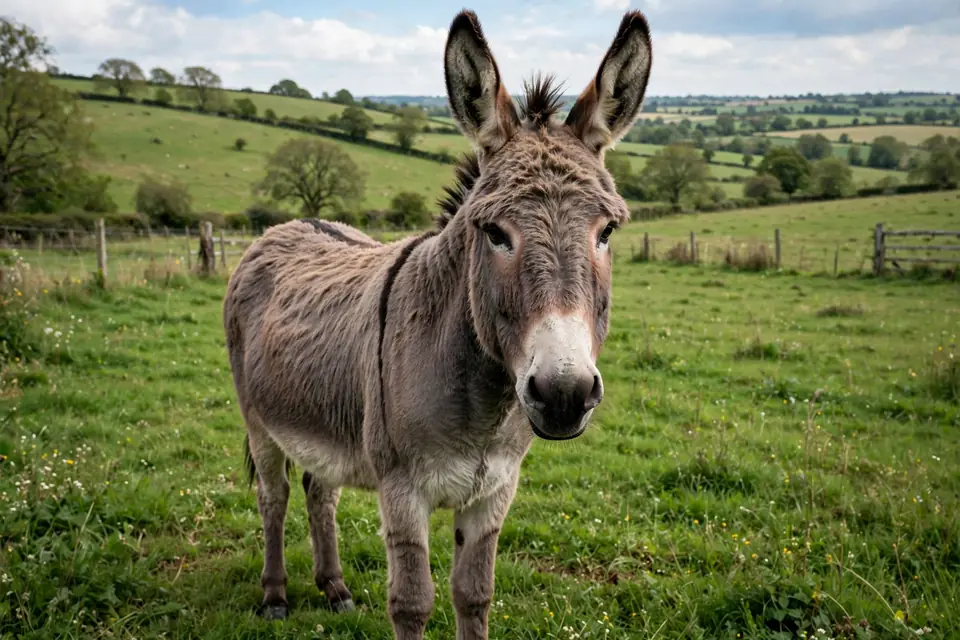
The Latin root: asinus — “donkey” or “ass.” The adjective form asinīnus meant “of a donkey” — donkey-like. In Latin itself, asinus doubled as slang for “dolt, blockhead”: Romans were already using donkey as an insult two thousand years ago.
Into English (~1600): the word entered English around 1600, initially meaning “obstinate, stupid” — the donkey’s two signature traits in the popular imagination: stubbornness (refusing to move) and dullness (the blank stare). The literal “donkey-like” sense is recorded from the 1620s.
The evolution: over four centuries, “asinine” shed its literal animal reference almost entirely. Nobody hearing “an asinine proposal” pictures a donkey — the word now operates as pure abstraction, a vessel for contempt at human folly. The journey from barnyard to boardroom is complete: it’s a word executives use in meetings, with no one remembering the animal that named it.
The French connection: the word traveled through Old French asin (donkey) on its way to Middle English — one more stop in a long journey from Roman farms to modern vocabularies.
A linguistic fossil: “asinine” is a window into dead metaphors — most users have no idea they’re invoking a donkey. Linguists call these “dead metaphors”: phrases whose original imagery has faded, leaving only the abstract meaning. “Asinine” is a perfect specimen — the donkey died out of the word centuries ago, but its ghost still does all the insulting work. Compare “scapegoat,” “straw man,” or “red herring”: English is full of animal corpses propping up abstract ideas, and asinine is among the oldest.
Asinine vs Similar Words
| Word | Meaning | Strength | Tone |
|---|---|---|---|
| Asinine | Extremely foolish, absurd | Very strong | Contemptuous, incredulous |
| Stupid | Lacking intelligence | Strong | Blunt, general |
| Foolish | Unwise, silly | Moderate | Mild, sometimes affectionate |
| Absurd | Wildly unreasonable | Strong | Logical/philosophical |
| Idiotic | Extremely stupid | Very strong | Harsh, personal |
| Ludicrous | So foolish it’s funny | Strong | Mocking, amused |
| Obtuse | Slow to understand | Moderate | Intellectual critique |
Choosing precisely: use asinine when the foolishness should have been avoidable — it carries an accusation of failed thinking. Use absurd for logical contradictions, ludicrous when it’s funny, obtuse for willful incomprehension. Idiotic attacks the person; asinine (usually) attacks the idea — a meaningful distinction in heated debates.
How to Use Asinine
Where it shines:
- Debate and criticism: “That argument is asinine because it assumes what it’s trying to prove.” — the word’s contempt gives your rebuttal teeth.
- Satire and humor: comedians and columnists love it — “asinine” sounds erudite while being insulting, the perfect satirical weapon.
- Exasperated venting: “The printer needs a firmware update to print. Asinine.” — instantly communicates this is beyond reason.
Where to avoid it:
- Describing people directly — “you’re asinine” is a personal attack; critique the idea, not the human.
- Formal or sensitive contexts — performance reviews, apologies, condolences. Its contempt makes it needlessly wounding.
- When you might be wrong — calling something asinine and then being refuted is doubly embarrassing; the word’s confidence becomes your liability.
Register note: asinine is formal enough for print (newspapers, essays, reviews) but sharp enough for conversation. It’s the rare insult that works in a boardroom and a bar alike.

Asinine in Pop Culture
The word has a long stage career. Michael Arlen used it in 1922 to skewer England’s dance-band culture (“that exquisitely asinine blare”). More recently, What We Do in the Shadows gave us Baron Afanas dismissing a vampire gathering as “this asinine affair” — the joke landing precisely because a centuries-old aristocrat would reach for the most withering Latinate insult available.
Why writers love it: “asinine” does double duty — it insults while flattering the insulter’s vocabulary. A character who says “asinine” instead of “dumb” is signaling education and exasperation simultaneously. Screenwriters use it as character shorthand: the word instantly marks someone as articulate, impatient, and probably right (or at least convinced they are).
The sports-commentary special: few domains deploy “asinine” like sports media, where it describes decisions that fail in public — the timeout nobody called, the trade nobody understands, the challenge flag thrown at the worst possible moment. An asinine call isn’t just wrong; it’s wrong on television, which is why the word fits so perfectly.
In Defense of Donkeys
Here’s the thing: donkeys don’t deserve this. The entire word rests on a two-thousand-year-old slander.
Donkeys are actually intelligent. Animal behaviorists rank them as cautious, strong problem-solvers with excellent memories — a donkey that refuses to cross a bridge isn’t being stupid; it’s assessing risk better than the human shouting at it. Their famous “stubbornness” is self-preservation: unlike horses, which panic and flee, donkeys stop and think. In a real sense, the donkey is doing exactly what “asinine” accuses humans of failing to do — exercising judgment.
So the word is ironic: we named our term for failure to think after an animal whose defining trait is refusing to act without thinking. Every use of “asinine” is an accidental compliment to donkeys — a fact worth deploying the next time someone calls your idea asinine. (“Actually, donkeys are highly intelligent, so thank you.”)
Frequently Asked Questions
What does asinine mean?
Extremely foolish or absurd — stupidity that inspires disbelief or contempt.
How do you pronounce asinine?
ASS-ih-nine (/ˈæs.ɪ.naɪn/) — stress on the first syllable, long “i” at the end.
Where does the word asinine come from?
Latin asinus (“donkey”) → asinīnus (“donkey-like”) → English ~1600.
Is asinine a bad word?
Not profane, but it’s a strong insult — contemptuous, so use it on ideas, not people.
What’s the difference between asinine and stupid?
Asinine is stronger — it implies the foolishness was avoidable and deserves contempt, not just correction.
Can you call a person asinine?
Grammatically yes, but it’s a personal attack — wiser to call the idea asinine.
What is an example of asinine behavior?
Requiring three approvals to order office pens, or blaming an intern for a board-level decision.
Is asinine formal or informal?
Both — it works in print essays and casual conversation; erudite yet sharp.
What are synonyms for asinine?
Absurd, idiotic, ludicrous, fatuous, inane — each with slightly different flavor (see the comparison table).
What is the opposite of asinine?
Wise, sensible, judicious, astute — words for sound judgment.
Are donkeys actually stupid?
No — donkeys are intelligent, cautious problem-solvers; the “stubborn” reputation is really risk assessment.
When was asinine first used in English?
Around 1600 (meaning “obstinate, stupid”); the literal “donkey-like” sense is recorded from the 1620s.
Does asinine relate to the word “ass”?
Directly — both come from Latin asinus; “ass” kept the animal meaning while “asinine” took the insult.
Why is asinine stronger than foolish?
“Foolish” can be affectionate (“you foolish romantic”); “asinine” is never affectionate — it’s pure contempt.
Source: For the etymology and definitions, see Wiktionary’s asinine entry.