
Boulangerie Meaning
Quick answer: Boulangerie is the French word for a bakery that specialises in bread — a shop where bread is baked on the premises and sold, from baguettes and country loaves to croissants and other baked goods. Pronounced roughly boo-lahn-zhuh-REE, it is a feminine noun in French (la boulangerie). In English, it usually means a French or French-style bakery, and in France the name carries a legal meaning: a true boulangerie must make its bread from scratch on site.
In this article
- What Does Boulangerie Mean?
- How to Pronounce Boulangerie
- Origin: From Baker to Bakery
- The Boulangerie in France
- The Legal Meaning: What Counts as a Boulangerie
- Boulangerie vs Pâtisserie
- What You Buy at a Boulangerie
- A Boulangerie in Daily French Life
- Using Boulangerie in English
- Boulangerie in Sentences
- Frequently Asked Questions
What Does Boulangerie Mean?
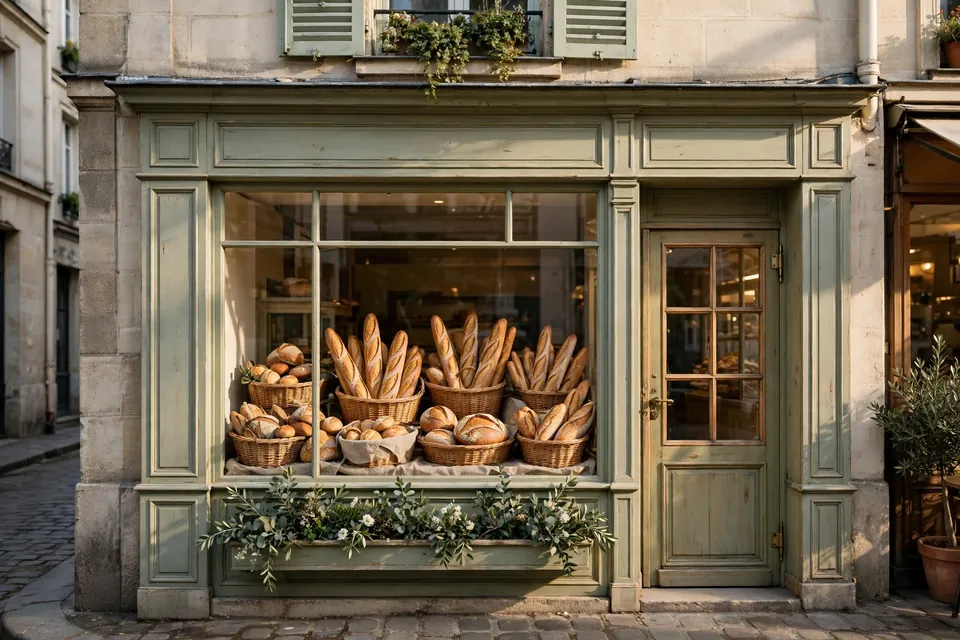
Boulangerie is a French noun meaning bakery — specifically, a bakery that specialises in bread. If you walk into a boulangerie in Paris, you will find shelves and baskets of bread above all else: long, crackling baguettes, round country loaves, seeded rolls, and sweet morning pastries known as viennoiseries. Many boulangeries also sell cakes and sandwiches, but bread is the defining product. A shop that only sells cakes is not a boulangerie; it is a pâtisserie (see below).
In English, the word is borrowed whole from French, and it keeps its French flavour. English speakers rarely say “I went to the boulangerie” about an ordinary supermarket bread aisle; they say it about a French bakery, a French-style bakery abroad, or a bakery that makes a point of traditional methods. That borrowed status is part of the word’s charm: using “boulangerie” instead of “bakery” signals French style, fresh bread, and a certain atmosphere — the smell of a wood oven, the morning queue, the paper-wrapped baguette carried home under an arm.
Grammatically, boulangerie is feminine in French: la boulangerie, une boulangerie. Its plural is boulangeries. The related word for the baker is boulanger (masculine) or boulangère (feminine).
How to Pronounce Boulangerie
Boulangerie is pronounced roughly boo-lahn-zhuh-REE in English approximation, or /buːˈlɑːnʒəri/ in dictionary notation. The French pronunciation is /bu.lɑ̃ʒ.ʁi/, with a nasal vowel in the second syllable that English speakers usually render as “lahn.” Breaking it down helps:
- bou — like “boo”
- lan — like “lahn,” with the vowel passing through the nose
- ge — like “zhuh,” with a soft French j sound
- rie — like “REE,” stressed and clear
The stress falls on the final syllable, as in most French words. English speakers commonly say “boo-lan-jer-ee,” which is close enough to be understood anywhere, including in France — though a French baker will appreciate the nasal “lahn” and the final “REE.” The most common mispronunciation is stressing the second syllable (“boo-LAN-ger-ie”), which sounds English rather than French but rarely causes confusion.
Origin: From Baker to Bakery
Boulangerie comes from boulanger, the French word for “baker,” plus the suffix -erie, which denotes a place where an activity happens or a product is sold — the same pattern as pâtisserie (from pâtissier, pastry cook) and fromagerie (from fromager, cheesemaker). Boulanger itself traces back through Old French bolanger to a Picard word for a baker of round loaves, related to an old word for a ball or round loaf.
The word entered English in 1793, in its French-bakery sense, and it has kept that sense ever since. Its long history in English mirrors the long history of French baking itself: bread has been central to French daily life for centuries, and the boulangerie has been its institution — regulated, celebrated, and fiercely defended — for nearly as long.
The Boulangerie in France
In France, the boulangerie is far more than a shop. It is a daily institution. Most French people live within walking distance of one, and buying bread is a daily or twice-daily ritual: the morning baguette for breakfast, the loaf for lunch and dinner. Bread is not a side item in French meals; it is the constant companion of the table, used to accompany cheese, soup, salads, and sauces.
A traditional boulangerie opens early — often before 7 a.m. — and the day’s rhythm follows the ovens. Bakers arrive in the small hours to mix, shape, and bake; the first baguettes come out warm and crackling; regulars arrive with their orders already known. Many boulangeries close for a midday break and again on one weekday, and in small villages the boulangerie may double as a social hub, post collection point, and source of local news. The village without a boulangerie is, in French cultural shorthand, a village in decline — which is why the arrival of a new baker is genuinely celebrated, and why some rural communes subsidise theirs.
The Legal Meaning: What Counts as a Boulangerie
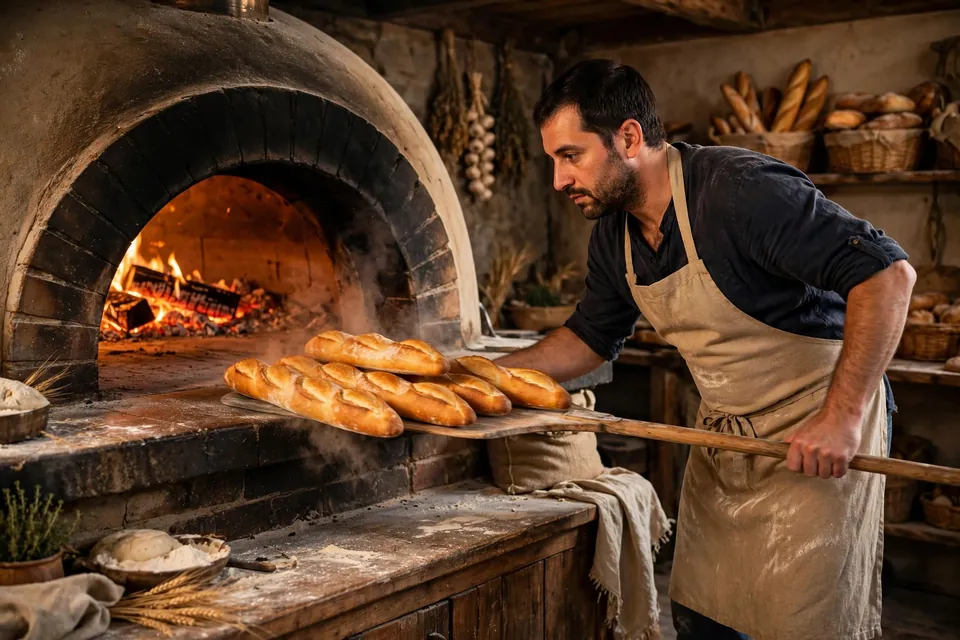
France takes the word seriously enough to legislate it. Under a 1998 French law (often called the “bread decree”), a shop may only call itself a boulangerie if its bread is made from scratch on the premises — mixed, kneaded, shaped, and baked on site, from raw ingredients. Shops that merely bake off pre-made frozen dough must use a different name, such as dépôt de pain (bread depot) or point chaud (hot point).
This matters because it protects both bakers and customers. For bakers, the title boulanger requires training and craft; for customers, the word on the sign is a guarantee that the bread was actually made there that day. The rule also explains a French distinction that puzzles visitors: two shops selling similar-looking baguettes may legally carry different names, and the difference is entirely about where and how the bread was made. When you see “boulangerie” on a French shopfront, you are seeing a claim about craft, backed by law.
Boulangerie vs Pâtisserie
Visitors to France often confuse the two great French food shops. The distinction is simple once you know it:
| Shop | Specialises in | Typical products |
|---|---|---|
| Boulangerie | Bread and viennoiserie | Baguettes, country loaves, croissants, pain au chocolat, brioche |
| Pâtisserie | Cakes and fine pastries | Éclairs, fruit tarts, mille-feuille, macarons, celebration cakes |
| Boulangerie-pâtisserie | Both | The full range — very common in France |
| Viennoiserie | Laminated morning pastries | Croissants, pain au chocolat, kouign-amann |
| Chocolaterie | Chocolate | Handmade chocolates, truffles |
The overlap is real: most boulangeries sell croissants (technically viennoiserie, a Viennese-influenced category), and many combined boulangerie-pâtisseries sell everything. The rule of thumb is about the shop’s centre of gravity: if bread dominates the shelves, it is a boulangerie; if cakes dominate the window, it is a pâtisserie.
What You Buy at a Boulangerie
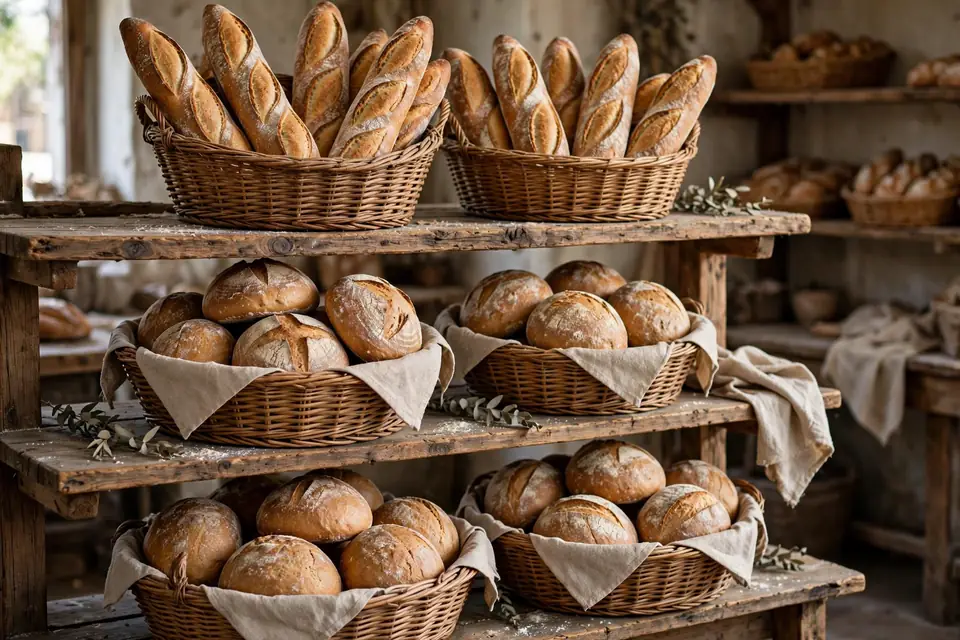
- Baguette: The iconic long, thin loaf with a crackling crust and soft interior. The classic baguette tradition is made with just flour, water, salt, and yeast — no additives.
- Pain de campagne: A rustic country loaf, often round, with a thicker crust and a longer keeping time than a baguette.
- Pain complet: Wholemeal bread, denser and nuttier than white loaves.
- Croissant: The buttery, layered crescent — a viennoiserie, not strictly bread, but a boulangerie staple.
- Pain au chocolat: A rectangular layered pastry wrapped around chocolate batons.
- Brioche: A rich, soft, slightly sweet bread enriched with butter and eggs.
- Fougasse and focaccia-style loaves: Flat, flavoured breads, sometimes with olives, herbs, or cheese.
- Sandwiches: Many boulangeries sell filled baguettes — the classic jambon-beurre (ham and butter) is a French institution in its own right.
A useful tip for visitors: baguettes are baked throughout the day, and the best time to buy is shortly after a bake — ask for one bien cuite (well baked) if you like a darker, crunchier crust, or pas trop cuite (not too baked) for a softer one.
A Boulangerie in Daily French Life
The boulangerie’s role in daily life is hard to overstate. French bread consumption has fallen from historic highs, but the ritual remains: the morning trip for bread, the baguette tucked under an arm or sticking out of a bag, the bread on the table at every meal. Children are often sent on the bread errand as a first independent chore, and the question “who will fetch the bread?” is a small, ordinary piece of French family life.
The boulangerie also anchors neighbourhoods. Regulars know the bakers, bakers know the regulars’ orders, and the shop’s opening hours shape the morning’s timetable. During holidays, boulangeries sell seasonal specialities — galette des rois (kings’ cake) in January, bûche de Noël (Yule log) at Christmas — which mark the year as surely as any calendar. To understand France, the saying goes, you could do worse than to stand in a boulangerie queue at 8 a.m. and watch a country wake up.
Using Boulangerie in English
In English, “boulangerie” is used in three main ways. First, for an actual French bakery, whether in France or abroad: “We found a wonderful boulangerie near the station.” Second, for a French-style bakery that trades on traditional methods: “The new boulangerie on Main Street bakes everything on site.” Third, in travel writing and food writing, where it evokes atmosphere more precisely than “bakery” can.
A few usage notes: keep the French spelling — boulangerie, not “boulangeri” or “boulangery.” Use it as a countable noun (“a boulangerie,” “several boulangeries”). And remember that in English it is a loanword, so it carries a slightly special, slightly foodie register: in a business report about the baking industry, “bakery” is the neutral term; in a restaurant review, “boulangerie” is the evocative one.
Boulangerie in Sentences
- “We stopped by the boulangerie to buy fresh baguettes for breakfast.”
- “He owns a famous boulangerie that serves some of the best croissants in Paris.”
- “The boulangerie on the corner has the most delicious pastries in the neighbourhood.”
- “To earn the privilege of being called a boulangerie, a baker’s bread must be made start to finish on the premises.”
- “Every Sunday, we visit the local boulangerie before the market opens.”
- “If you pass the boulangerie, bring back a baguette!”
Frequently Asked Questions
What does boulangerie mean?
Boulangerie is the French word for a bakery that specialises in bread — a shop where bread is baked on the premises and sold.
How do you pronounce boulangerie?
Roughly boo-lahn-zhuh-REE, with the stress on the final syllable. The French pronunciation is /bu.lɑ̃ʒ.ʁi/.
Is a boulangerie the same as a bakery?
Essentially yes, but with a French and bread-focused flavour: in English, “boulangerie” usually means a French or French-style bakery, while “bakery” is the general term.
What is the difference between a boulangerie and a pâtisserie?
A boulangerie specialises in bread (plus morning pastries); a pâtisserie specialises in cakes and fine pastries. Many shops are combined boulangerie-pâtisseries.
Can any shop call itself a boulangerie in France?
No. Under French law, a shop may only use the name if its bread is made from scratch on the premises. Shops baking pre-made dough must use another name.
Is boulangerie masculine or feminine?
Feminine: la boulangerie, une boulangerie. The baker is le boulanger (masculine) or la boulangère (feminine).
What is the plural of boulangerie?
Boulangeries.
When did boulangerie enter English?
Its first known use in English dates to 1793, in the French-bakery sense.
What does boulangerie-pâtisserie mean?
A shop that is both a bakery and a pastry shop, selling bread and cakes — very common in France.
Source: For the dictionary definition and pronunciation, see Cambridge Dictionary’s entry for boulangerie.