
TPMS Meaning
Quick answer: TPMS stands for Tire Pressure Monitoring System — the electronic system in modern vehicles that monitors the air pressure in your tires and warns you on the dashboard when a tire is significantly under-inflated. The warning light looks like a horseshoe-shaped tire cross-section with an exclamation mark inside. TPMS has been mandatory on all new passenger cars and light trucks in the United States since model year 2008, and it warns when a tire drops about 25% below the recommended pressure.
In this article
- What Does TPMS Mean?
- The TPMS Warning Light: What It Looks Like
- How TPMS Works
- Direct vs Indirect TPMS
- Why Tire Pressure Matters
- What to Do When the TPMS Light Comes On
- Why the TPMS Light Flashes
- Resetting the TPMS Light
- What TPMS Does Not Do
- History and Legal Requirements
- Frequently Asked Questions
What Does TPMS Mean?
TPMS stands for Tire Pressure Monitoring System (in British English, Tyre Pressure Monitoring System). It is an electronic safety system built into most modern vehicles that continuously monitors the air pressure inside your tires and alerts you when pressure falls dangerously low. Rather than discovering a flat or soft tire by eye — which is unreliable, since a tire can lose a quarter of its pressure before it looks visibly flat — TPMS tells you through the dashboard.
The system goes by a few related names. The sensors inside the wheels are called TPMS sensors; the dashboard symbol is the TPMS light or tire pressure warning light; and the whole setup is sometimes described as a form of vehicle telematics, since it reports real-time data to the driver. If your car was built in the last decade and a half, it almost certainly has TPMS, whether you have noticed it or not — most drivers only meet the system on the day its light comes on.
The TPMS Warning Light: What It Looks Like
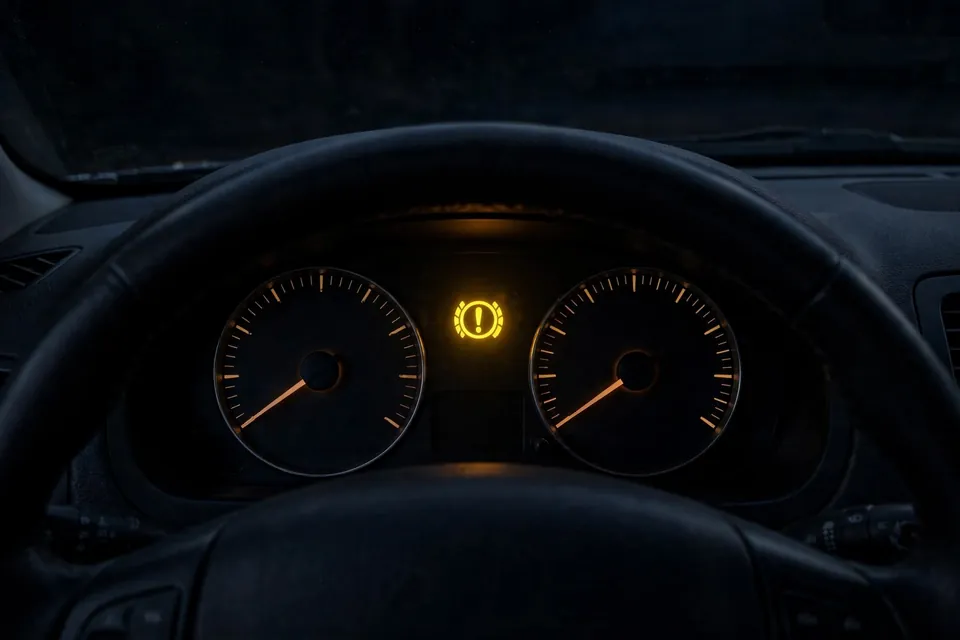
The TPMS warning light is a yellow symbol shaped like a cross-section of a tire with an exclamation mark inside — often described as a horseshoe with an exclamation point. It is easy to confuse with other dashboard symbols, so it helps to know what it is not: it is not the check-engine light, not the oil light, and not the brake warning. Some vehicles also show a text message (“Check Tire Pressure”) or a display of each tire’s pressure in pounds per square inch (PSI).
Under the US federal standard, the light must illuminate when any one of the four road tires (not counting the spare) is 25% or more below the manufacturer’s recommended pressure. That recommended pressure is printed on the placard inside the driver’s door jamb — not on the tire’s sidewall, which shows the tire’s maximum pressure, a different number. Checking the placard is the single most useful habit a driver can adopt for tire care.
How TPMS Works
Both types of TPMS share the same goal — detect under-inflation early — but they reach it by different routes. In a direct system, a small battery-powered sensor is attached to the back of each tire’s valve stem, or banded to the wheel, and measures the actual air pressure (and often temperature) inside the tire. The sensor transmits that data wirelessly to the car’s central computer, which compares it with the recommended pressure and triggers the warning when a tire falls too low.
In an indirect system, there are no pressure sensors in the wheels at all. Instead, the car reuses its anti-lock braking system (ABS) wheel-speed sensors: an under-inflated tire has a slightly smaller rolling diameter, so it rotates faster than a correctly inflated tire at the same speed. Software detects that difference and infers low pressure. Indirect systems are cheaper and need no sensor batteries, but they cannot tell you which tire is low or by how much, and they must be recalibrated after tires are inflated or rotated.
Direct vs Indirect TPMS
| Feature | Direct TPMS | Indirect TPMS |
|---|---|---|
| How it measures | Pressure sensor in each wheel | Wheel-speed data from ABS sensors |
| Shows actual PSI? | Yes, often per tire | No — warning only |
| Identifies the tire? | Yes, on most displays | Usually not |
| Sensor batteries | Yes (last roughly 5–10 years) | None |
| Needs recalibration | After sensor replacement | After inflation, rotation, or tire change |
| Cost | Higher | Lower |
Most newer vehicles use direct systems, because drivers increasingly expect a per-tire pressure readout. If your dashboard shows four numbers in PSI, you have a direct system. If it only shows a warning light, you may have either — your owner’s manual will say which.
Why Tire Pressure Matters
Under-inflated tires are not a minor inconvenience; they change how a car behaves. Low pressure reduces traction, lengthens braking distances, and increases the risk of a blowout, especially at highway speeds or in hot weather. It also costs money: under-inflation increases rolling resistance, so the engine works harder and fuel economy falls, and it wears tires unevenly, shortening their life.
The safety case is what drove the law. After a series of fatal accidents linked to under-inflated tires in the late 1990s — the Firestone and Ford tire controversy — the US Congress passed the TREAD Act of 2000, directing the National Highway Traffic Safety Administration (NHTSA) to require tire pressure monitoring. The result was Federal Motor Vehicle Safety Standard No. 138, with full compliance required for new vehicles by September 1, 2007 (model year 2008). Similar mandates followed in the European Union (from November 2014), Russia, Japan, South Korea, and other countries.
What to Do When the TPMS Light Comes On
- Do not panic, but do not ignore it. A TPMS light means at least one tire is significantly low. It is safe to drive cautiously to a nearby service station, but not to ignore the warning for days.
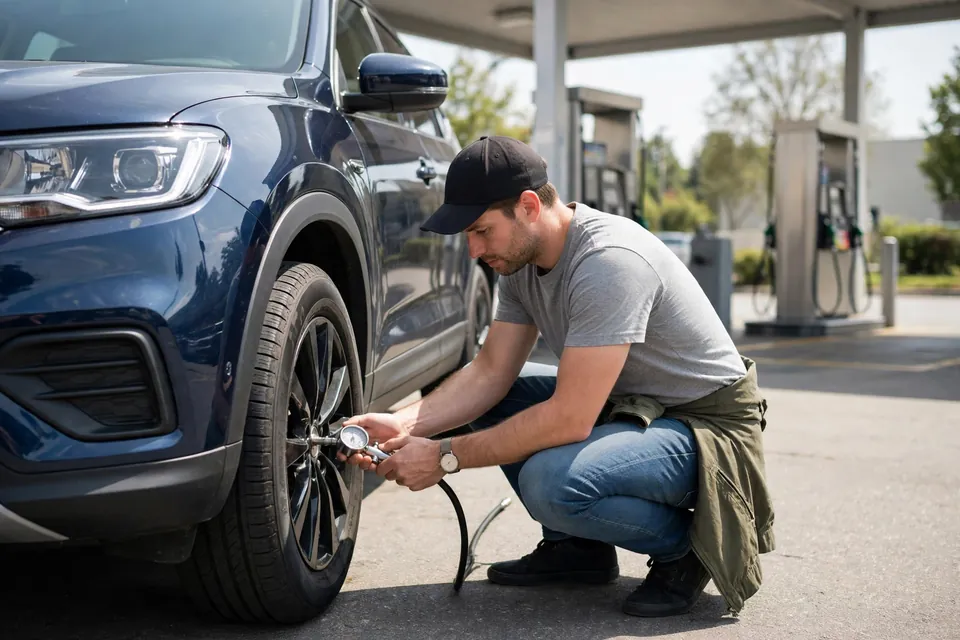
- Check all four tires with a gauge. A handheld gauge is more accurate than a visual check or a kick. Compare each reading with the placard pressure inside the driver’s door.
- Inflate to the recommended pressure. Use an air pump at a service station or a portable inflator. Inflate when tires are cold (before driving, or after less than a mile) for an accurate reading.
- Look for the cause. Check for nails, cuts, or a leaking valve. A tire that keeps losing pressure after inflation has a leak and needs repair or replacement.
- Remember temperature. Tire pressure drops roughly 1 PSI for every 10°F (about 5.5°C) fall in temperature — which is why TPMS lights famously appear on the first cold morning of autumn. This is normal physics, not necessarily a leak, but the tires still need air.
If the light goes out after inflation, the system has done its job. If it stays on despite correct pressures, see the flashing-light section below.
Why the TPMS Light Flashes
A steadily illuminated TPMS light means low pressure. A light that flashes for 60–90 seconds when you start the car, then stays on, means something different: a system malfunction, most commonly a dead or faulty sensor, a sensor damaged during a tire change, or interference after fitting a spare wheel. The distinction matters because a flashing light does not necessarily mean your tires are low — but it does mean the system cannot be trusted to warn you, so manual pressure checks become essential until it is repaired.
Sensor batteries are the most common culprit: they are sealed inside the sensor and typically last 5–10 years, so cars from the early TPMS era are now reaching sensor replacement age. Replacement sensors must be compatible with your vehicle and usually need to be programmed or “relearned” by the car, a job for a tire shop or dealer.
Resetting the TPMS Light
On most cars, the TPMS light resets itself after you inflate the tires to the correct pressure and drive for a few minutes (sometimes up to 10–20 minutes at speed). If it does not, check your owner’s manual for the reset procedure, which varies by make:
- Button reset: Many cars have a TPMS reset button under the steering wheel or in the glove box — press and hold it (with the ignition on) until the light blinks.
- Menu reset: Some cars reset through the dashboard or infotainment menu under vehicle or tire settings.
- Drive relearn: Some direct systems relearn automatically after a short drive.
- Indirect systems: Almost always require a manual recalibration after inflation or rotation, or the light will keep returning.
Never reset the light without checking and correcting the pressures first. Resetting a warning you have not investigated defeats the entire purpose of the system.
What TPMS Does Not Do
- It is not a substitute for manual checks. TPMS only warns at 25% below recommended pressure — a tire 20% low, already harming fuel economy and tire life, will not trigger it. Monthly gauge checks remain the gold standard.
- It usually ignores the spare. The federal standard covers the four road tires; many spare tires (especially temporary spares) are not monitored.
- It does not detect all damage. A cut sidewall, a bulge, or uneven wear will not trigger TPMS unless pressure actually falls.
- It cannot fix a leak. TPMS is a warning system, not a repair — a slow leak still needs a tire shop.
- It can be wrong. Faulty sensors, recent tire changes, and extreme temperature swings can all produce false or delayed warnings, which is why a gauge check is the final word.
History and Legal Requirements
TPMS first appeared in luxury vehicles in Europe in the 1980s, as an expensive novelty. Mass adoption followed the US legislation of the 2000s, and today it is standard equipment almost everywhere new cars are sold. The EU mandate (November 2014) and mandates in other markets mean that a car without TPMS is now the exception, not the rule.
Aftermarket TPMS kits also exist: valve-cap sensors that send readings to a phone app or dashboard display, popular for older cars and trailers.
Frequently Asked Questions
What does TPMS stand for?
Tire Pressure Monitoring System — the system that monitors tire air pressure and warns the driver when a tire is significantly under-inflated.
What does the TPMS light look like?
A yellow horseshoe-shaped tire cross-section with an exclamation mark inside. Some cars also show a text message or per-tire PSI readings.
When does the TPMS light come on?
When any road tire falls about 25% below the manufacturer’s recommended pressure (found on the placard inside the driver’s door).
What is the difference between direct and indirect TPMS?
Direct TPMS uses a pressure sensor in each wheel and shows actual PSI; indirect TPMS infers pressure from wheel-speed differences via the ABS sensors and shows only a warning.
Why is my TPMS light on when my tires look fine?
A tire can lose 25% of its pressure before it looks flat. Cold weather also lowers pressure. Check all tires with a gauge against the placard pressure.
Why does my TPMS light flash?
Flashing at startup, then staying on, usually means a system fault — often a dead or damaged sensor — rather than low pressure. Manual checks are essential until it is repaired.
How do I reset the TPMS light?
Usually it resets itself after correct inflation and a short drive. Otherwise use the reset button, dashboard menu, or recalibration procedure in your owner’s manual.
Is TPMS mandatory?
Yes, on all new passenger cars and light trucks in the US since model year 2008, and on new vehicles in the EU since November 2014, with similar rules in many other countries.
Can I drive with the TPMS light on?
Cautiously, to a nearby service station — but not indefinitely. Under-inflated tires reduce grip, lengthen braking, and raise blowout risk.
Does TPMS monitor the spare tire?
Usually not. The standard covers the four road tires, so check the spare manually.
Source: For how TPMS works and the two system types, see Pirelli’s TPMS guide.