Earthquake Pills Meaning: What Are “Earthquake Pills”?
Quick Answer
“Earthquake pills” are the giant rubber-and-steel bearings (seismic base isolators) placed under buildings to absorb earthquake shocks — so the ground shakes but the building barely moves.
- Real name: Seismic base isolation bearings
- Look: Massive rubber-and-steel “pills,” often 1m+ wide
- Job: Decouple the building from ground motion
- Where: Hospitals, city halls, bridges — huge in Japan
What Do “Earthquake Pills” Mean?
Wikipedia defines seismic base isolation as the use of structural elements that substantially decouple a superstructure from its substructure resting on shaking ground — protecting the building’s integrity during earthquakes.
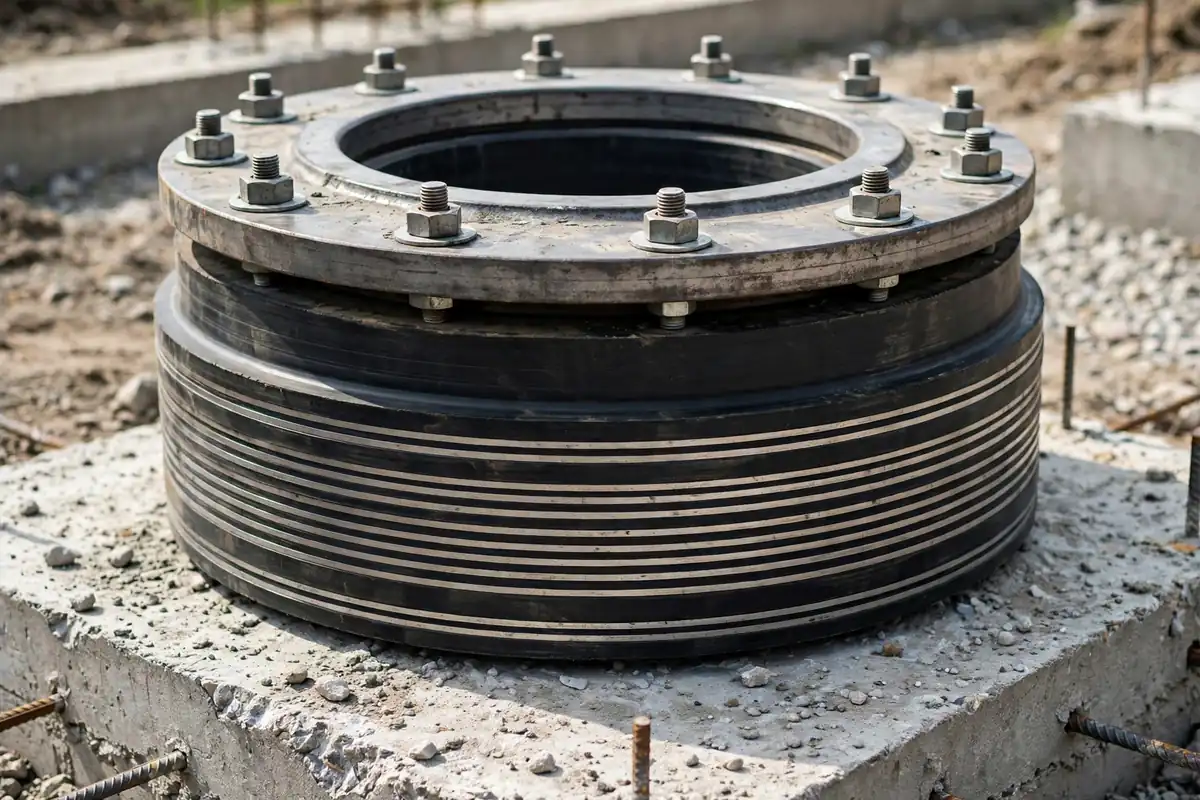
In plain language: “earthquake pills” are enormous rubber-and-steel bearings, shaped like giant pills or hockey pucks, installed between a building’s foundation and the structure above. When the ground lurches sideways, the bearings flex and absorb the motion — the earth moves, the building stays eerily still.
The nickname exploded on TikTok and social media, where viral videos show buildings visibly floating on rows of these bearings — looking, unmistakably, like a structure resting on giant pills.

How Do Earthquake Pills Work?
Think of them as shoe insoles for skyscrapers:
- Placement: the bearings sit between the foundation (which moves with the ground) and the building above (which you want to keep still).
- During a quake: the ground jerks sideways — but instead of that motion slamming into the rigid structure, the bearings’ rubber layers flex horizontally, absorbing the displacement.
- The anatomy: alternating layers of rubber (flexibility) and steel plates (vertical strength to carry the building’s immense weight), often with a lead core that deforms plastically to dissipate energy as heat.
- The physics: isolation lengthens the building’s natural period — shifting it away from the earthquake’s most destructive frequencies. Instead of resonating with the shaking (like a tuning fork), the building rides above it.
- Re-centering: after the shaking stops, the bearings’ elasticity pulls the building back toward its original position — no permanent lean.
The result, captured in countless test videos: shake the table violently, and the model building on top barely sways. It’s genuinely mesmerizing to watch.
Types of Base Isolation
| Type | How It Works | Best For |
|---|---|---|
| Lead-rubber bearings (LRB) | Rubber + steel + lead core; the lead yields to absorb energy | Most common — the classic “pill” |
| High-damping rubber bearings | Special rubber compounds provide damping without lead | Where lead is undesirable |
| Friction pendulum bearings | The building slides on a curved dish; gravity re-centers it like a pendulum | Heavy structures, bridges |
| Oil / viscous dampers | Shock absorbers — convert motion to heat via fluid resistance | Often combined with bearings |
| Triple friction pendulum | Multiple sliding surfaces for different quake intensities | Critical facilities in high-seismic zones |
Engineers often combine types — bearings for isolation plus dampers for extra energy absorption — tailoring the system to the building’s weight, height, and local seismic risk.
Famous Buildings on “Pills”
- San Francisco City Hall: retrofitted with 530 isolators after the 1989 Loma Prieta earthquake — one of the largest isolation retrofits in the world.
- Los Angeles City Hall: sits on over 400 bearings — a 1920s landmark floated on modern “pills.”
- California hospitals: state law effectively requires base isolation (or equivalent performance) for hospitals — because hospitals must keep functioning after a quake, not just stay standing.
- Apple Park (Cupertino): the “spaceship” campus reportedly uses base isolation — fitting for a building designed to survive the San Andreas.
- Japan: the world leader — thousands of isolated buildings, from hospitals to apartment towers. After the 2011 Tōhoku quake, isolated buildings dramatically outperformed conventional ones.
- Bridges: isolation bearings are standard on long-span bridges in seismic zones — the deck floats on bearings atop the piers.
History: From Ancient Tombs to TikTok
- ~550 BC: the Tomb of Cyrus the Great in Pasargadae (Persia) used a form of base isolation — two stone platforms separated by lead sheets, an intuitive grasp of decoupling millennia before the engineering theory.
- Ancient Greece: some temples used layers of sand or timber between foundation and structure — early vibration-damping intuition.
- 1974: Dr. Bill Robinson in New Zealand invents the lead-rubber bearing — the breakthrough that made modern base isolation practical and affordable.
- 1980s–90s: adoption spreads through Japan, the US, Italy, and New Zealand; landmark retrofits (SF City Hall) prove the concept at scale.
- 1994 Northridge / 1995 Kobe: major quakes become real-world tests — isolated buildings perform strikingly well, accelerating adoption.
- 2011 Tōhoku: Japan’s isolated buildings ride out the magnitude-9.0 quake; the footage cements base isolation’s reputation.
- 2020s: TikTok virality — videos of buildings “on pills” introduce millions to the concept, coining the nickname “earthquake pills.”

Do They Really Work?
Yes — with evidence from real earthquakes:
- Measured performance: in instrumented buildings, isolation typically reduces floor accelerations by 3–5× compared to fixed-base buildings — the difference between “terrifying but fine” and “catastrophic.”
- 2011 Tōhoku: isolated hospitals in the affected region remained operational; conventional buildings nearby suffered severe non-structural damage (falling ceilings, toppled equipment — often the real danger).
- Content protection: isolation protects not just the structure but everything inside — surgical equipment, data centers, museum collections. For hospitals and labs, this matters as much as the building surviving.
- Limits: isolation doesn’t make buildings “earthquake-proof” — no engineering does. Extremely large near-fault displacements can exceed a bearing’s capacity, and vertical shaking is harder to isolate than horizontal. The honest claim: isolation dramatically reduces damage, it doesn’t eliminate risk.
- Cost: isolation adds roughly 5–10% to construction cost — but can pay for itself in a single quake through avoided damage and downtime, especially for critical facilities.
Why Are They Called “Pills”?
The nickname is pure visual logic: lead-rubber bearings are short, round cylinders — squat drums of dark rubber banded with steel — and a building foundation lined with dozens of them looks like it’s resting on a tray of giant pills.
The name caught fire because it’s perfect internet language: instantly visual, slightly absurd, and more memorable than “elastomeric seismic base isolation bearings.” It follows the same path as other engineering nicknames — the “speed bump”, the “spaghetti junction” — where the public renames a technical thing by what it looks like.
Engineers, for the record, still say “isolators” or “bearings.” But “earthquake pills” is what the internet decided — and the internet usually wins.
Base Isolation vs Other Earthquake Engineering
Base isolation is one of several strategies engineers use against earthquakes:
| Strategy | How It Works | Analogy |
|---|---|---|
| Base isolation (“pills”) | Decouples building from ground motion | Shock absorbers under the building |
| Reinforcement | Strengthens the structure to resist forces | Armor — take the hit |
| Damping | Absorbs energy within the structure (tuned mass dampers, viscous dampers) | Cushioning inside the walls |
| Ductile design | Allows controlled flexing without collapse | Willow bending instead of breaking |
Modern seismic design combines these: a hospital might sit on isolators (“pills”) and use ductile framing and internal dampers. Isolation handles the big motion; the other strategies handle what remains. It’s defense in depth — the same philosophy as wearing both a seatbelt and having airbags.
Frequently Asked Questions
What are earthquake pills?
Seismic base isolation bearings — giant rubber-and-steel cylinders placed under buildings to absorb earthquake motion.
Why are they called “pills”?
Because they look like giant round pills — the nickname went viral on TikTok.
How do earthquake pills work?
They sit between foundation and building; their rubber layers flex sideways during a quake while steel plates carry the weight and a lead core absorbs energy.
Do earthquake pills actually work?
Yes — real quakes (notably 2011 Tōhoku) show isolated buildings suffer far less damage; floor accelerations drop 3–5×.
Are buildings on earthquake pills earthquake-proof?
No — nothing is earthquake-proof. Isolation greatly reduces damage but can’t eliminate all risk.
Where are earthquake pills used?
Hospitals, city halls, bridges — and thousands of buildings in Japan, the world leader in base isolation.
Who invented them?
The modern lead-rubber bearing was invented by Dr. Bill Robinson (New Zealand) in 1974.
How much do earthquake pills cost?
Isolation adds roughly 5–10% to construction cost — often recovered in avoided damage from a single major quake.
Can old buildings get earthquake pills?
Yes — it’s called seismic retrofitting. SF and LA City Halls were both lifted and placed on isolators decades after construction.
How do you use “earthquake pills” in a sentence?
“The new hospital sits on earthquake pills — base isolators that absorb seismic shocks.”
What’s the biggest building on base isolation?
Among the largest: Apple Park in Cupertino and numerous Japanese high-rises — some exceeding 50 stories — all floating on isolation systems.
Related engineering terms on SpellProf: EOD meaning, MOQ meaning.
Source: For the engineering details, see Wikipedia’s article on seismic base isolation.