
EMP Meaning: What EMP Stands For & How It Works
Quick answer: EMP stands for electromagnetic pulse — a brief, intense burst of electromagnetic energy that can disrupt or damage electronic devices. Also called a transient electromagnetic disturbance, an EMP induces a sudden voltage surge in conductors: unprotected circuits — power grids, vehicles, phones, computers — can malfunction or fail permanently. EMPs occur naturally (lightning, solar storms) and can be created artificially (high-altitude nuclear detonations). An EMP is not directly harmful to the human body — the danger is the aftermath: infrastructure going dark.
In this article
- What Does EMP Mean?
- How an EMP Works: The Physics in Plain Language
- Types of EMP: Natural and Artificial
- What an EMP Actually Does to Electronics
- What an EMP Does NOT Do
- How Big an Area Does One Burst Affect?
- Real Historical Events
- Protection Basics: Shielding and Faraday Cages
- EMP in Pop Culture
- Example Sentences Using EMP
- Frequently Asked Questions
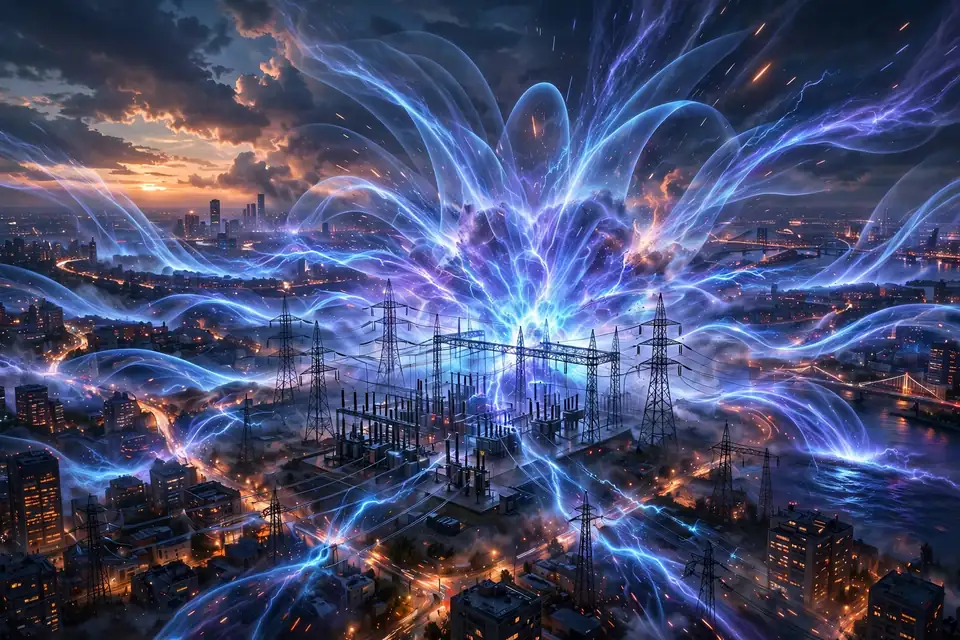
What Does EMP Mean?
EMP stands for electromagnetic pulse — a short, powerful burst of electromagnetic energy that can interfere with or destroy electrical and electronic equipment — also called a transient electromagnetic disturbance: “transient” because it lasts a fraction of a second, “disturbance” because it disrupts anything conductive it reaches.
The defining trait is speed and intensity: an EMP rises and falls far faster than ordinary surges, which is why it is dangerous to electronics — circuits can be overwhelmed before they have time to react. A lightning strike frying a router is the everyday example; a high-altitude nuclear EMP is the extreme version of the same physics, scaled to continental size.
The term appears in engineering and military planning, science writing, and popular fiction (where it is often exaggerated). Like other technical acronyms that crossed into everyday speech — our guide to FTP meaning traces a similar path — EMP moved from specialist vocabulary into headlines. This article covers the real physics first and the mythology second.
How an EMP Works: The Physics in Plain Language
An EMP damages electronics through electromagnetic induction — the principle behind generators. When a rapidly changing magnetic field passes through a conductor (a wire, a circuit trace, a power line), it induces an electric current in it. An EMP does this violently and everywhere at once:
- The burst. An enormous energy release — a lightning channel, a solar eruption, a nuclear detonation — radiates electromagnetic energy outward.
- The field sweeps over conductors. Every wire, cable, and antenna experiences a rapidly changing field — long conductors like power lines act as antennas, collecting far more energy than small devices.
- Voltage spikes. The changing field induces huge, fast surges — thousands of times larger than what equipment was designed for.
- Components fail. Delicate semiconductor junctions overheat and break down; protective devices are overwhelmed by the spike’s speed. Equipment either malfunctions or is permanently destroyed.
Two facts make EMPs hard to defend against: they arrive at the speed of light (no time to unplug anything), and the most vulnerable components are the most modern — microchips are more delicate than old vacuum tubes, so an electronic society is more exposed.
Types of EMP: Natural and Artificial
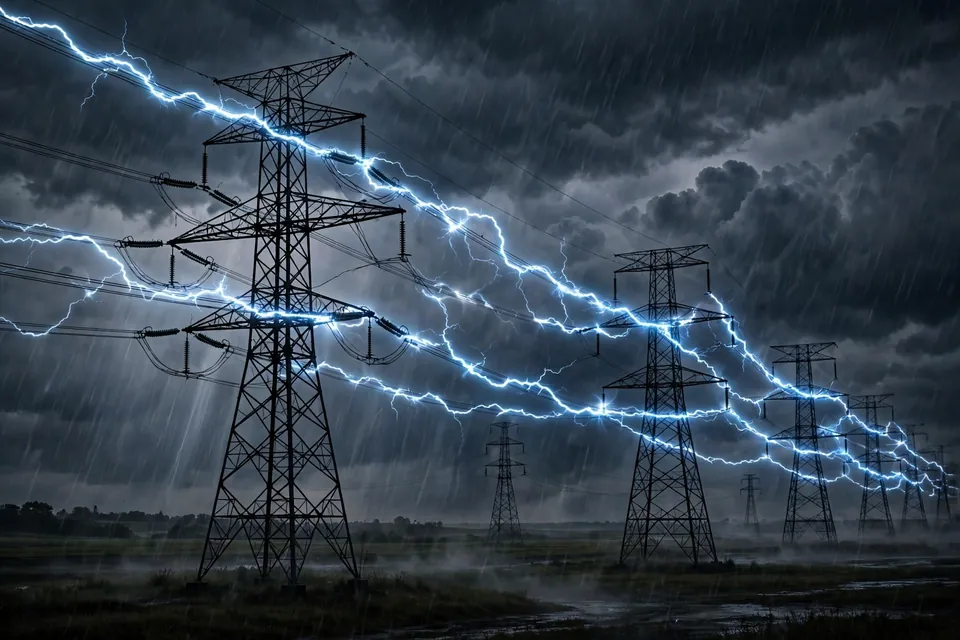
EMPs come from very different sources — and the differences matter for how seriously to take each one:
| Type | Source | Scale | Notes |
|---|---|---|---|
| Lightning EMP | Lightning strikes | Local — a building or a few blocks | Common. The everyday EMP; grounding and surge protectors handle most of it. |
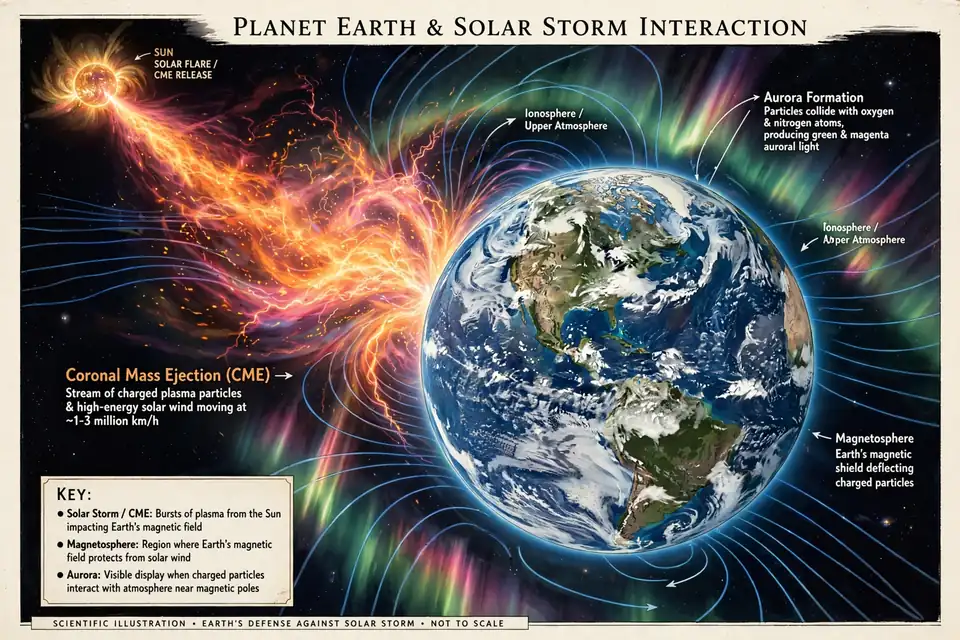
| Solar / geomagnetic storm | Coronal mass ejections from the Sun | Continental to global | Inevitable eventually. The 1859 Carrington Event is the benchmark. |
| High-altitude nuclear EMP | Nuclear detonation high above Earth | Continental | Rare by design — the scenario of most military planning. |
| Non-nuclear devices | Flux-compression generators, directed energy | Tactical — a building or a convoy | Real but limited. Short range, military applications. |
The key split: nature produces EMPs constantly, while the artificial kinds — especially high-altitude nuclear EMP — are human choices that live mainly in strategic-planning documents. Lightning protection is building code; HEMP hardening is a specialized military discipline.
What an EMP Actually Does to Electronics
Against electronics, an EMP is brutally effective:
- Microchips and semiconductors are the most vulnerable. A fast, high-voltage spike punches through transistor junctions, causing permanent shorts. Phones, computers, and car engine controllers are densely packed with these.
- Power grids: long transmission lines collect enormous induced currents that can melt large transformers — custom-built, slow to replace, and the grid’s most fragile link.
- Vehicles: modern cars rely on dozens of electronic control units. A strong EMP can disable engine management and dashboards; older vehicles with minimal electronics are far less affected.
- Communications: cell towers, radios, and satellite ground stations have exposed antennas and sensitive receivers — the most exposed components of all.
- Data and storage: unshielded drives and memory can be corrupted or wiped; offline backups in shielded storage are the standard mitigation.
The pattern holds: the more advanced and interconnected the electronics, the harder the hit. Simple devices — bulbs, basic motors, unpowered tools — are largely unaffected.
What an EMP Does NOT Do
Fiction has given the EMP a mythology that outruns the physics. The real risks differ from the imagined ones:
- It does not directly harm the human body — an EMP is not ionizing radiation. The danger is entirely indirect: hospitals losing power, vehicles stalling, communications going dark.
- It does not cause an explosion — no blast or fireball from the EMP itself. High-altitude EMPs are invisible, possibly with no visible sign at all.
- It does not destroy everything permanently. Shielded or simply unplugged and disconnected equipment often survives — a device in a drawer with its battery removed is far safer than one plugged into the wall.
- It is not a magic “reset button.” Fiction loves an EMP that neatly disables only the enemy’s tech. Reality is indiscriminate: a large EMP degrades everything unprotected in its footprint.
Knowing what an EMP cannot do focuses attention on the real vulnerabilities — grids, vehicles, and communications — instead of science-fiction scenarios.
How Big an Area Does One Burst Affect?
The footprint depends on the source and altitude, and the numbers are dramatic:
- Lightning: equipment within roughly a few hundred meters of the strike — occasionally further through wiring.
- High-altitude nuclear EMP: a single high-altitude detonation can expose a continental-scale area, as the energy interacts with the upper atmosphere and magnetic field over a huge region — one device, continental consequences.
- Solar storms: a severe coronal mass ejection can disturb the entire sun-facing side of the planet. The 1859 Carrington Event affected telegraph systems worldwide.
- Non-nuclear devices: tactical ranges — a building, a city block, a convoy. Powerful locally, irrelevant at distance.
Altitude is the multiplier for artificial EMPs: the higher the detonation, the wider the exposed area. The takeaway is simple: the biggest EMPs are the ones you cannot see coming and cannot outrun.
Real Historical Events
EMPs are not hypothetical — history has already run the experiments:
- The Carrington Event (1859): the largest solar storm ever recorded. It set telegraph wires sparking, shocked operators, and produced auroras near the equator. In 1859 the world ran on telegraphs; the same storm today would strike a civilization built on microchips and continental grids.
- Starfish Prime (1962): a US high-altitude nuclear test over the Pacific that knocked out streetlights in Hawaii (roughly 1,400 km away) and disabled several satellites.
- The 1989 Quebec blackout: a strong geomagnetic storm collapsed Quebec’s power grid in 90 seconds, leaving millions without electricity. A natural EMP, in the modern era, with a modern casualty: the grid.
- The 2003 Halloween solar storms: powerful eruptions that damaged satellites and disrupted GPS — a reminder that Carrington-scale events are a matter of when, not if.
Each event refined the science — and confirmed the same lesson: the infrastructure is more fragile than the physics is forgiving.
Protection Basics: Shielding and Faraday Cages
EMP protection is a real engineering discipline; the concepts are straightforward, even if industrial implementation is expensive:
- The Faraday cage: an enclosure of conductive material that routes electromagnetic energy around its interior. A sealed metal box or an unplugged microwave demonstrates the principle — but continuity matters: gaps and attached cables defeat the shielding.
- Disconnect and isolate: equipment that is unplugged, with batteries removed and no long cables attached, is far less vulnerable — no conductor acts as an antenna. Offline spares stored this way are standard practice in critical industries.
- Surge protection and grounding: industrial surge arrestors and shielded cabling blunt the slower components of a pulse, though they are less effective against the fastest HEMP components.
- Hardened design: military and critical-infrastructure equipment is built to EMP-hardened standards — shielded enclosures, filtered power inputs, tolerant components — from the blueprint stage, not as an add-on.
- Grid-level measures: utilities can install blocking devices against geomagnetically induced currents and keep spare large transformers — the long-lead-time component whose loss turns a blackout into a months-long outage.
The honest summary: perfect protection is impractical, but substantial protection is routine for anything designed with the threat in mind. The vulnerable systems are the ones built without considering it — most consumer electronics and much of the civilian grid.
EMP in Pop Culture
The EMP has a second life as a cultural idea. Fiction uses it as a clean way to disable technology: the power dies, the cars stop, the phones go dark. A shelf of post-apocalyptic fiction is built on “grid-down” scenarios — stories really about infrastructure dependence, with the EMP as trigger. In preparedness communities it is a standard scenario discussed in practical terms (backup power, communication plans), and every solar storm warning brings EMP explainers back into headlines, mixing genuine science with hype. Knowing the real physics — especially the what-it-does-NOT-do section above — is the best defense against the hype cycle.
Example Sentences Using EMP
- “Engineers built the control room as a Faraday cage to protect it from EMP interference.”
- “A severe solar storm can produce a natural EMP strong enough to trip power grids across a continent.”
- “The military’s EMP-hardened radios kept working when everything else went silent.”
Our guide to SNAFU meaning covers another military-born term that crossed into everyday language — EMP followed a similar path from defense jargon to common vocabulary.
Frequently Asked Questions
What does EMP stand for?
EMP stands for electromagnetic pulse — a brief, intense burst of electromagnetic energy that can disrupt or damage electronics, also called a transient electromagnetic disturbance.
Can an EMP hurt humans?
Not directly. An EMP is not ionizing radiation and does not harm the human body. The danger is indirect — grids, vehicles, hospitals, and communications failing.
What causes an EMP?
Natural and artificial sources: lightning, solar storms, high-altitude nuclear detonations, and specialized non-nuclear devices.
What is a high-altitude EMP (HEMP)?
An EMP from a nuclear detonation high above Earth, exposing a continental-scale area — the scenario of most military planning.
Would my phone survive an EMP?
Probably not if powered on and connected — modern phones are packed with semiconductors. A phone powered off, unplugged, and shielded has a far better chance.
What is a Faraday cage?
An enclosure of conductive material that routes electromagnetic energy around its interior — the foundational concept of EMP protection.
Did the Carrington Event really happen?
Yes — in 1859 the largest recorded solar storm set telegraph wires sparking worldwide. Scientists treat a repeat as a matter of when, not if.
What happened during Starfish Prime?
A 1962 US high-altitude nuclear test that knocked out streetlights in Hawaii about 1,400 km away — the clearest demonstration of high-altitude EMP effects.
Source: For the technical definition, history, and physics of electromagnetic pulses, see Wikipedia’s article on electromagnetic pulse.