“…” Meaning in Text: What the Three Dots Really Mean
Quick answer: In texting, “…” (the ellipsis) most often signals that a thought is unfinished, hesitant, or trailing off — compare the flat finality of “Yes.” with the loaded uncertainty of “Yes…”. Depending on context it can mean awkward silence, passive-aggression, flirtation, suspense, or simply be someone’s typing habit (a noted generational marker — heavy ellipsis use reads as “over 60” to younger texters). It is also the typing indicator: three dots in a chat bubble mean the other person is composing a message. Formally, the ellipsis (…) marks omitted words or a pause.
In this article
- What Does “…” Mean in a Text?
- The Feelings Behind the Dots: A Field Guide
- Is “…” Passive-Aggressive?
- The Generational Divide
- Ellipsis vs. Other Punctuation in Texts
- The Other Three Dots: The Typing Indicator
- What “…” Means on Different Platforms
- The Ellipsis in Formal Writing
- How to Reply to “…”
- Frequently Asked Questions
What Does “…” Mean in a Text?
Three little dots carry an astonishing amount of weight. The mark is called an ellipsis (plural: ellipses), from the Greek élleipsis, “to leave out” — and “left out” is exactly what it communicates: something has been left unsaid.
In texting, “…” is the written equivalent of trailing off mid-sentence. “Yes” is an answer; “Yes…” is an answer with a shadow — reluctance, doubt, or a second half the sender chose not to type. Linguists call this implicature: meaning carried not by the words but by the deliberate gap around them. The dots invite (or force) the reader to fill in the blank, which is why the same three dots can feel flirty in one conversation and hostile in another. The dots themselves are neutral; the context does all the talking.
Formally, an ellipsis marks either an omission (“The witness said … and left the room” — words cut from a quotation) or a pause (“I thought he was…”). Texting simply took that pause-function and ran with it, turning a punctuation mark into a whole emotional vocabulary.
The Feelings Behind the Dots: A Field Guide
Here are the most common readings, roughly ordered from innocent to loaded:
- Thinking / trailing off: “I was going to say…” — the sender paused mid-thought. The most literal use.
- Hesitation: “I don’t know…” — uncertainty, reluctance to commit.
- Awkward silence: a lone “…” as a full reply often means “I have no response to that” — the textual shrug.
- Disappointment: “oh…” / “ok…” — the air going out of the conversation. Short message + dots is the classic danger combination.
- Passive-aggression: “fine…” / “whatever…” — technically agreement, emotionally a slammed door. (More on this below.)
- Suspense / teasing: “guess what…” / “wait for it…” — playful, common in captions and flirting.
- Flirtation: “hey…” with the right history can be an invitation; with the wrong history, a red flag.
- Disapproval without words: replying “…” to something inappropriate — a boundary set in three dots.
- Just a habit: some people type “…” the way others type commas. No emotion intended at all.
Notice how message length changes everything: a long, warm message ending in “…” reads as thoughtful trailing-off; a two-letter reply with “…” reads as cold. The dots amplify whatever the words already suggest.
Is “…” Passive-Aggressive?
Sometimes — and this is the reading that causes the most real-world friction. The passive-aggressive ellipsis works because it is deniable: “I just put dots, what’s the big deal?” But recipients consistently report that messages like “ok…”, “sure…”, and “fine…” feel loaded, and they’re usually right. Research on digital communication keeps finding the same thing: punctuation carries tone, and in a medium with no facial expressions, a tiny mark does outsized emotional work.
Before accusing anyone of dot-based hostility, run this four-question check:
- Does this person always use dots? If yes, it’s style, not shade.
- Is the message short? Short + dots leans negative; long + dots usually doesn’t.
- Is there an emoji? A 😂 or 😉 after the dots almost always makes them friendly.
- Did the conversation just get tense? If yes, the dots are probably carrying that tension.
And the mirror advice: if you don’t want to sound passive-aggressive, don’t end short replies with “…” unless you mean the edge. “Ok” and “ok…” are different messages.
The Generational Divide
Here’s a genuinely useful piece of texting anthropology: heavy ellipsis use is a generational marker. Many people over 60 use “…” the way younger people use line breaks or commas — as a soft separator between thoughts. It comes from the era of letters and postcards, where space was precious and an ellipsis marked “new idea” without wasting a line. They mean absolutely nothing by it.
Recipients under 35, raised on messaging apps where every mark is scrutinized, often read those same dots as ominous. This mismatch — grandma’s friendly “…” landing as dread — is one of the most common and most innocent miscommunications in digital life. If the dots come from a parent or older relative, assume warmth until proven otherwise.
The reverse happens too: younger texters’ period-at-the-end-of-a-text (“Ok.”) reads as abrupt or angry to them, while older texters see it as simply correct punctuation. Every generation weaponizes punctuation differently.
Ellipsis vs. Other Punctuation in Texts
The dots don’t operate alone — texters read every mark as tone. How “…” compares:
| Ending | How it reads | Example |
|---|---|---|
| No punctuation | Neutral, casual, the modern default | “ok” — just an answer |
| Period | Final, firm — can read as abrupt or angry in texts | “Ok.” — conversation closed |
| Exclamation | Warm, enthusiastic, friendly | “Ok!” — happy to help |
| Ellipsis | Unfinished — hesitant, trailing, or loaded | “Ok…” — …but? |
This is why punctuation fights happen: the sender typed a neutral period out of grammar habit, and the recipient read anger. Studies of digital communication consistently show that in texting — a medium with no voice or face — punctuation does the emotional heavy lifting. The ellipsis is simply the hardest-working mark of all, because “unfinished” is the most ambiguous tone there is. When in doubt, the exclamation mark is the safest warm signal in casual texting; the ellipsis is the one that always asks to be interpreted.
The Other Three Dots: The Typing Indicator
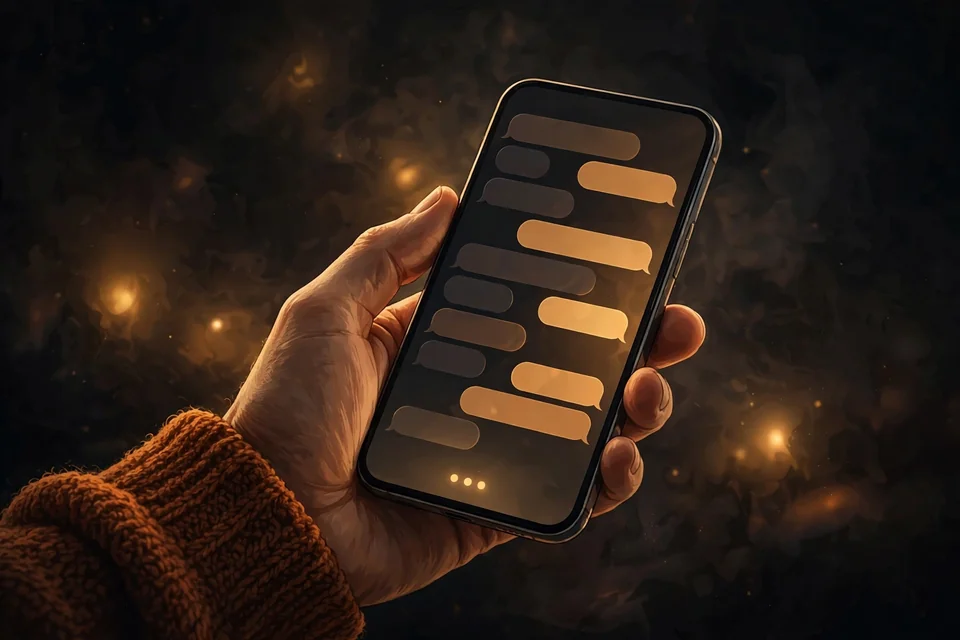
Separate from the punctuation mark is the typing awareness indicator — the three animated dots (●●●) that appear in iMessage, WhatsApp, Messenger, and most chat apps when the other person is composing a message. A few things worth knowing:
- It means typing started, not that a message is coming — people abandon drafts constantly, so dots that vanish with no message are normal.
- On iMessage, the indicator can linger for a few seconds after typing stops.
- You can turn it off: on iPhone, Settings → Messages → toggle off typing indicators (wording varies by iOS version); WhatsApp has similar privacy settings.
- The dancing dots are also why “…” as punctuation feels so charged — your brain has been trained to read three dots as “something is about to happen.”

What “…” Means on Different Platforms
| Platform | Typical reading of “…” |
|---|---|
| iMessage / WhatsApp | Personal chats: hesitation, disappointment, or just habit |
| Instagram / TikTok captions | Suspense and storytelling — “wait for it…” |
| Snapchat | Playful or flirty between friends |
| Slack / Teams / work email | Risky — can read as unprofessional or passive-aggressive; use complete sentences instead |
| Dating apps | Flirty/teasing — or, with shrinking replies, losing interest |
Workplace rule: in professional writing, the ellipsis should appear only in its formal roles (omissions in quotes, deliberate pauses). Ending a Slack message to your manager with “…” is how misunderstandings are born.
For more texting slang decoded, see our guides to ASL meaning in slang and PMO meaning in slang.
The Ellipsis in Formal Writing
Outside texting, the ellipsis follows actual rules — and style guides disagree about the details:
- AP Stylebook: three periods with no spaces between them: …
- Chicago Manual of Style: three periods separated by spaces: . . .
- The single character: … (U+2026) — most phones auto-convert three typed periods into this; it means the same thing.
- Four dots: a period plus an ellipsis (….) marks an omission at the end of a quoted sentence — Chicago and APA recommend it.
- Two vs. three vs. many: purists use exactly three; texters use “..” for a light pause and “….” or more for extra drama. In formal writing, stick to three.
How to Reply to “…”
Got hit with a cryptic “…” and don’t know what to do? Match the move to the situation:
- If it’s clearly a habit (they always do it): ignore the dots entirely and reply to the words.
- If it feels loaded: ask directly — “Did I say something wrong?” or “What do you mean by that?” beats three hours of spiraling.
- If it’s flirty: play along or set the boundary — the dots are an invitation to interpret, so interpret deliberately.
- If it’s a shutdown (“…” as the whole reply to something inappropriate): take the hint. It means this conversation is over.
- If you’re the one typing it: re-read before sending. If you wouldn’t say the sentence out loud with a meaningful pause and a look, don’t send it with dots.
Frequently Asked Questions
What does “…” mean in texting?
Usually that a thought is unfinished, hesitant, or trailing off. Context decides whether it’s awkward, flirty, passive-aggressive, or just habit.
Is “…” rude in a text?
Not always. It’s only rude when the context is negative — short replies like “ok…” or “fine…” lean hostile; long messages with dots usually don’t.
What do the three dots mean on iPhone messages?
Two things: as punctuation, an ellipsis (unfinished thought); as the animated typing indicator, it means the other person is composing a message.
Why do old people use “…” so much in texts?
It’s a generational habit from the letter/postcard era, where an ellipsis separated thoughts without wasting space. They almost never mean anything negative by it.
What does “…” (one character) mean vs “…” (three periods)?
The same thing. Phones often auto-convert three periods into the single … character (U+2026).
Does the number of dots matter?
A little: “..” is a light casual pause, “…” is the standard ellipsis, and “….” or more adds drama or a longer awkward silence.
Should I use “…” at work?
Better not. In work chats it can read as passive-aggressive or unprofessional — use complete sentences instead.
What should I reply to “…”?
If it feels loaded, ask directly (“What do you mean?”). If it’s someone’s habit, just reply to the words and ignore the dots.
What is an ellipsis in grammar?
A punctuation mark of three dots indicating omitted words, a pause, or a thought trailing off — from Greek élleipsis, “to leave out.”
Can “…” mean flirting?
Yes, in the right context — “hey…” or “guess what…” can be playful or teasing. With strangers or after something inappropriate, it more likely means disinterest or disapproval.
Source: For the full history of the punctuation mark, see Wikipedia’s article on the ellipsis.