DWI Meaning: What Does DWI Mean?
Quick answer: DWI stands for Driving While Intoxicated (in some states, Driving While Impaired). It is the legal term for operating a motor vehicle while affected by alcohol or drugs. Whether a state uses DWI or DUI (Driving Under the Influence) depends on that state’s laws — the two terms often describe the same offense, but in a few states they are separate charges with different BAC thresholds and penalties.
In this article

What Does DWI Stand For?
DWI most commonly stands for Driving While Intoxicated. In a handful of states, the same letters stand for Driving While Impaired instead. Either way, it names the criminal offense of operating a motor vehicle — a car, truck, motorcycle, or in some states even a boat — while your mental or physical abilities are affected by alcohol, drugs, or a combination of both.
The word “while” is doing real work in the phrase. DWI laws punish driving while intoxicated, not drinking itself. A driver who drank earlier but is no longer impaired is not committing a DWI; a driver who is impaired behind the wheel is, even if they feel “fine.” That distinction is why traffic stops so often turn on observable behavior — weaving between lanes, delayed reactions, the smell of alcohol — rather than on how much someone reports having had to drink.
DWI is an acronym, not a slang term. It appears in state statutes, police reports, court records, and news coverage. If you see it on paperwork or in a headline, it is almost always being used in its legal sense, the way affidavit or mitigation are used — as precise legal vocabulary rather than casual language.
DWI vs DUI: What’s the Difference?
This is the question almost everyone asks, and it is also the parent keyword behind this article’s topic: is DUI and DWI the same thing? The honest answer is it depends on the state.
In most of the United States, DUI (Driving Under the Influence) and DWI are simply two names for the same offense. A state legislature picks one term for its statute books, and that is the term everyone in the state uses. California charges DUI. Texas charges DWI.
In a few states, however, both terms exist in the law as separate offenses with different thresholds:
| State | How the terms differ |
|---|---|
| Maryland | DUI is the more serious charge (BAC of 0.08% or higher); DWI is a lesser charge for impairment with a BAC between 0.07% and 0.08%. |
| Texas | DWI is the standard adult charge; DUI applies only to drivers under 21 with any detectable alcohol in their system. |
| Colorado / New York | DUI is the main charge; DWAI (Driving While Ability Impaired) covers lower-level impairment. |
The practical takeaway: the letters alone do not tell you how serious a charge is. Read the elements of the offense in the relevant state — the BAC number and the statutory language — rather than assuming DWI is always worse than DUI or vice versa. Two drivers with identical BAC readings can face differently named charges in different states for the same behavior.
Which States Use DWI?
There is no single national list that never changes, because legislatures occasionally rename offenses. But as a general picture, the states most associated with the term DWI include Texas, New York, New Jersey, New Mexico, Minnesota, Missouri, Louisiana, Arkansas, and North Carolina. States that use DUI as their primary term include California, Florida, Arizona, Georgia, Tennessee, and Washington.
Other states use their own acronyms for the same idea:
- OWI — Operating While Intoxicated (Indiana, Iowa, Michigan, Wisconsin)
- OUI — Operating Under the Influence (Massachusetts, Maine, Rhode Island)
- OVI — Operating a Vehicle under the Influence (Ohio)
- DUII — Driving Under the Influence of Intoxicants (Oregon)
- DWUI — Driving While Under the Influence (Wyoming)
Notice that several states say “operating” rather than “driving.” That wording can matter in court: in some places, sitting behind the wheel of a running car while intoxicated can count even if the car never moves. Like the military-born SNAFU, DWI is an acronym whose exact expansion shifts with the institution using it.
The Legal Meaning of DWI
Legally, DWI has two pillars: operation of a vehicle and intoxication or impairment at the time of operation. Prosecutors typically prove the second pillar in one of two ways.
1. “Per se” intoxication — the BAC number. In every U.S. state, a blood alcohol concentration of 0.08% or higher is illegal per se for drivers 21 and over. “Per se” means the number alone is enough — the state does not have to prove you were visibly impaired. Lower thresholds apply to commercial drivers (0.04%) and drivers under 21 (0.02% or even zero tolerance, depending on the state).
2. Observable impairment. A driver can also be charged with a DWI below the 0.08% threshold if there is evidence of impairment: failing field sobriety tests, slurred speech, erratic driving, or the officer’s observations. This is why “I was under the limit” is not automatically a defense.
Importantly, DWI is not alcohol-only. Prescription medications, over-the-counter drugs that cause drowsiness, cannabis, and illegal drugs can all support a DWI charge if they impair driving ability. Many drivers are surprised to learn that a legally prescribed medication can lead to the same charge as alcohol — the law cares about impairment, not about whether the substance was legal to possess.
How Is a DWI Detected?
A DWI case usually begins with a traffic stop and builds through a sequence of tests:
- Observation: weaving, speeding, or delayed stops give the officer a reason for the stop.
- Field sobriety tests: the walk-and-turn, one-leg stand, and horizontal gaze nystagmus tests — standardized exercises used to establish probable cause.
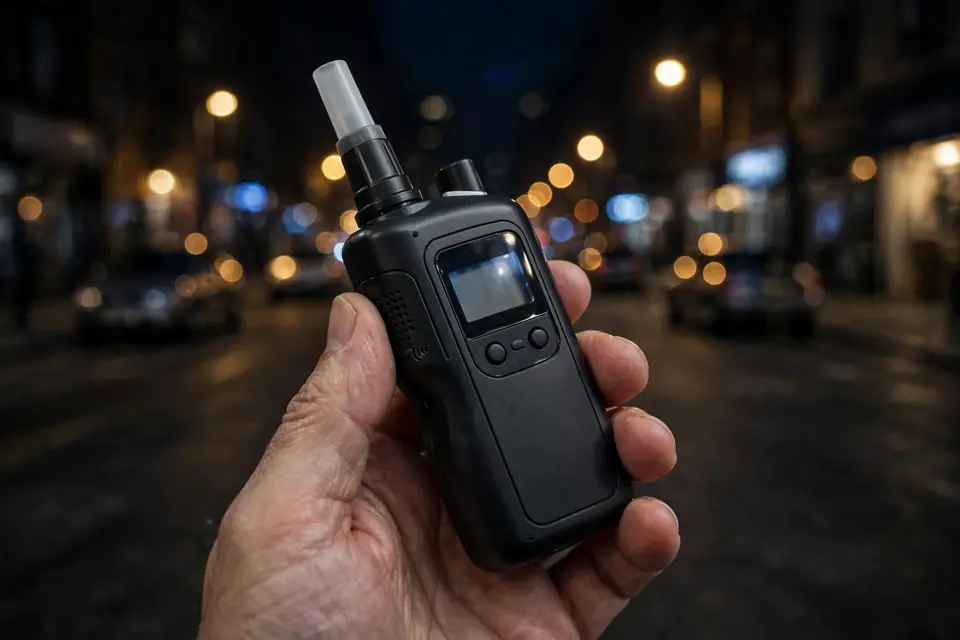
- Preliminary breath test: a handheld breathalyzer at the roadside estimates BAC.
- Chemical test: after arrest, an evidentiary breath, blood, or urine test produces the BAC number used in court. Refusing this test usually triggers automatic license suspension under “implied consent” laws.
What Are the Penalties for a DWI?
Penalties vary widely by state and by circumstances, but a first-offense DWI in most states is a misdemeanor carrying some combination of fines, license suspension, and possible jail time. Typical first-offense consequences include:
- Fines ranging from several hundred to a few thousand dollars
- Driver’s license suspension, often 90 days to a year
- Possible jail time, often up to 6–12 months for a first offense (frequently suspended or served as probation)
- Mandatory alcohol education or treatment programs
- Ignition interlock device requirements in many states
- Points on the driving record and sharply higher insurance premiums
Penalties escalate for aggravating factors: a very high BAC, a crash causing injury or death, having a child passenger, or repeat offenses. Multiple DWIs can become felonies in many states. A DWI conviction also stays on driving and criminal records and can affect employment, especially for jobs involving driving.
Note: this is general information about how DWI laws typically work, not legal advice. Laws change and differ by state. Anyone facing a charge should consult a licensed attorney in their jurisdiction.

DWI and Related Terms
DWI sits inside a whole family of impaired-driving acronyms. Here is how the common ones relate:
| Term | Stands for | Where you’ll see it |
|---|---|---|
| DWI | Driving While Intoxicated / Impaired | Texas, New York, New Jersey, and others |
| DUI | Driving Under the Influence | California, Florida, Arizona, and most states |
| OWI | Operating While Intoxicated | Michigan, Indiana, Iowa, Wisconsin |
| OUI | Operating Under the Influence | Massachusetts, Maine, Rhode Island |
| DWAI | Driving While Ability Impaired | Colorado, New York (lesser offense) |
| BAC | Blood Alcohol Concentration | Everywhere — the measurement at the heart of these laws |
Outside the courtroom, you may also hear DWI used loosely to mean any drunk-driving incident (“he got a DWI last year”), the way people say “I got a DUI” even in DWI states. In everyday speech the terms have largely merged; only in statutes do the distinctions still bite.
Where Did the Term DWI Come From?
The concept of punishing drunk driving predates the automobile’s mass era — New York passed one of the first laws against it in 1910. The acronym DWI rose to prominence as states codified traffic laws through the mid-20th century, each legislature choosing its own label.
The modern framework took shape with the push for a uniform 0.08% BAC limit. Through the 1980s and 1990s, advocacy groups and federal highway funding incentives drove states toward the 0.08 standard; by the early 2000s, all 50 states had adopted it. The acronyms stayed regional even as the numbers converged — which is why the same 0.09% reading is a DWI in Texas, a DUI in California, and an OWI in Michigan.
Frequently Asked Questions
What does DWI stand for?
DWI stands for Driving While Intoxicated in most states that use the term, or Driving While Impaired in a few others. It is the legal name for the offense of operating a vehicle while affected by alcohol or drugs.
Is a DWI the same as a DUI?
In most states, yes — they are two names for the same offense, and which one you see depends on the state’s laws. In a few states (like Maryland and Texas), they are legally distinct charges with different BAC thresholds or different classes of drivers.
Is DWI worse than DUI?
Not automatically. The seriousness depends on the state’s statute, not the letters. In Maryland, DUI is the more serious charge and DWI the lesser one; in Texas, DWI is the standard adult charge while DUI applies to minors. Always check the specific state’s law.
What BAC is a DWI?
In every U.S. state, a BAC of 0.08% or higher is illegal per se for drivers 21 and over. Commercial drivers face a 0.04% limit, and drivers under 21 face 0.02% or zero-tolerance limits depending on the state.
Can you get a DWI for drugs, not alcohol?
Yes. DWI laws cover impairment by any substance — illegal drugs, cannabis, and even prescription or over-the-counter medications that impair driving ability. The charge is about impairment, not about which substance caused it.
Can you get a DWI on a bike or a boat?
It depends on the state. Many states’ DWI statutes cover motor vehicles broadly, and some extend to boats (often called BUI — boating under the influence). Non-motorized bicycles are usually covered by separate laws, if at all.
What happens if you refuse a breathalyzer?
Under implied consent laws in most states, refusing the evidentiary chemical test after arrest triggers an automatic license suspension, separate from any criminal case. The roadside preliminary test and the post-arrest evidentiary test have different refusal rules.
How long does a DWI stay on your record?
It varies by state — commonly 5 to 10 years on a driving record for lookback purposes (how prior offenses count toward enhanced penalties), and potentially permanently on a criminal record unless expunged where the law allows it.
What’s the difference between DWI and DWAI?
DWAI (Driving While Ability Impaired) is a lesser offense used in states like Colorado and New York for impairment below the 0.08% threshold — for example, a BAC between 0.05% and 0.079% in Colorado. It carries lighter penalties than a full DWI/DUI.
Does DWI mean the same thing outside the U.S.?
Other countries use different terms — the UK prosecutes “drink driving,” Canada uses “impaired driving,” and Australia uses “drink driving” or “drug driving.” The acronym DWI is primarily American legal vocabulary.
Source: For national data on impaired driving laws and enforcement, see the National Highway Traffic Safety Administration’s drunk driving overview.