
C-Suite Meaning: What C-Suite Means in Business
Quick answer: The C-suite is a company’s top level of executives — the senior leaders whose job titles start with “Chief,” such as the CEO (Chief Executive Officer), CFO (Chief Financial Officer), COO (Chief Operating Officer), CTO (Chief Technology Officer), and CMO (Chief Marketing Officer). The “C” comes from “chief,” and the term has been in use since about 1998. C-suite executives set company strategy, make the biggest decisions, and answer to the board of directors, sitting above vice presidents and directors. In startups the C-suite may be two or three people wearing many hats; in large corporations it can include a dozen specialized chiefs.
In this article
- What Does C-Suite Mean?
- Why the “C”? The Origin of the Term
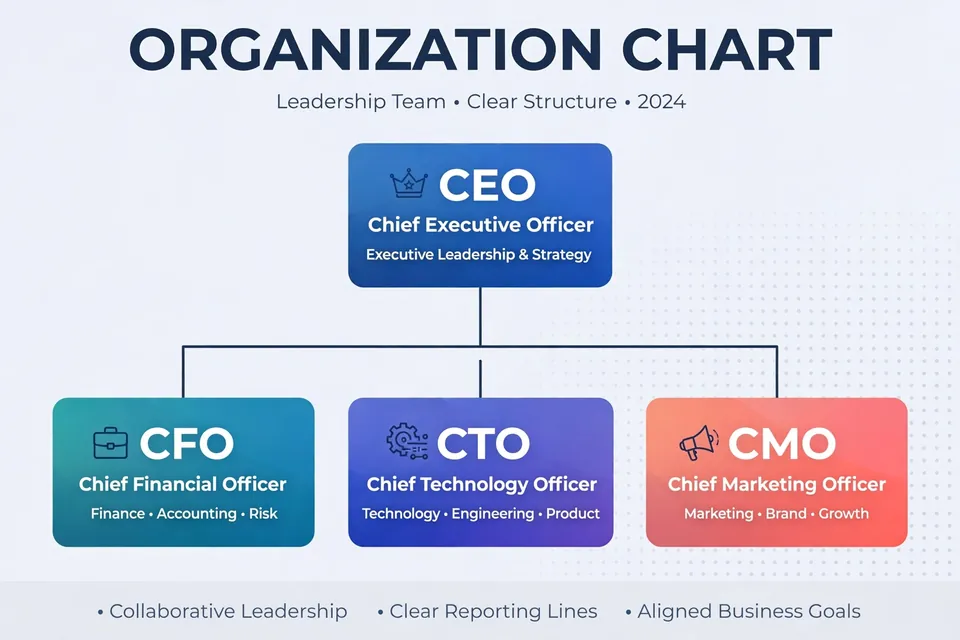
- The Core C-Suite Roles
- What the C-Suite Actually Does Day to Day
- C-Suite vs Board of Directors vs VPs: Clearing Up the Confusion
- The C-Suite in Startups vs Big Corporations
- How People Reach the C-Suite
- C-Suite in Example Sentences
- Frequently Asked Questions

What Does C-Suite Mean?
The C-suite is the collective name for an organization’s highest-ranking executives — the small group of senior leaders who run the company. The name comes from the fact that their titles almost all begin with the word “Chief”: Chief Executive Officer, Chief Financial Officer, Chief Operating Officer, and so on.
In everyday business language, “the C-suite” is shorthand for “top management.” When someone says “the C-suite approved the merger” or “this needs C-suite buy-in,” they mean the decision came from — or needs to come from — the company’s most senior leadership, not middle management.
A few key points define the term:
- It is a group, not a person. Nobody’s job title is “C-suite” — it describes the tier of executives taken together.
- It implies authority over strategy. C-suite leaders decide what the company does — direction, budgets, acquisitions — not just how it does it.
- It sits at the top of the management chain. Below come executive vice presidents, VPs, and directors; above sits only the board of directors.
- It is used across industries. Tech, finance, healthcare, retail, nonprofits — any sizable organization can have a C-suite, though the exact mix of roles varies.
The term is business jargon with a precise meaning — and it appears constantly in job postings, business news, and corporate announcements.
Why the “C”? The Origin of the Term
The “C” simply stands for “Chief.” The pattern goes back to the CEO — Chief Executive Officer — a title that became standard in American corporations during the 20th century as companies grew too large for a single “president” to describe the top job. As organizations added more senior roles with company-wide authority, they followed the same naming pattern: Chief Financial Officer, Chief Operating Officer, Chief Information Officer, and the family kept growing.
Business writers eventually needed a collective noun for this top tier — and “C-suite” fit perfectly. The “suite” part is a play on words: it suggests both a suite of offices (the executive floor) and a suite in the musical sense (a set of related pieces forming a whole). Dictionaries date the term’s usage to around 1998, when it started appearing in business journalism during the dot-com boom, as startups invented new chief titles and the media needed language for the expanding executive layer. The term stuck and is now standard business English worldwide. You will also see “C suite” and “CSuite,” but the hyphenated form is standard.
The Core C-Suite Roles
Not every company has every chief — but most C-suites are built from the same core roles:
| Title | Full name | Main responsibility |
|---|---|---|
| CEO | Chief Executive Officer | The top executive — sets overall vision and strategy, makes final calls, represents the company publicly |
| CFO | Chief Financial Officer | Money — budgets, financial planning, reporting, fundraising, investor relations |
| COO | Chief Operating Officer | Day-to-day operations — the CEO’s second-in-command for execution |
| CTO | Chief Technology Officer | Technology strategy and engineering — the product’s technical foundation |
| CIO | Chief Information Officer | Internal systems and data — IT infrastructure and digital tools |
| CMO | Chief Marketing Officer | Brand and growth — marketing strategy and customer acquisition |
| CHRO | Chief Human Resources Officer | People — hiring, culture, compensation, talent development |
| CPO | Chief Product Officer | Product vision and roadmap — what gets built and why (common in tech) |
| CISO | Chief Information Security Officer | Security — protecting systems and data from threats |
A few clarifications worth knowing:
- CTO vs CIO is the classic confusion. Roughly: the CTO builds technology for customers (the product), while the CIO manages technology for employees (internal systems). In smaller companies one person often covers both.
- Not every “chief” is C-suite. Titles like “Chief of Staff” are senior but usually advisory roles to the CEO — the C-suite label is reserved for executives with company-wide functional authority.
- New chiefs keep appearing. Recent years have added the Chief AI Officer, Chief Data Officer, and Chief Sustainability Officer — reflecting whatever a company considers strategically vital at the moment.
What the C-Suite Actually Does Day to Day
The C-suite’s daily reality is less glamorous than the titles suggest — and more consequential. A C-suite executive’s week typically revolves around:
- Setting direction: translating strategy into priorities — what matters this quarter, what gets funded, what gets cut.
- Making high-stakes decisions: acquisitions, major hires, market entries, product bets — calls that cannot be delegated because the risk is company-level.
- Aligning the organization: meetings with other chiefs and their VPs, making sure finance, product, marketing, and operations pull in the same direction.
- Managing outward relationships: boards, investors, key customers, regulators, media — the company’s interface with the outside world.
- Leading through layers: developing the VPs and directors who run each function — measured in company outcomes (revenue, growth, profitability), not individual output.
One useful framing: VPs and directors manage work; the C-suite manages the company. A VP of engineering ships software; the CTO decides whether the company bets on AI or doubles down on its existing platform. That difference in altitude — execution vs. direction — is what the C-suite label really marks, and why C-suite news moves markets: when a CEO resigns, investors read it as a signal about the company’s direction, not just its staffing. For more on how business and tech shorthand works, see our guide to FTP meaning — another three-letter term that confuses newcomers until someone explains it plainly.
C-Suite vs Board of Directors vs VPs: Clearing Up the Confusion
Three layers of corporate leadership get mixed up constantly. Here is how they differ:
| C-suite | Board of directors | VPs and directors | |
|---|---|---|---|
| What they are | Senior executives who run the company | Overseers elected by shareholders | Managers who run departments |
| Employment | Full-time employees | Generally not employees; govern part-time | Full-time employees |
| Main job | Set strategy and execute it | Oversee and approve strategy; hire/fire the CEO | Execute within their department |
| Authority | Runs daily operations | Can overrule the CEO; approves major moves | Limited to their area |
| Accountability | Answer to the CEO and board | Answer to shareholders | Answer to the C-suite |
The most common confusion is C-suite vs board: the C-suite works at the company every day, while the board oversees it from above, meeting periodically. The CEO is the bridge — usually the only C-suite member who also sits on the board — which is why boards can hire and fire CEOs.
The other confusion is C-suite vs “executive” titles below it. “Executive vice president” sounds C-suite-level, but EVPs typically report to a chief. If someone needs a chief’s approval, they are not in the C-suite.
The C-Suite in Startups vs Big Corporations
The C-suite looks very different depending on company size — same label, different reality:
- Early startups: the “C-suite” is often two or three co-founders with grand titles and startup-sized jobs — the CEO is also the salesperson, the CTO also writes code. Titles here are partly aspirational, partly practical: customers and investors expect to talk to a CEO.
- Growing companies: the C-suite becomes real and full-time — typically when firms hire their first true CFO, formalize the COO role, and add a CMO as growth becomes a science rather than hustle.
- Large corporations: the C-suite expands and specializes — a dozen or more chiefs, each owning a global function. At this scale, chiefs rarely touch day-to-day work; they manage through their organizations, with much of their time going to the board, investors, and regulators.
There are structural variations: some companies skip the COO entirely, some merge CTO and CIO, and founder-led companies sometimes keep unusual titles. The C-suite is a convention, not a law — companies assemble the version that fits.

How People Reach the C-Suite
Nobody starts in the C-suite — most chiefs reach it in their 40s or 50s, following a recognizable pattern:
- Deep expertise first: future CFOs master finance, future CTOs master engineering — the C-suite is built on credibility in a function.
- Climbing the management ladder: individual contributor to manager to director to VP — each step adding scope (bigger teams, bigger budgets) and broadth (working across functions).
- Proving business impact: the jump from VP to C-suite requires thinking in company terms — revenue, strategy, risk — not just functional terms.
- Visibility and sponsorship: C-suite appointments are made by CEOs and boards, so being known and trusted by senior leadership matters enormously.
- Sometimes, a sideways move: many chiefs get there via a different company — a VP of marketing becomes a CMO at a smaller firm, then at a larger one. The title often arrives with the job change.
There is no single required credential — MBAs are common among CEOs and CFOs but far from universal. What unites C-suite careers is the shift from doing the work to deciding what work matters — and being accountable for the outcome.
Corporate life has its own colorful vocabulary for the climb — our guide to SNAFU meaning covers one of the military-born terms that migrated into office slang along the way.
C-Suite in Example Sentences
- “The C-suite approved the acquisition after months of negotiation.”
- “She joined the startup as CTO, becoming part of its three-person C-suite.”
- “Getting C-suite buy-in is the hardest part of selling enterprise software.”
- “In a company this small, the C-suite still answers customer support tickets.”
Frequently Asked Questions
What does C-suite mean?
The C-suite is a company’s top tier of executives — the senior leaders whose titles begin with “Chief,” such as the CEO, CFO, COO, CTO, and CMO. They set strategy and run the organization.
What does the “C” stand for in C-suite?
“Chief” — as in Chief Executive Officer. The term collectively describes all the chief-titled executives together.
When was the term C-suite first used?
The term dates to around 1998, emerging in business journalism during the dot-com era as companies multiplied their chief-level titles.
Who is in the C-suite?
Typically the CEO, CFO, COO, CTO, CIO, and CMO, plus others by company — CHRO, CPO, and CISO are common additions.
Is the CEO part of the C-suite?
Yes — the CEO is the head of the C-suite and usually its most prominent member, reporting to the board of directors.
What is the difference between the C-suite and the board of directors?
The C-suite runs the company day to day as full-time employees; the board oversees the company from above, approves major decisions, and hires or fires the CEO.
Are vice presidents part of the C-suite?
No. VPs and EVPs typically report to C-suite executives — senior management, but a layer below.
What is the difference between a CTO and a CIO?
Roughly: the CTO builds technology for customers (the product), while the CIO manages technology for internal operations. Smaller companies often combine the roles.
Source: For the dictionary definition and first-known use, see Merriam-Webster’s entry for C-suite.