
Barre Meaning: What Is Barre Workout?
Quick answer: Barre (pronounced “bar”) is a low-impact fitness workout that blends ballet, Pilates, and yoga into one routine. Named for the stationary ballet barre used for balance, it focuses on small, controlled isometric movements and high repetitions that fatigue muscles — the famous “barre shake” — building strength, flexibility, and posture without heavy weights or jumping. Created by dancer Lotte Berk in London in 1959, it’s now a global fitness category. No dance experience needed.
In this article

What Does Barre Mean?
Barre has two related meanings:
- The fitness workout: a low-impact group exercise format combining ballet-inspired movements, Pilates core work, and yoga flexibility — performed with a ballet barre for support.
- The physical bar: the horizontal handrail in ballet studios (from French barre, “bar”) that dancers — and now fitness participants — hold for balance.
Pronunciation: “bar” — the final “re” is silent, French-style. (Saying “bar-ee” marks you instantly as a beginner.)
The core principle: isometric contraction — holding still while contracting specific muscles. Instead of big dynamic movements, barre uses tiny one-inch pulses, sustained holds, and deep stretches that fatigue muscles to exhaustion. That trembling — the “barre shake” — is the point: muscles worked to failure rebuild stronger, all without stressing joints.
Not a dance class: despite the ballet vocabulary (pliés, relevés, tucks), barre is strength and conditioning, not choreography. You won’t learn routines; you’ll learn alignment, control, and endurance.
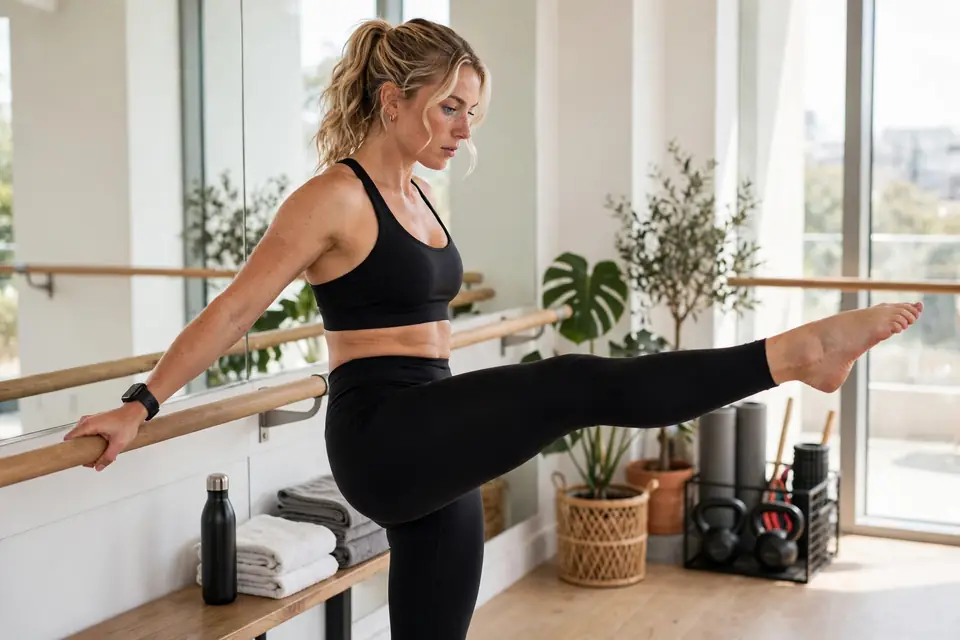
Why the barre matters: the bar isn’t decoration — it’s a biomechanical tool. Holding it lets you isolate muscles you’d otherwise stabilize with, forcing the target muscle to do all the work. It also enables safe single-leg work and deeper ranges of motion than free-standing exercise allows. The dancer’s support becomes the exerciser’s amplifier.
What Happens in a Barre Class?
A typical 45–60 minute class follows this arc:
- Warm-up (5–10 min): light cardio and dynamic stretching, often with planks and push-ups to wake up the core and arms.
- Arm work: light hand weights (1–3 lbs) with high-repetition bicep curls, tricep extensions, shoulder presses — the burn arrives fast.
- Barre work — legs and glutes: the heart of class. Holding the barre, you’ll do plié squats, leg lifts, pulses, and tucks — small movements, enormous burn. Each side gets isolated and exhausted before switching.
- Seat work: glute-focused exercises — donkey kicks, fire hydrants, pretzel — targeting the muscles sitting builds neglect.
- Core on the mat: Pilates-style ab work — curls, planks, oblique twists.
- Cool-down: yoga-inspired deep stretching — the reward for the shake.
Equipment: beyond the barre itself — resistance bands, yoga straps, Pilates balls, light weights. Participants wear yoga-style activewear and grippy socks (bare feet slip; regular socks slide).
The vibe: upbeat music, an instructor calling encouragement and corrections, a room of people shaking together. It’s hard but welcoming — low-impact means your neighbor might be 25 or 65.
The History of Barre: Lotte Berk’s Invention
1959, London: Lotte Berk, a German-born dancer, opened a studio after a back injury ended her performing career. Combining ballet training with rehabilitative exercise, she created a conditioning method that protected the spine while building strength — barre was born as injury rehab, not fitness trend.
Berk’s philosophy: she viewed it as an arts-based method, not “keep-fit” — reportedly disdaining the fitness label and wanting to be taken seriously as an artist. The irony: her artistic method became a fitness empire.
The spread: her daughter Esther Fairfax popularized it in the UK; former student Lydia Bach brought it to the US in 1971. Over decades it evolved into branded formats — Pure Barre, The Bar Method, Barre3 — and then into a generic category taught in 40+ countries.
Why it exploded (2010s): barre hit the sweet spot of modern fitness — low-impact (joint-friendly aging), efficient (full body in under an hour), aesthetic (the “long, lean” promise), and social (boutique studio culture). It survived where trends died because the method actually works.
Barre Vocabulary: Terms You’ll Hear
First class can feel like a foreign language. Here’s the essential glossary:
- Plié (plee-AY) — bending the knees while keeping the back straight; the foundation of barre leg work.
- Relevé (rel-uh-VAY) — rising onto the balls of the feet; builds calves and ankle stability.
- Tuck — tilting the pelvis under to engage deep core and glutes; the signature barre cue.
- Pulse — tiny up-and-down movements (an inch or less) that keep muscles under constant tension.
- Attitude / Arabesque — leg positions borrowed from ballet, used for glute and back work.
- First / Second position — foot placements (heels together vs. feet apart, toes out) that change which muscles fire.
- Flat back — hinging at the hips with a straight spine; the safe-power position for seat work.
Don’t memorize — instructors demonstrate everything. Within three classes, the vocabulary becomes muscle memory.
Barre vs Pilates vs Yoga vs Ballet
| Barre | Pilates | Yoga | Ballet | |
|---|---|---|---|---|
| Core idea | Ballet-inspired strength | Core control | Mind-body union | Artistic dance |
| Key method | Isometric pulses | Controlled core moves | Poses + breath | Choreography |
| Equipment | Ballet barre | Reformer/mat | Mat | Barre + stage |
| Impact | Low | Low | Low | High (jumps) |
| Cardio | Light–moderate | Light | Light (varies) | High |
| Goal | Strength + tone | Core + alignment | Flexibility + calm | Performance |
The overlap is the point: barre borrows deliberately — ballet’s positions, Pilates’ core, yoga’s stretch. If you like one, you’ll likely like barre; if you want pure cardio or heavy lifting, look elsewhere.
Benefits of Barre
- Total-body strength: high-rep, low-weight work builds muscular endurance — the “long, lean muscle” barre is famous for.
- Posture: constant alignment cues retrain how you stand and sit — many report feeling taller within weeks.
- Flexibility: every class ends with deep stretching; range of motion improves steadily.
- Low-impact: no jumping, no pounding — joint-friendly for all ages and many injuries (with modifications).
- Core strength: the entire method is built on core engagement — abs work even during leg sets.
- Balance and proprioception: single-leg barre work sharpens stability — protective against falls as you age.
- Mind-body focus: the precision required demands presence — a moving meditation that reduces stress.
The honest caveat: barre builds endurance and tone, not maximal strength or significant cardio — pair it with walking, running, or weights for complete fitness. And as with any exercise, consult a doctor before starting if you have health concerns.
The “long, lean muscles” claim: barre marketing promises long, lean muscles — physiologically, muscles don’t lengthen from exercise (that’s genetics and posture). What barre actually delivers is improved muscle definition with low bulk (light weights don’t trigger hypertrophy) plus better posture, which genuinely makes you look longer. The promise is marketing poetry over an honest result.
Who Is Barre For?
Beginners: absolutely — classes are designed for all levels, with instructors offering modifications. Expect to be humbled (the movements look easy; they aren’t) and welcomed.
Dancers: a natural fit — the vocabulary is familiar, the workout complements dance training.
Older adults: the low-impact, balance-focused format is ideal — many studios have dedicated 50+ participants.
Prenatal/postnatal: many studios offer modified classes — but always clear it with your doctor first.
What to bring: water, grippy socks, and humility — the shake comes for everyone. What not to expect: tutus, choreography, or judgment.
First-class survival tips: tell the instructor you’re new (they’ll watch your form), grab a spot near the middle (not the front mirror, not the back corner), take breaks when you need them (shaking to failure is the goal; collapsing is not), and don’t compare — the regular beside you has done this 200 times. Everyone’s first class is humbling; everyone’s tenth is addictive.
Frequently Asked Questions
What does barre mean?
A low-impact fitness workout blending ballet, Pilates, and yoga — named for the ballet barre used for balance.
How do you pronounce barre?
“Bar” — French-style, silent “re.”
Is barre a good workout?
Yes — for strength endurance, posture, flexibility, and low-impact fitness; pair with cardio for completeness.
Do you need dance experience for barre?
No — it’s strength training with ballet vocabulary, not a dance class.
Who invented barre?
Lotte Berk, a German dancer, in London in 1959 — originally as back-injury rehabilitation.
What is the “barre shake”?
The muscle trembling from isometric fatigue — a sign the targeted muscles are working to exhaustion.
Is barre better than Pilates?
Different, not better — barre emphasizes standing leg/glute work; Pilates emphasizes core on mat/reformer. Many do both.
Can beginners do barre?
Yes — classes offer modifications; expect it to feel harder than it looks.
What do you wear to barre?
Yoga-style activewear and grippy socks (studios often sell them).
How often should you do barre?
2–4 times weekly is typical for results; muscles need rest days between intense sessions.
Does barre build muscle?
It builds muscular endurance and tone — not bulk; the light weights and high reps favor lean definition.
Is barre low-impact?
Yes — no jumping or pounding, making it joint-friendly across ages.
What’s the difference between Pure Barre and barre?
Pure Barre is a branded franchise; “barre” is the generic workout category — like Kleenex vs. tissue.
Can barre help posture?
Yes — constant alignment work retrains posture; one of its most-reported benefits.
What should I eat before barre?
A light snack 1–2 hours before (banana, toast) — the isometric work is surprisingly draining on empty.
Is barre good for weight loss?
It tones and strengthens; meaningful fat loss needs cardio + nutrition alongside — barre alone is not a weight-loss program.
Source: For an expert overview of barre exercise, see Cleveland Clinic’s guide to barre.