Lily of the Valley Meaning: What Does Lily of the Valley Mean?
Quick answer: Lily of the valley symbolizes the return of happiness — joy coming back after hardship — along with humility, purity, and good luck. This tiny white bell-shaped spring flower (Convallaria majalis, French muguet) is the May birth flower, the centerpiece of France’s May 1st Fête du Muguet, a favorite of royal brides, and — despite its innocence — thoroughly poisonous. In Christian legend it’s called “Our Lady’s Tears,” said to have sprung from the Virgin Mary’s tears at the cross.
In this article

What Does Lily of the Valley Mean?
In the language of flowers, lily of the valley (Convallaria majalis) carries one of the most beloved messages in all of floriography: the return of happiness. It blooms in late spring, right when winter’s hardship gives way to warmth — so for centuries it has stood for joy coming back, hope renewed, better days arriving.
Layered around that core meaning:
- Humility — the tiny bells nod downward, half-hidden beneath broad leaves; the flower’s posture reads as modesty.
- Purity and innocence — the clean white bells tied the plant to virtue long before bridal bouquets.
- Good luck — French tradition holds that a sprig received on May 1st brings a year of fortune.
- True love and devotion — its sweetness and delicacy made it a romantic emblem, “the desire to bring renewed happiness to a loved one.”
- Motherly love and consolation — through the “Our Lady’s Tears” legend, it speaks of comfort in grief.
No other flower packs quite this combination — sweetness with a shadow: every meaning is gentle, yet the plant itself is dangerously toxic. That tension is part of its fascination.
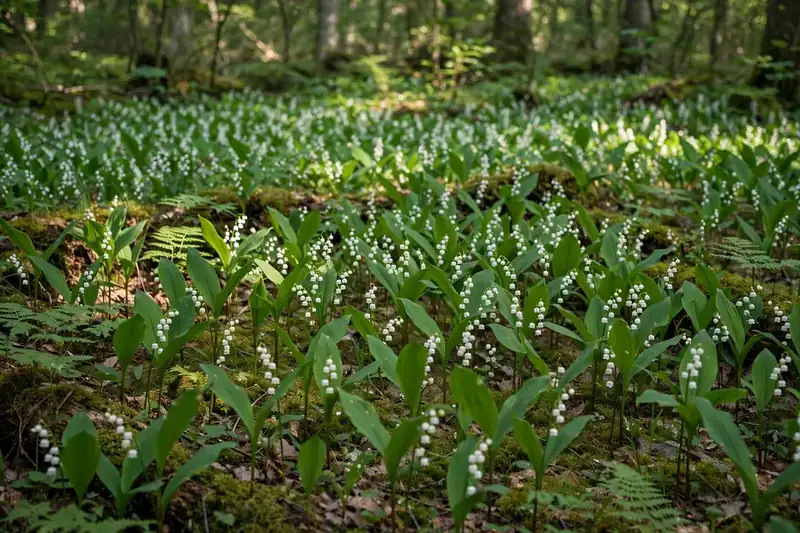
Botanically, it’s a study in quiet confidence: a low-growing perennial (15–30 cm) that spreads by underground rhizomes into dense woodland carpets, thriving in shade where showier flowers fail. Two broad leaves frame each arching stem of 5–15 nodding bells, and the scent — intensely sweet, green, unmistakable — can perfume an entire garden from a single patch. Gardeners prize it as ground cover; florists prize it as fragrance; everyone else prizes it as meaning.
The Language of Flowers
Lily of the valley’s meanings come from floriography — the Victorian-era “language of flowers,” in which every bloom carried a coded message lovers and friends could exchange without words. In that system, sending lily of the valley said: “happiness is returning to you” — the perfect message for reconciliations, recoveries, and new beginnings.
The flower’s physical traits wrote its own dictionary entry. It blooms in May (renewal), its bells hang downward (humility), it’s white (purity), and it spreads as a woodland carpet (quiet abundance rather than showy display). Victorian flower dictionaries barely needed to invent symbolism — the plant announced it.
Color variations carry their own shades: white (the classic) means purity and a return to happiness; pink (Rosea variety) suggests gentle affection; the green-tinged bells speak of renewal and spring’s freshness. For more symbolic meanings in nature, see dragonfly.
Legends and Religious Symbolism
Few flowers carry as many sacred stories:
- Eve’s tears: one legend says lily of the valley first bloomed where Eve’s tears fell as she was cast from the Garden of Eden — sorrow transformed into beauty.
- Our Lady’s Tears: in Christian tradition, the flower sprang from the Virgin Mary’s tears at the foot of the cross — giving it themes of motherly love, purity, and consolation in suffering.
- Apollo’s gift: Greek legend holds that Apollo created the flower to carpet the forest floor beneath the feet of his Muses — a divine floor covering.
- Celtic luck: in Celtic tradition the flower was believed to bring happiness and ward off evil — an early version of its good-fortune meaning.
- The Bible: the name echoes the biblical “lily of the valleys” from the Song of Songs 2:1 — though scholars note the biblical flower was likely a different species; European herbalists attached the phrase to Convallaria in the 15th–16th centuries.
These stories share a pattern: tears becoming flowers, grief becoming grace. Lily of the valley is the botanical embodiment of consolation — which is why it appears at both weddings and funerals.
May Day in France
Nowhere is the flower more beloved than France, where May 1st is La Fête du Muguet — Lily of the Valley Day. On this public holiday, the French exchange small sprigs and bouquets of muguet as tokens of good luck; the flowers are even sold tax-free on street corners by tradition.
The custom dates to May 1, 1561, when King Charles IX received a sprig of lily of the valley as a lucky charm during a visit and was so charmed that he began presenting bouquets to the ladies of his court every May Day. The fashion spread through French society and never left — through the Belle Époque, when Parisian seamstresses gifted sprigs to clients, to today, when millions of stems change hands each spring.
The French call a sprig a porte-bonheur — literally a “bringer of happiness.” It’s the national flower of Finland too (since 1967), and was the national flower of the former Yugoslavia — a small flower with an outsized diplomatic career.
Royal Weddings and Pop Culture
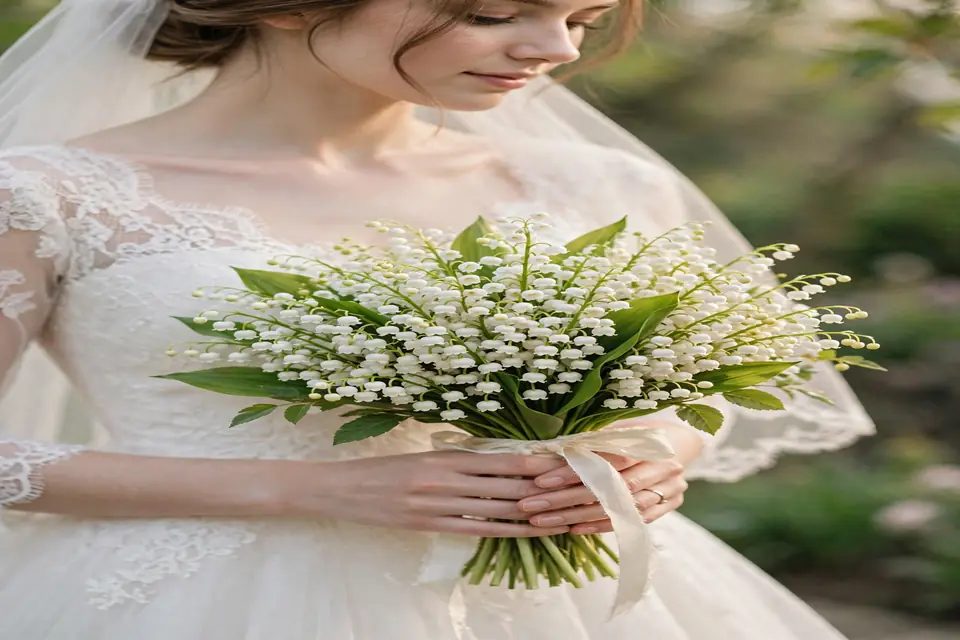
Lily of the valley is the royal bride’s flower. Kate Middleton carried it in her 2011 wedding bouquet; Princess Diana did the same in 1981; Grace Kelly wove it into her 1956 bouquet. The choice is never accidental — the flower’s meanings (purity, humility, return of happiness) read as a bridal manifesto.
Beyond weddings, the flower perfumes culture itself: the classic fragrance Muguet de Bois (Coty, 1941) bottled its scent; Christian Dior’s Diorissimo (1956) was built around it — Dior considered lily of the valley his lucky flower. In Britain, a folk song called “Lily of the Valley” is still sung in Cornish pubs on Flora Day. Sweet, bridal, lucky — the flower’s public image is all light.
Beautiful but Poisonous
Here the story turns: every part of lily of the valley is toxic — flowers, leaves, stems, and especially the red berries. It contains cardiac glycosides (convallatoxin and related compounds) that can cause nausea, vomiting, irregular heartbeat, and in severe cases cardiac arrest. There is no safe folk-medicine use; historical claims (Stevenson’s Kidnapped praised “lilly of the valley water” for gout) have no scientific support.
Practical cautions: keep it away from children and pets who might eat the berries; wear gloves if handling large quantities; and never confuse it with wild garlic (ramsons), whose leaves look similar in spring — foragers have been poisoned by the mistake. The vase water itself becomes toxic, so don’t let pets drink it.
The toxicity deepens the symbolism rather than contradicting it: beauty with boundaries. Like many beloved things, lily of the valley rewards admiration at a respectful distance.
Giving Lily of the Valley
When is this flower the right gift? Its message — renewed happiness — suits:
- Reconciliations: the classic “let’s be happy again” flower.
- New mothers (May babies): it’s the May birth flower, paired with hawthorn.
- Weddings: purity, humility, devoted love.
- Sympathy: consolation and “Our Lady’s Tears” comfort — appropriate for funerals.
- Good-luck wishes: the French porte-bonheur tradition, job interviews, new homes.
Avoid giving it where its toxicity matters — households with curious toddlers or pets — and note that its powerful scent can overwhelm small rooms. For romantic symbolism, pair it with knowledge of beloved — the language of devotion in words.
Frequently Asked Questions
What does lily of the valley symbolize?
The return of happiness — plus humility, purity, good luck, and true love.
What is the spiritual meaning of lily of the valley?
Consolation and renewed joy — in Christian legend (“Our Lady’s Tears”) it represents comfort in suffering and purity of heart.
Is lily of the valley poisonous?
Yes — all parts are toxic, especially the berries. It contains cardiac glycosides dangerous to humans and pets.
Why is lily of the valley given on May 1st in France?
The Fête du Muguet tradition dates to 1561, when King Charles IX gave the flower as a good-luck token; it symbolizes happiness for the coming year.
What is the May birth flower?
Lily of the valley (with hawthorn) — representing sweetness, humility, and the return of happiness.
What does lily of the valley mean in the Bible?
The name echoes Song of Songs 2:1 (“lily of the valleys”); Christian tradition links it to the Virgin Mary’s tears (“Our Lady’s Tears”).
Why do royal brides carry lily of the valley?
For its symbolism of purity, humility, and devoted love — carried by Kate Middleton, Princess Diana, and Grace Kelly.
Can you grow lily of the valley at home?
Yes — it’s a hardy shade-loving perennial (zones 2–7), but it spreads aggressively and is toxic, so plant thoughtfully away from children and pets.
What does a lily of the valley tattoo mean?
Renewed happiness, purity, and humility — often chosen as May birth-flower ink or a memorial of loved ones.
Is lily of the valley lucky?
In French tradition, yes — a sprig received on May 1st (porte-bonheur) is believed to bring a year of good fortune.
What’s the difference between lily of the valley and lily?
Despite the name, it’s not a true lily — true lilies are Lilium species; lily of the valley is Convallaria majalis, in the asparagus family.
Does lily of the valley come back every year?
Yes — it’s a hardy perennial that returns each spring, spreading via underground rhizomes.
What scent does lily of the valley have?
An intensely sweet, green, fresh fragrance — famously captured in perfumes like Diorissimo; a single patch can scent a whole garden.
Source: For the flower’s symbolism (“return of happiness”) and cultural traditions, see the Royal Horticultural Society’s guide to the meaning of flowers.