Gyaru Meaning: Japan’s Bold ‘Gal’ Fashion Subculture Explained
Quick answer: Gyaru (Japanese: ギャル, pronounced “gyah-roo”) is a Japanese fashion subculture whose name comes from the English slang word “gal.” Born in 1970s Tokyo, it exploded in 1990s Shibuya as a rebellion against Japan’s traditional beauty ideals — pale skin, dark hair, quiet conformity. Instead, gyaru embraced tanned skin, bleached hair, dramatic makeup, and bold Western-influenced fashion. Key branches include kogal (schoolgirl style), ganguro (extreme tan), and gyaruo (the male version). After fading in the 2010s, gyaru is now enjoying a Reiwa-era revival.
In this article
- What Does Gyaru Mean?
- Where Did Gyaru Come From?
- The Gyaru Look: Key Elements
- Gyaru Substyles: Kogal, Ganguro, and More
- Shibuya, Egg Magazine, and the Peak Years
- Gyaruo: The Male Gyaru
- Decline and the Reiwa Revival
- Gyaru’s Global Influence
- Gyaru vs. Lolita vs. Harajuku Fashion
- Frequently Asked Questions

What Does Gyaru Mean?
Gyaru means “gal” — it is simply the Japanese transliteration (ギャル) of the English slang word for a girl or young woman. But in Japan the word grew into something much bigger than a synonym for “girl”: it names a fashion subculture, an attitude, and for a time, a social phenomenon that defined a generation of Tokyo youth.
At its core, gyaru is about deliberate, visible self-construction. Where mainstream Japanese beauty culture prized pale skin, dark straight hair, subtle makeup, and modest dress, gyaru flipped every one of those values: deep tans, bleached-blonde hair, heavy eye makeup, platform boots, and miniskirts. The look was loud on purpose. It said, in the middle of rule-bound 1990s Japan: I am here, I am fabulous, and I don’t need your approval.
Early on, the subculture was considered racy and was associated with juvenile delinquency — teenage girls with tans and dyed hair read as rebellious in a society that expected young women to be quiet, studious, and marriage-minded. Over time, though, gyaru matured into a recognized (if still provocative) style movement with its own magazines, brands, celebrities, and even government cultural recognition — Japan’s Ministry of Foreign Affairs has promoted gyaru fashion abroad alongside Lolita fashion as a Japanese cultural export.
Where Did Gyaru Come From?
Gyaru’s roots reach back to the 1970s, when American fashion brands like Levi’s and Wrangler used the word “Gals” in advertising their women’s lines — one popular theory for how the term entered Japanese youth slang. Early gyaru was simply slang for a lively, sociable young woman, not yet a fashion movement.
The fashion side began with bodikon (body-conscious) style in the late 1980s — tight, glamorous clubwear — which radicalized through the early 1990s into dyed chapatsu (brown) and blonde hair, tanned skin, and barely-there clothing. The catalyst was Namie Amuro, the Okinawan pop star whose natural tan, mini skirts, and platform boots were copied by millions of teenage fans. When bodikon’s followers pushed the look further — darker tans, bigger hair, heavier makeup — the media started calling them gyaru, and the subculture was born.
The timing mattered. Japan’s bubble economy had burst, the “lost decades” were beginning, and a generation of young women was coming of age in an economy that no longer promised them the secure futures their mothers had. Gyaru’s flashy consumerism — designer bags, expensive tans, constant shopping — was, among other things, a bright, defiant answer to national gloom.

The Gyaru Look: Key Elements
Across its many substyles, gyaru has a recognizable visual grammar:
- Hair: bleached blonde, light brown, or vivid colors; long, often with extensions, curls, and teased volume. Dark roots were not a flaw — they were part of the aesthetic.
- Skin: tanned, sometimes extremely so (the ganguro extreme). This was the single most rebellious element in a culture that prized bihaku (beautiful white skin).
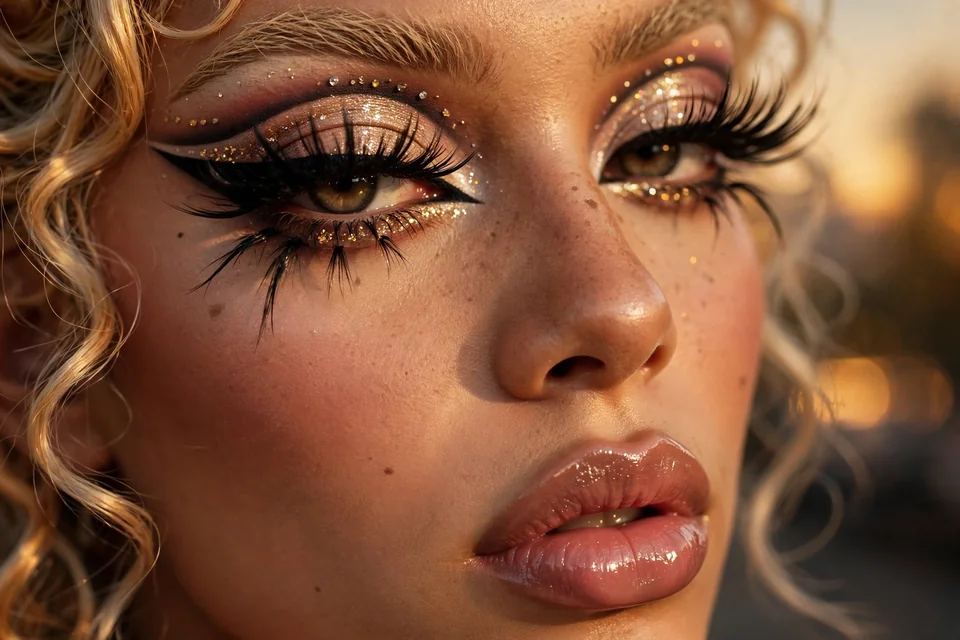
- Makeup: dramatic eyes — extended eyeliner drawn below the natural lash line, heavy false lashes top and bottom, bright under-eyes — with contoured faces and glossy or nude lips. The technique is deliberately visible, not “natural.”
- Nails: long, decorated, often 3D nail art — a gyaru signature as recognizable as the hair.
- Fashion: miniskirts, platform boots, fur-trimmed everything, animal prints, and later, brand-heavy luxury (Louis Vuitton, Chanel) mixed with Shibuya 109 fast fashion.
- Attitude: the slang term gyaru-go (gal language) — playful, exaggerated speech — plus a performative sociability. Being gyaru was as much about how you acted as how you looked.
Gyaru Substyles: Kogal, Ganguro, and More
Gyaru splintered into dozens of named substyles. The most important:
| Substyle | Era | Signature look |
|---|---|---|
| Kogal (kogyaru) | Early–mid 1990s | School uniform hacked into fashion: shortened skirts, loose socks (loose socks slouching around the ankles), dyed brown hair, designer bags. Affluent private-school girls were the pioneers. |
| Ganguro | Late 1990s–early 2000s | The extreme: deep dark tan, white lipstick and eye makeup in stark contrast, bleached hair, platform boots, bright stickers and accessories. |
| Yamanba / Manba | Early 2000s | Ganguro pushed further: even darker tan, white makeup above and below the eyes, colorful Hawaiian-style clothing. Named after the mountain witch of folklore. |
| Hime gyaru | Late 2000s | “Princess gal”: the tan dropped away in favor of elegant, Rococo-inspired dresses, curls, tiaras, and pink luxury — gyaru gone romantic. |
| Agejo | 2000s–2010s | Hostess-inspired glamour: sexy, polished, expensive-looking, from the pages of Koakuma Ageha magazine. |
| Neo-gyaru / Reiwa gyaru | 2020s | The revival: classic elements (tan, blonde hair, bold eyes) mixed with modern streetwear and social-media polish. |
Each substyle was a response to the last — ganguro answered kogal’s relative tameness, hime gyaru answered ganguro’s extremity. The subculture was constantly arguing with itself, which is part of why it stayed culturally alive for so long.
Shibuya, Egg Magazine, and the Peak Years
No place mattered more than Shibuya — specifically the Shibuya 109 shopping complex, which functioned as the subculture’s laboratory. Trends were invented on its floors daily: a new way to tie loose socks, a new eyeliner shape, a new brand. What sold at 109 on Friday was on every gyaru in Japan by the following month.
The print engine was Egg magazine (founded 1995), the bible of gyaru culture, alongside Popteen, Ranzuki, and Koakuma Ageha. These magazines didn’t just report the subculture — they manufactured it, running reader-model (dokusha moderu) features that turned ordinary Shibuya girls into style icons with national followings. The feedback loop between street, shop, and magazine made gyaru the most commercially powerful youth subculture Japan had ever produced.
At its late-1990s/early-2000s peak, gyaru was unavoidable: dominating youth fashion, music videos, and advertising, and spilling into mainstream politics and media. It was, for a few years, simply what young Tokyo looked like.
Gyaruo: The Male Gyaru
Gyaru was overwhelmingly female, but it had a male counterpart: gyaruo (ギャル男, “gal man”). Gyaruo adopted the tanned skin, bleached or frosted hair, and flashy fashion — deep V-necks, flashy accessories, sculpted eyebrows — and hung around the same Shibuya territories. Magazines like Men’s Egg served the scene. Gyaruo never reached gyaru’s scale, but its existence underlines something important: gyaru was never really about femininity in the traditional sense. It was about visibility as a choice — refusing to blend in, whatever your gender.
Decline and the Reiwa Revival
By the early 2010s, gyaru was fading. Several forces converged: the original 1990s gyaru aged into their thirties and forties; Japan’s prolonged recession made extreme consumerist fashion feel exhausting; Egg magazine itself ceased print publication in 2014; and younger Japanese women gravitated toward tamer, “natural” beauty standards amplified by Instagram-era aesthetics.
Then came the surprise: in the Reiwa era (2019–present), gyaru started coming back. Egg relaunched, this time as a web and social-media brand, finding a new generation of readers. The revival — sometimes called neo-gyaru — keeps the signature elements (the tan, the blonde hair, the unapologetic eyes) but filters them through contemporary streetwear and TikTok-era self-documentation. What was once a rebellion against conformity has become, for Gen Z discoverers, a heritage style — proof that the look was always bigger than its era.
Our therian meaning guide covers another modern identity subculture, and BTS meaning traces how Asian pop culture went global — the same wave that carried gyaru’s aesthetics worldwide.
Gyaru’s Global Influence
Gyaru never stayed in Shibuya. By the mid-2000s, the aesthetic was visible across East and Southeast Asia — Hong Kong, Taiwan, and Thailand all developed local gyaru scenes, with their own magazines and 109-style shopping hubs. Western internet culture picked it up too: English-language forums and early YouTube tutorials taught gyaru makeup to teenagers in America and Europe who had never been to Japan, and the look’s DNA is clearly visible in later Western trends — the heavy contouring, dramatic lashes, and “baddie” makeup of the 2010s owe an obvious debt to gyaru’s visible-construction philosophy.
The subculture also pioneered things the mainstream later claimed: reader-model influencer culture (ordinary girls turned style stars, the direct ancestor of the Instagram influencer), nail art as identity, and the idea that makeup could be architectural rather than corrective — built to transform the face, not to fake a “natural” one. When today’s beauty creators talk about makeup as self-expression rather than enhancement, they are speaking gyaru’s language, whether they know it or not.
Gyaru vs. Lolita vs. Harajuku Fashion
Outsiders often lump Japan’s street styles together. They are distinct movements:
| Style | Core idea | Look |
|---|---|---|
| Gyaru | Rebellion via glamour; Western-influenced | Tan, blonde hair, bold makeup, sexy fashion |
| Lolita | Victorian/Rococo modesty as fantasy | Frilly dresses, bonnets, parasols; no connection to Nabokov’s novel |
| Harajuku (general) | Creative chaos; the district, not one style | Layered, colorful, mix-and-match experimentation |
| Mori kei | “Forest girl” naturalism | Earthy layers, soft and introverted |
Frequently Asked Questions
What does gyaru mean in Japanese?
It is the Japanese transliteration of English “gal” — but it names a whole fashion subculture, not just a girl.
How do you pronounce gyaru?
“Gyah-roo” — three crisp syllables, with the stress on the first.
What is the difference between gyaru and ganguro?
Ganguro is an extreme substyle of gyaru: the very dark tan with contrasting white makeup, peaking around 2000.
Is gyaru offensive?
Not inherently — it is a style label. Note, though, that in modern Japanese the word has picked up secondary connotations about women disengaged from conventional work/marriage norms, so context matters.
What is a gyaruo?
The male version of gyaru — tanned, bleached hair, flashy Shibuya fashion.
Is gyaru still a thing?
Yes — it is reviving. After fading in the 2010s, the Reiwa-era neo-gyaru movement (with Egg relaunched online) is bringing the look back.
What is kogal fashion?
The early-1990s schoolgirl branch of gyaru: shortened uniform skirts, loose slouchy socks, dyed brown hair, and designer bags.
Why did gyaru girls tan?
The tan was a deliberate rejection of Japan’s traditional pale-skin beauty ideal — the single most rebellious element of the look.
What magazines were important to gyaru?
Egg (the bible, founded 1995), plus Popteen, Ranzuki, and Koakuma Ageha for the agejo branch.
Where did gyaru fashion come from?
Shibuya, Tokyo — especially the Shibuya 109 shopping complex — in the 1990s, with roots in 1970s “gal” slang and 1980s bodikon clubwear.
Source: For the full history of the subculture, see Wikipedia’s article on Gyaru.