Moonstone Meaning: The Gemstone of Intuition and New Beginnings
Quick answer: Moonstone is a feldspar gemstone named for its signature glow — adularescence, a soft blue-white light that seems to float under the surface like moonlight on water. In crystal and folk traditions it means intuition, emotional balance, and new beginnings; it is linked with the moon, feminine energy, and protection for travelers, and it is the birthstone for June. Scientifically it is layers of two feldspars (orthoclase and albite) scattering light, with a hardness of 6–6.5 on the Mohs scale. Beware two look-alikes: rainbow moonstone is actually white labradorite, and much cheap “moonstone” is opalite, a man-made glass.
In this article
- What Is Moonstone?
- Adularescence: Why Moonstone Glows
- Moonstone Meaning and Symbolism
- How People Use Moonstone Today
- History and Legends of Moonstone
- Varieties and Colors of Moonstone
- Real Moonstone, Rainbow Moonstone, and Opalite
- Moonstone Facts at a Glance
- How to Care for Moonstone
- Frequently Asked Questions
What Is Moonstone?
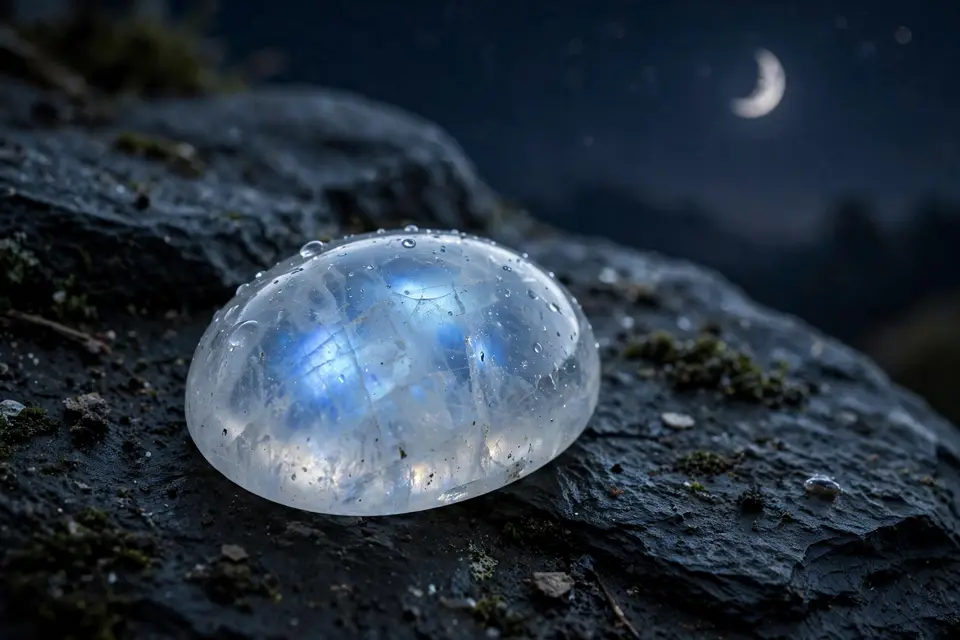
Moonstone belongs to the feldspar group — the most abundant family of minerals in the Earth’s crust — and specifically to the orthoclase variety of potassium feldspar. What separates it from its drab cousins is its internal architecture: as the stone forms, two feldspar minerals, orthoclase and albite, separate into paper-thin alternating layers. That layered structure is the entire secret of the gem, because it is what bends and scatters light into the stone’s famous glow.
The name needs no explanation once you have seen a fine specimen: the effect looks exactly like moonlight diffused through thin cloud, or glimmering on still water. Classic material came from Sri Lanka, whose stones show the prized blue sheen on a near-colorless body; today India, Madagascar, Myanmar, Tanzania, and the USA also produce moonstone. It is almost always cut as a smooth cabochon (a dome without facets), because the glow displays best on a curved surface that lets the light roll as the stone moves.
Adularescence: Why Moonstone Glows
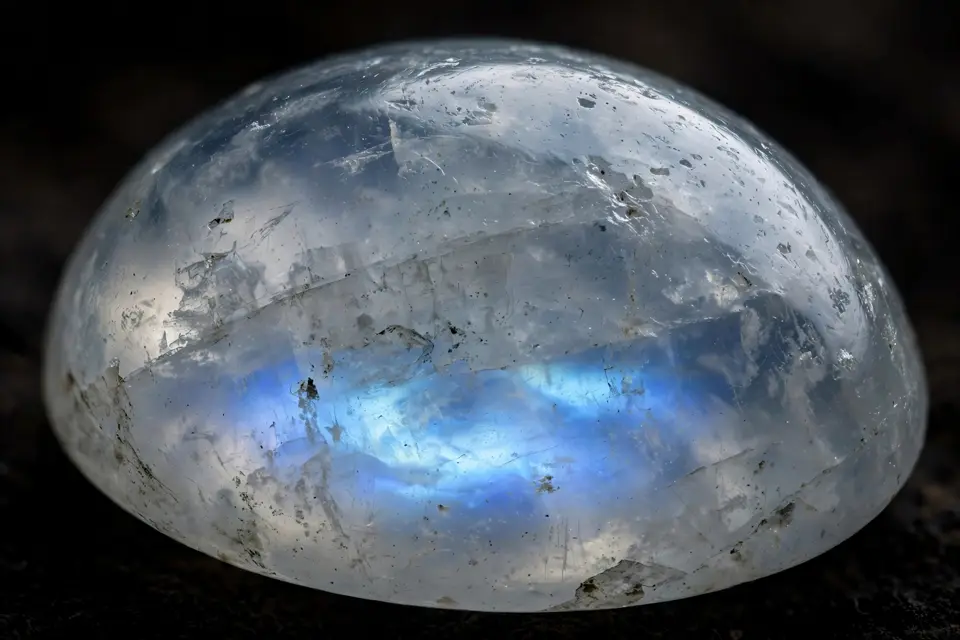
The phenomenon has its own name — adularescence, after Mt. Adular in Switzerland, an early source of the stone. Here is what happens physically: light entering the gem strikes the microscopic boundary between the orthoclase and albite layers and is scattered rather than reflected cleanly. The result is a billowy, floating patch of light — usually blue or silvery white — that hovers just beneath the surface and slides across the dome as you tilt the stone. In the finest “blue moonstone,” the sheen is a vivid electric blue on a crystal-clear body, and those stones command serious prices.
Some moonstones show bonus effects: a sharp cat’s-eye line (chatoyancy) or, rarely, a four-rayed star (asterism). All of them come from the same layered construction — which is why a piece of plastic or glass, however milky, can imitate the color but never quite the movement of the light.
Moonstone Meaning and Symbolism
Moonstone’s meanings, across crystal-healing and folk traditions, orbit its lunar appearance. These are beliefs, not medical or scientific findings — but they have been remarkably consistent for centuries:
| Traditional Meaning | The Belief |
|---|---|
| New beginnings | Its core modern meaning — the stone of fresh starts, inner growth, and strength through change |
| Intuition | Linked to the moon’s “knowing without seeing”; used in meditation to heighten awareness and dreams |
| Emotional balance | Believed to calm emotional instability and stress, and to soothe the wearer like moonlight itself |
| Feminine energy & fertility | Associated with moon goddesses and cycles; traditionally linked to love, passion, and fertility |
| Traveler’s protection | An old belief: moonstone guards those who travel by night or over water |
| Love & reconciliation | In parts of Asia it was a traditional lovers’ gift, believed to kindle passion and reunite separated lovers |
In chakra-based traditions it is most often assigned to the Crown and Third Eye chakras. As a June birthstone (sharing the month with pearl and alexandrite) and a traditional 13th wedding anniversary gift, it is also simply a beautiful, historically loved gem — the meanings ride on top of a genuinely lovely stone, which is more than many talismans can claim.
How People Use Moonstone Today
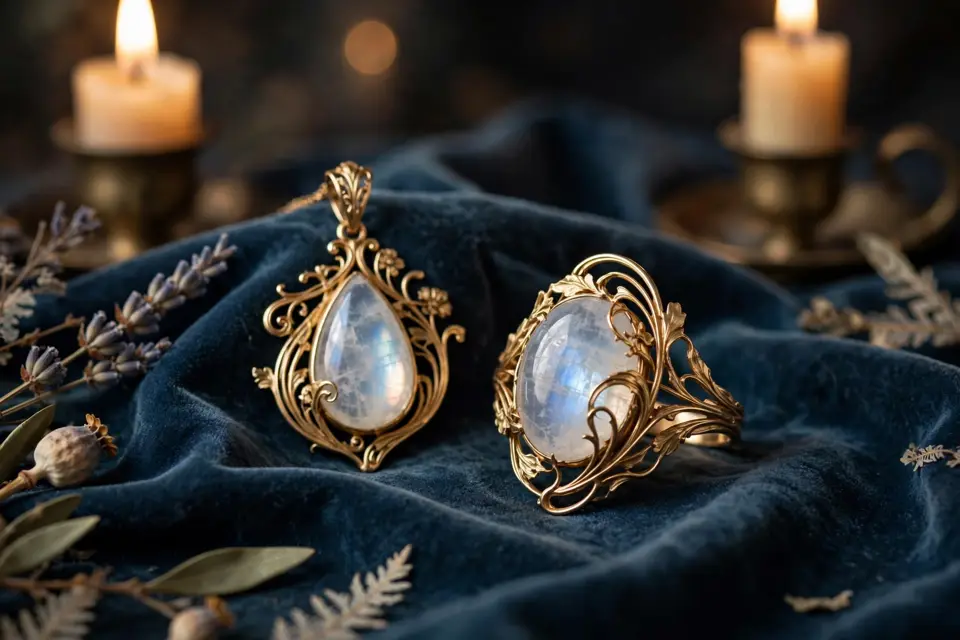
- Jewelry first. Pendants and earrings are the classic choice — they catch light beautifully and, sitting away from knocks and countertops, suit a 6–6.5 hardness stone far better than an everyday ring. When moonstone is set in rings, bezel settings that wrap the edge in metal are the traditional protection.
- Meditation and sleep, in the crystal tradition. Practitioners hold moonstone during meditation for its intuition associations, or keep a tumbled stone by the bed in the belief it encourages calm and vivid dreams. As with all crystal practice, treat these as personal rituals and symbolism, not therapy.
- Gifting with intent. The symbolism makes moonstone the rare gem that sends a message: for a June birthday, a 13th anniversary, or — most distinctively — for someone starting over: a new job, a new city, a new chapter. “New beginnings” is a gift-worthy thought that diamonds cannot easily say.
- By moonlight, for the romantics. An old custom holds that moonstone should be charged or cleansed in moonlight — ideally a full moon. There is no science in it, but as rituals go, leaving a moon-named stone on a windowsill overnight is harmless, photogenic, and two thousand years in spirit.
History and Legends of Moonstone
The Romans admired moonstone nearly two thousand years ago, believing it was formed from solidified rays of the moon and that it carried the image of Diana, their moon goddess. In India, moonstone has been sacred for centuries: Hindu tradition links it with the moon god Chandra, and it remains a traditional wedding gift believed to bring harmony to marriages. Greek and Roman writers alike associated the stone with their moon deities, and the superstition grew that its glow waxed and waned with the phases of the moon — a belief still repeated by sellers today (the glow, of course, depends on your viewing angle, not the calendar).
The gem’s modern fame came in waves: it glittered through the Art Nouveau jewelry of René Lalique around 1900, rode the 1960s–70s taste for mystical natural stones, and — in a delightful bureaucratic footnote — was named the state gemstone of Florida in 1970, to honor the Moon landings, even though moonstone is not mined in Florida at all. Few gems have been loved by so many cultures for the same simple reason: it looks like the moon decided to be portable.
Varieties and Colors of Moonstone
| Variety | Appearance | Notes |
|---|---|---|
| Blue moonstone | Colorless body, vivid blue sheen | The classic and most valuable; traditionally from Sri Lanka |
| White moonstone | Milky white, silvery-white glow | The most common and affordable true moonstone |
| Peach / pink moonstone | Soft peach to salmon body | Popular in modern jewelry; gentle white sheen |
| Grey moonstone | Smoky grey body, silvery flash | Sometimes called the “new moon” stone in crystal shops |
| Black moonstone | Dark grey-brown body, peachy/silver sheen | Often combined with peach moonstone in the same deposit |
| “Rainbow moonstone” | White body, blue-to-multicolor flash | Actually white labradorite — a different feldspar (see below) |
Real Moonstone, Rainbow Moonstone, and Opalite
Buying moonstone means navigating two famous confusions. Rainbow moonstone is beautiful and genuinely natural — but gemologically it is white labradorite, a plagioclase feldspar, not the orthoclase of true moonstone. The trade name is entrenched and the stone is honestly sold under it by reputable dealers, but you should know which mineral you are paying for; labradorite’s flash (labradorescence) tends to be sharper and more multicolored than moonstone’s soft billow.
The second confusion is opalite — a man-made opalescent glass frequently sold as “opalite moonstone” or “sea opal.” It has no feldspar, no layers, and no adularescence: hold it against the light and it glows a flat orange where real moonstone stays blue-white. Real moonstone shows that floating, moving sheen, feels cool like a mineral, and — being only moderately hard — may show gentle surface wear over the years. We unpack the glass itself in our opalite meaning guide, and if you enjoy gems with reputations, compare moonstone’s calm with the luck-and-protection lore of tiger’s eye.
Moonstone Facts at a Glance
| Fact | Detail |
|---|---|
| Mineral | Orthoclase feldspar (potassium aluminum silicate, KAlSi₃O₈) |
| Hardness | 6–6.5 on the Mohs scale — moderate; needs thoughtful settings |
| Signature effect | Adularescence — floating blue-white sheen from layered structure |
| Birthstone | June (with pearl and alexandrite); 13th anniversary gift |
| Main sources | Sri Lanka, India, Madagascar, Myanmar, Tanzania, USA |
| Typical cut | Cabochon (smooth dome) to display the sheen |
| Key associations | Moon, intuition, new beginnings, emotional balance, travelers |
How to Care for Moonstone
At 6–6.5, moonstone is softer than quartz and far softer than sapphire, and feldspar has natural cleavage planes — a hard knock can chip or even split it. Treat it accordingly: clean with warm water, mild soap, and a soft brush; skip ultrasonic and steam cleaners; store pieces separately in a soft pouch so harder gems do not scratch them; and choose bezel or protected settings for rings you wear daily. Pendants and earrings — which live safer lives — are where moonstone has always shone brightest, literally.
Frequently Asked Questions
What does moonstone mean spiritually?
In crystal and folk traditions: new beginnings, intuition, and emotional balance. It is the classic moon stone — linked to lunar cycles, feminine energy, dreams, and calm. These are traditional beliefs, not scientific claims.
What is adularescence?
The floating blue-white glow unique to moonstone, caused by light scattering between microscopic layers of orthoclase and albite feldspar inside the stone. It is named after Mt. Adular in Switzerland.
Is moonstone a birthstone?
Yes — for June, alongside pearl and alexandrite. It is also a traditional gift for the 13th wedding anniversary.
Is rainbow moonstone real moonstone?
It is a real, natural gem — but gemologically it is white labradorite, a different feldspar. The name is a long-standing trade term.
How can I tell if moonstone is real?
Look for the moving, billowy sheen that slides as you tilt the stone, a cool mineral feel, and natural (often slightly cloudy) interiors. Flat, uniform milky glass with an orange glow against light is opalite, a man-made substitute.
Is moonstone expensive?
Common white and peach material is affordable; fine blue-sheen, transparent Sri Lankan stones can be costly per carat. Clarity plus strong blue adularescence sets the price.
Can moonstone be worn every day?
Yes, with care — at 6–6.5 Mohs it scratches and chips more easily than harder gems. Protective settings and removing it for rough work keep it safe.
What chakra is moonstone associated with?
Most often the Crown and Third Eye chakras in modern crystal traditions, reflecting its links to intuition and awareness.
Where does moonstone come from?
Historically Sri Lanka (the classic blue sheen), and today also India, Madagascar, Myanmar, Tanzania, and the United States.
Does moonstone really change with the moon’s phases?
That is an old legend. The glow changes with the angle of light and viewing, not with the lunar calendar — though the legend is part of the stone’s charm.
Source: For more on moonstone’s properties and traditional meanings, see MyCrystals’ moonstone guide.