Valhalla Meaning: Odin’s Hall of the Slain
Quick answer: Valhalla comes from Old Norse Valhǫll, meaning “hall of the slain.” In Norse mythology it is Odin’s great hall in Asgard, where warriors who died bravely in battle — the einherjar — are gathered by the valkyries. There they fight each other by day, rise healed, and feast by night on an everlasting boar and rivers of mead — all in training for Ragnarök, the final battle, when they will march out to fight beside Odin. Only half the battle-slain go to Valhalla; the other half belong to the goddess Freyja. Today “Valhalla” also survives as a word for any hall of honor for fallen heroes, and in the military toast “Til Valhalla.”
In this article
What Does Valhalla Mean?
The name is a compound, and it is blunt about what the place is. Valr in Old Norse means the slain — specifically, the bodies of warriors killed on a battlefield — and hǫll means hall. Valhǫll: the hall of the slain. (The familiar English “Valhalla” is actually a slight mistranslation that stuck — it carries the genitive ending of the phrase “to Valhalla” — but it has been the standard English form for two centuries.)
The hall belongs to Odin, chief of the Norse gods, and stands in Glaðsheimr in Asgard, the realm of the gods. Our knowledge of it comes mainly from two medieval Icelandic sources: the Poetic Edda, a collection of older mythological poems (the poem Grímnismál gives the most detailed description), and the Prose Edda of Snorri Sturluson, written in the 13th century. Court poems like Eiríksmál (c. 954, for the fallen king Eric Bloodaxe) show the idea was already beloved in the Viking Age itself: when a great king died, poets pictured Odin having the benches strewn and the valkyries carry in wine, as if royalty were coming — because it was.
Inside the Hall: Shields, Spears, and 540 Doors
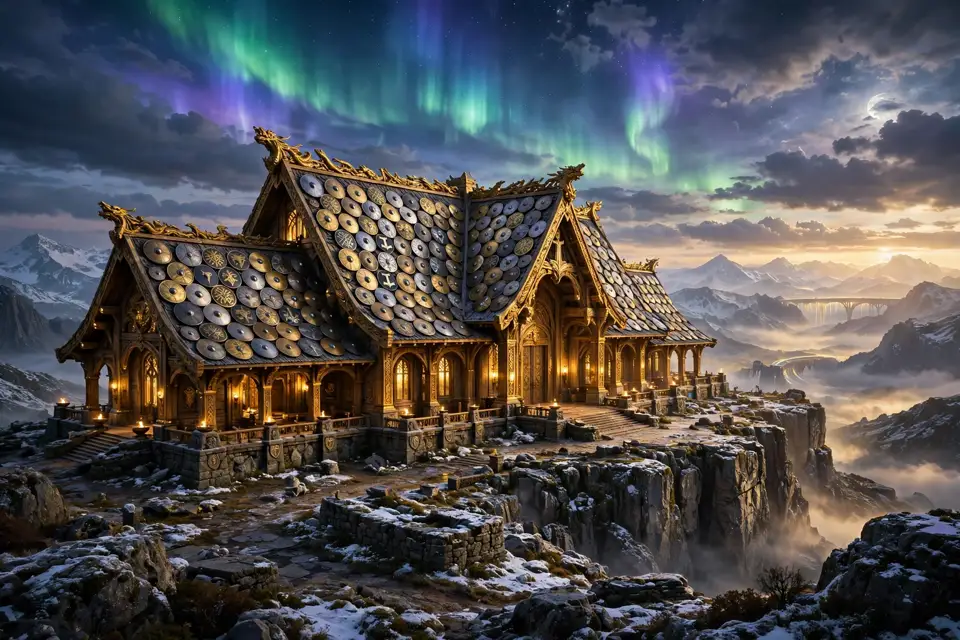
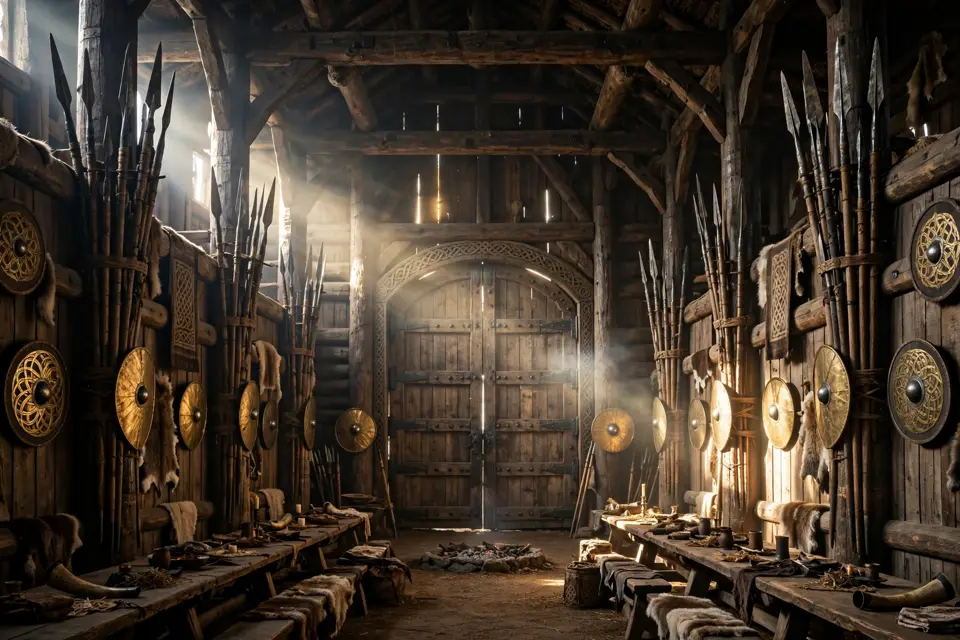
Grímnismál describes a building that is less a palace than a fortress dressed for war:
| Feature | Description in the Sources |
|---|---|
| Roof | Thatched with golden shields |
| Rafters | Spears — the building is literally framed with weapons |
| Doors | 540 doors, each wide enough for 800 warriors to march out side by side |
| Before the hall | The golden tree Glasir, whose foliage is red gold |
| On the roof | The goat Heiðrún and the stag Eikþyrnir, feeding on the tree Læraðr |
| Company | The einherjar plus legendary heroes and kings of old, welcomed by Bragi, god of poetry |
Do the poem’s arithmetic and the scale is staggering: 540 doors × 800 men means the hall is imagined as the mustering point of an army of hundreds of thousands — and Snorri still has a visitor told that, vast as the crowd is, they will seem too few when the wolf comes. Valhalla is grand, but it is grand the way a barracks is grand: every golden shield on the roof is equipment, not decoration.
Who Gets into Valhalla — and Who Doesn’t
Admission has one essential criterion: death in battle. But even that does not guarantee a place, because the choosers divide the harvest. The valkyries — literally “choosers of the slain,” from valr + kjósa, to choose — move over battlefields selecting who dies and who is taken. Then, Grímnismál says, Freyja chooses half of the slain for her own field, Fólkvangr, and Odin receives the other half for Valhalla. The popular image of Valhalla as the sole destination of heroic dead is therefore only half the myth — literally.
And everyone else? Those who die of illness or old age go to Hel, the realm of the dead ruled by the goddess of the same name — not a place of torment in the oldest sources, but a grey continuation rather than an honor. Scholars add an honest caution: the tidy rule (battle → Valhalla/Fólkvangr, sickness → Hel) may owe some of its neatness to Snorri, writing two centuries after Iceland converted to Christianity. Baldr, a god who is murdered, still ends up in Hel in Snorri’s own telling. Real Viking Age belief was probably messier than any chart — but the chart is what the surviving texts give us.
Daily Life of the Einherjar: Battle, Boar, and Mead
The residents are called the einherjar — a word usually explained as “outstanding warriors” or “lone fighters” — and their days run on a glorious loop:
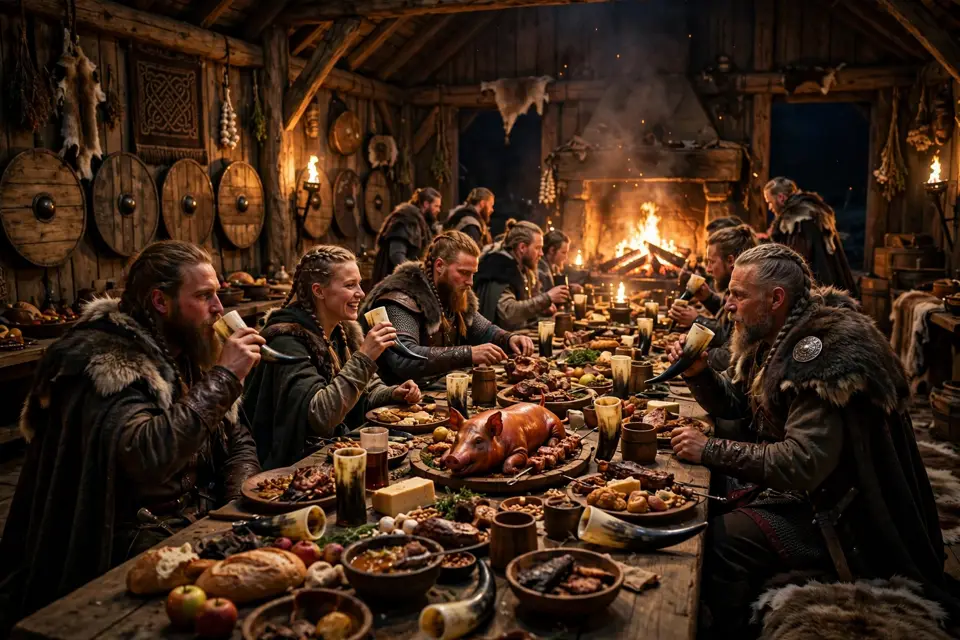
- Morning: they arm themselves and fight each other in the great courtyard — real combat, with real deaths.
- Evening: the slain rise again, fully healed, and ride back to the hall reconciled.
- Night: the feast. The boar Sæhrímnir is cooked by the chef Andhrímnir in the cauldron Eldhrímnir — and the boar is whole again the next day, endlessly. The drink is mead that flows from the udders of the goat Heiðrún standing on the roof, in quantities the prose describes as filling a vat so large no warrior goes thirsty. The valkyries themselves serve at the tables.
It reads like paradise designed by soldiers: the two best parts of a warrior’s life — the fight and the feast — with the worst part, staying dead, removed. But nobody in the myth mistakes it for retirement.
Why Valhalla Exists: Training for Ragnarök
Here is the detail that changes everything: Odin is not rewarding the dead. He is recruiting. Norse myth is unusual among world mythologies in that the gods know how their story ends. At Ragnarök, the wolf Fenrir will break free, and Odin will ride out to face him — with the einherjar marching behind him through those 540 doors, 800 abreast. The daily battles in the courtyard are training; the feasts keep the army bound to its commander; the endless gathering of heroes across the centuries is a levy for one specific morning.
The poems do not hide the odds. Odin knows the wolf will swallow him. In Eiríksmál, when the hero Sigmundr asks why Odin let the brave King Eric fall, Odin answers, in effect: because the grey wolf is watching the home of the gods, and no one knows the hour. Valhalla is therefore best understood not as heaven but as a fortress of the doomed and willing — an army enjoying the best mess hall in mythology while it waits for a battle it expects to lose, and intends to fight anyway.
Valhalla Is Not “Viking Heaven”
The shorthand is everywhere, and it misleads in three ways. First, Valhalla is not for the good — it is for the battle-slain, and specifically for those Odin wants; virtue, kindness, and a well-lived life earn no seat. Second, it is not eternal rest — it is eternal preparation, ending in a final deployment. Third, it is not final: at Ragnarök the einherjar fall with their god. Norse eschatology simply lacks the idea of permanent, peaceful reward; even its hall of heroes is a war measure. (The Norse attitude — honor the dead, then face what comes — is a cousin of the Latin idea in our memento mori guide, though the Vikings expressed it with considerably more mead.)
Valhalla in the Modern World
Few mythological addresses are as alive. Wagner’s operas made “Walhall” a byword for grandeur; Marvel’s Thor films put a gleaming Valhalla on cinema screens; the game Assassin’s Creed Valhalla (2020) carried the name to millions of players. Germany built a literal one: the Walhalla memorial near Regensburg (opened 1842), a marble hall of fame honoring illustrious figures of German history. And in modern military and veteran communities, “Til Valhalla” — “to Valhalla” — has become a toast and farewell to comrades killed in service: a promise that the fallen went somewhere fitting, and that the living will meet them there. The Old Norse grammar is slightly off (purists note it should be til Valhallar), but the sentiment would have been perfectly understood in any Viking Age hall: the honored dead are feasting; we will join them when our turn comes.
Frequently Asked Questions
What does Valhalla mean?
From Old Norse Valhǫll — “hall of the slain” (valr = the battle-slain, hǫll = hall). It is Odin’s hall in Asgard for warriors killed in battle.
Who goes to Valhalla?
Warriors who die in battle and are chosen — but only half of them. Freyja takes the other half to Fólkvangr; those who die of sickness or old age go to Hel.
What do warriors do in Valhalla?
As the einherjar, they fight each other daily, rise healed each evening, and feast on the everlasting boar Sæhrímnir and mead from the goat Heiðrún — training for Ragnarök.
How many doors does Valhalla have?
540, according to Grímnismál — each wide enough for 800 warriors to march through side by side at Ragnarök.
What are valkyries?
“Choosers of the slain” — female figures who move over battlefields deciding who dies and conducting chosen warriors to Valhalla, where they also serve at the feasts.
Is Valhalla like heaven?
Not really. It is not a reward for goodness, not a place of rest, and not eternal — it is Odin’s barracks for Ragnarök, whose inhabitants will fight and fall in the last battle.
What does “Til Valhalla” mean?
“To Valhalla” — a modern military toast and memorial phrase honoring fallen comrades, implying they died with honor and will be met again.
Where is Valhalla located?
In Glaðsheimr, in Asgard, the realm of the gods — with the golden tree Glasir before it and the goat Heiðrún on its roof.
What is the difference between Valhalla and Fólkvangr?
Both receive the battle-slain: Odin takes half to Valhalla, and Freyja chooses half for Fólkvangr, where her hall is called Sessrúmnir. The sources describe Valhalla in far greater detail.
What happens to Valhalla at Ragnarök?
The einherjar march out with Odin to the final battle against Fenrir and the forces of chaos. Odin is swallowed by the wolf — the fate the whole hall was built to prepare for.
Source: For more on Valhalla and the Norse afterlife, see the New World Encyclopedia’s Valhalla entry.